

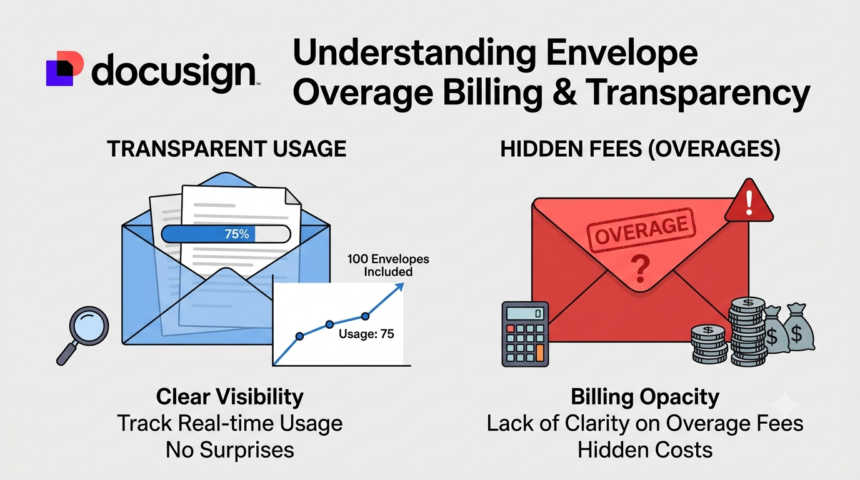

I started digging into DocuSign’s billing practices because of a number. Ninety three dollars. That was the overage fee a small business owner in California got hit with in early 2024, despite believing her usage sat comfortably inside her paid plan. She filed a complaint with the Better Business Bureau1, asked for an itemized explanation, and got a form response instead. DocuSign told her the charges reflected real usage above her allowance and that the amount was final. No breakdown. No apology. Just a bill.
That exchange is small. It is also, once you spend enough time in DocuSign’s support forums, its Trustpilot reviews, and its own pricing documentation, entirely typical. The company that made “please sign here” a one click experience for thirty million users a day has built an unusually opaque system for telling those same users what a signature actually costs. And the opacity is not incidental. It is the business model.
What Is An Envelope, Really
Start with the basic unit. DocuSign does not charge per document or per signature. It charges per envelope, a term the company invented to describe a package that can contain one document or fifty, sent to one signer or twenty. An envelope counts the moment you hit send, whether the recipient ever opens it or not. Resend a contract because of a typo and you have burned a second envelope on the same deal. As the e-signature comparison site SignWell2 put it in its own breakdown of the pricing, an envelope counts against your quota the instant it leaves your outbox, regardless of what happens next.
That framing sounds harmless until you run the math on a real workflow. A mortgage broker sending a corrected disclosure. A landlord who needs a witness to re-sign because the first attempt bounced. A tax preparer serving fifteen hundred clients a year, most of whom need multiple rounds of paperwork during a compressed filing season. Every retry is a full envelope, billed at full price, and none of that friction shows up anywhere on DocuSign’s public pricing page.
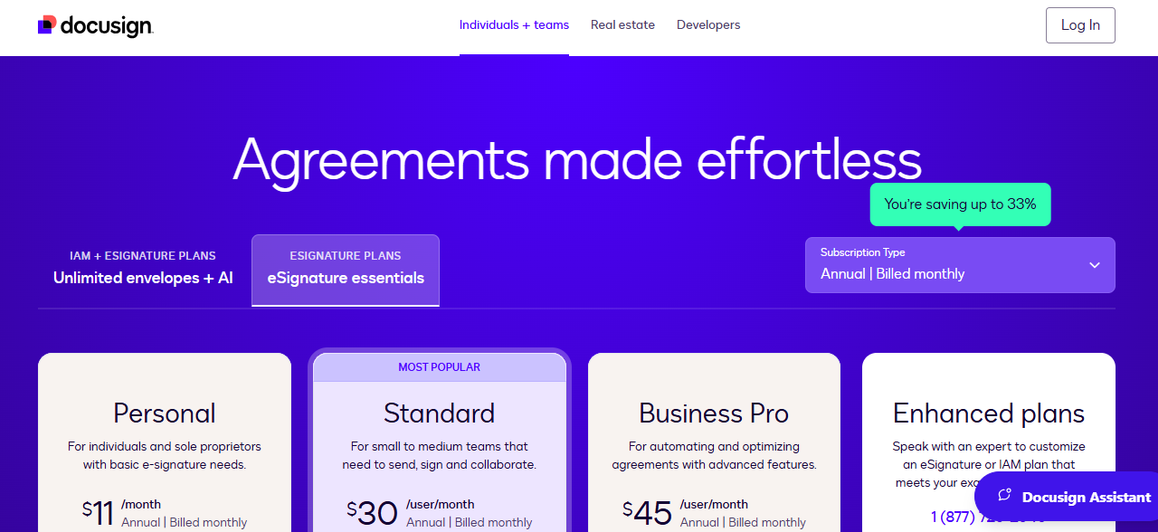
DocuSign3 sells four tiers. Personal runs about ten dollars a month and includes five envelopes. Standard runs twenty five dollars a user per month, billed annually, and includes roughly one hundred envelopes per user per year. Business Pro runs closer to forty dollars a user per month for the same rough allowance plus extra features. Above that sits Enhanced, formerly Enterprise, where pricing exists only inside a sales call.
On paper, that is four clean boxes. In practice, the number that matters most, the price of the next envelope after you run out, is nowhere on the site. I checked. The pricing page for eSignature plans will happily tell you what a subscription costs. It will not tell you what happens the month you go over. For that, you have to ask.
People do ask. Constantly. On DocuSign’s community forum4, a user posted a straightforward question in 2024: how much does it cost to purchase additional envelopes beyond the one hundred included in a Standard plan. A DocuSign community moderator answered that pricing depends on account configuration and offered a rough example. A Standard Annual plan works out to about three dollars an envelope, the moderator wrote, because the plan bundles one hundred envelopes into a three hundred dollar annual fee. That is arithmetic, not a real rate card, and the thread never gets more specific than that. They further said:
FYI. I contacted the sales team and was informed that the enterprise plan requires a minimum of 500 envelopes. However, I used 171 envelopes last year with a different service, so I don’t need the enterprise plan. I just need to know how much it would cost to purchase additional envelopes beyond the 100-envelope allowance.
Other users have tried to nail down the actual number and hit the same wall. A pricing analysis from the e-signature reseller SignWell5 found that outside estimates for the true overage rate range anywhere from two dollars to five dollars per envelope depending on plan, region, and whether the buyer prepaid, and noted that the DocuSign community forum is filled with people who only discovered the real cost after their business had already scaled past it. A G2 reviewer cited in a Juro6 pricing breakdown put a specific number on it from lived experience, reporting an average cost of four dollars and fifty cents per envelope once volume passed the included allowance.
Procurement platform Vendr7, which aggregates real contract data from its client base, found that overage on API heavy accounts can run anywhere from fifty cents to more than two dollars per envelope depending on negotiated terms, and that buyers who raise their expected volume before signing a contract secure meaningfully lower overage rates than those who bring it up afterward. Three sources, three different numbers, all describing the same product. That spread is not a rounding error. It is what happens when a company keeps its real price list off the internet.
The Texas Tax Office
The clearest illustration of how this plays out for a real small business comes from Killeen, Texas. Lillie Aguero & Associates has done tax prep for two decades, serving around fifteen hundred to two thousand clients a year. During the pandemic the firm started using DocuSign so clients stuck at home or deployed overseas could sign remotely. The owner, Kim Walker, paid three hundred dollars a year and the arrangement worked, until it didn’t.
A DocuSign representative called to say the firm had gone over its one hundred document allowance for the year by thirty envelopes. A second representative followed up to talk pricing. According to local news coverage from KCEN 68, that representative told Walker her only options were to pay for the overage directly or sign a new fifteen hundred dollar annual contract. When she asked what the overage itself would cost, she was quoted three thousand dollars for thirty documents, exactly one hundred dollars per envelope. Walker asked repeatedly for an itemized breakdown showing how thirty extra documents added up to three thousand dollars. She never got one. Emails obtained by the station show the representative simply repeating that it was “one standard fee.”
The station reached out to DocuSign directly. Only then did a spokesperson acknowledge that cheaper options existed and that the representative appeared to have steered Walker toward the most expensive path available. DocuSign agreed to let the firm send its next one hundred documents free of charge and issued the now familiar corporate promise, we’ll fix this. The episode is worth sitting with. A twenty year local business, a rate quote roughly thirty times what the company’s own spokesperson later described as standard, and a resolution that only arrived after a television reporter got involved. Even though Docusign promises transparency, that is not how pricing works when pricing is actually transparent. That is what pricing looks like when the sales team has room to charge whatever the traffic will bear.
A Pattern, Not An Incident
If Walker’s story were the only one, you could call it a bad actor on one sales call. It is not the only one. Trustpilot9 hosts more than a thousand reviews of DocuSign, and by the site’s own tally roughly three quarters of them are one star. Billing, not the product itself, is the theme that shows up again and again. One reviewer described being charged again after closing their account out of fear DocuSign would surprise them with another bill, and then getting hit with exactly that surprise bill anyway. Another recounted being charged seventy five dollars twice in consecutive months despite filing a credit card dispute after the first charge, and says a support agent asked them to withdraw the dispute before a refund would even be considered, then ended the chat mid conversation. A third reviewer in the UK said DocuSign’s response to a billing complaint was to point to a specific clause buried in the terms and conditions, telling them they should have known about the extra charge from reading section 4.4.4.
The pattern extends past individual envelope overages into the surrounding billing architecture, auto renewals nobody remembers agreeing to, seats for employees who left the company months earlier, refund requests that go nowhere. One small business owner described discovering they had been billed for three user seats when only one was still active, and said DocuSign refused a refund for the two departed employees even after multiple escalation requests. Another user in Australia described a billing dispute severe enough that they escalated it to the Australian Competition and Consumer Commission after weeks of unanswered support tickets. None of these are envelope overages specifically. All of them describe the same underlying posture, a billing system built to extract maximum revenue with minimum visibility, and a support structure that treats a customer’s confusion as the customer’s problem to solve.
The user ended their complaint with:
Based on our experience, I would strongly encourage people to thoroughly research alternatives before signing up. There are other providers offering lower fees, better communication and far more responsive support.
A 2026 review analysis from the contract management company Signeasy10, which read through more than two thousand five hundred G2 reviews and over a thousand Trustpilot reviews, found that pricing friction and billing surprises accounted for roughly one in four critical reviews of the product on G2, and that Trustpilot skewed even harder toward billing complaints specifically, with unnotified renewals and a narrow thirty day refund window as the recurring grievance. That is not a handful of disgruntled customers. That is a quarter of the negative review volume for one of the most widely used software products in the world, all clustered around the same theme.
Why the Fog Helps DocuSign
Here is my read on why this keeps happening, and why it probably is not going to stop on its own. DocuSign’s core product has flattened. E-signature is table stakes now. Adobe Sign, PandaDoc, SignWell, DocuSeal, and a dozen smaller competitors all offer functionally similar signing experiences at lower or more predictable prices. A blog post from the file management company The Drive AI11 ran the numbers for a five person team sending fifty documents a month and found that switching from DocuSign Standard to a flat rate competitor could save more than a thousand dollars a year without losing any core functionality. When the product itself stops being the differentiator, the business has two levers left: lock in customers through contracts and integrations, and extract more revenue per account through mechanisms customers do not fully understand until they are already dependent on the platform.
Envelope overage billing is exactly that kind of mechanism. It is variable, so it scales with a customer’s growth rather than staying flat. It is confusing enough that customers rarely shop around mid contract, since untangling actual per envelope costs requires a level of forensic accounting most small businesses do not have time for. And it is enforced unevenly, with DocuSign’s own support forum showing moderators quoting different rough figures to different users depending on their plan, while enterprise customers negotiate custom rates behind closed doors that never make it into any public document. A procurement analysis from Vendr12 described this explicitly, noting that overage terms on API heavy accounts are negotiable and that buyers who address it during the initial sales conversation end up with dramatically better rates than those who wait. Translate that out of procurement speak. The company will quietly reveal its real prices to whoever has the leverage to demand them and let everyone else find out by surprise.
A cost analysis from the software research firm CostBench13 pulled together publicly available complaints, including one Reddit thread describing a customer weighing whether to pay for DocuSign’s paid API tier and concluding that the tier priced at nearly six thousand dollars a year would eat almost the entire profit margin from a single sale, and a Hacker News comment describing a developer who abandoned DocuSign’s API entirely because per envelope costs above one dollar made the integration financially unworkable for his use case. CostBench’s own tally counted at least five distinct categories of hidden cost sitting outside DocuSign’s headline pricing, spanning implementation, training, add on fees, per envelope API costs, and renewal price increases that its research pegged as high as twenty percent in a single cycle.
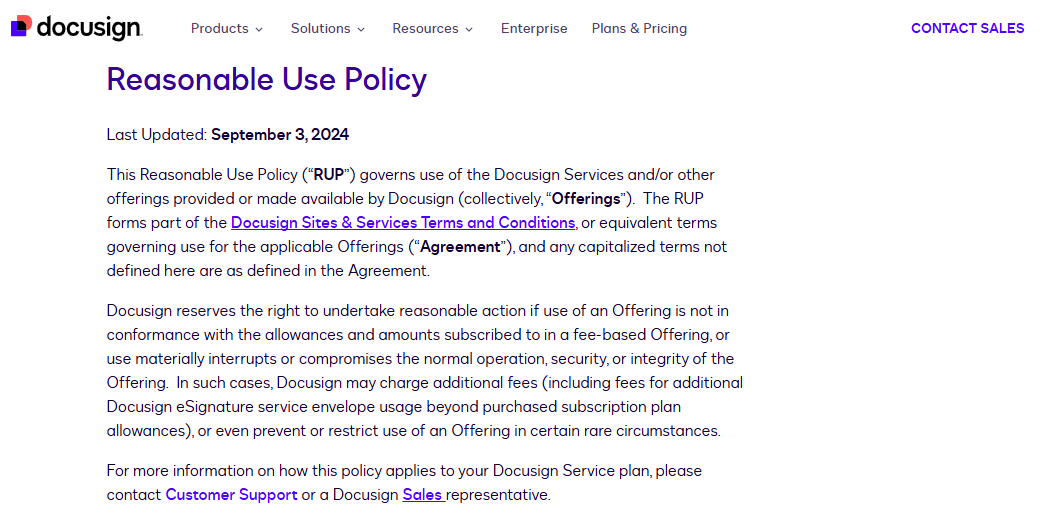
There is a second layer to this worth naming directly, because it complicates the simple story of “overage fee equals extra charge.” DocuSign’s14 terms include what it calls a Reasonable Use Policy, and under that policy, exceeding your envelope allowance does not automatically trigger a per unit bill. Sometimes it just cuts off your ability to send anything at all until the next billing cycle, or until you upgrade. Functionally, that is still an overage penalty, it just gets paid in lost productivity rather than dollars. A landlord who cannot send a lease addendum because his account is locked mid month is paying a cost every bit as real as a cash fee, he is just paying it in a currency DocuSign does not have to itemize on an invoice.
This dual system, sometimes a metered charge, sometimes a hard stop, sometimes a sales call demanding an upgrade, means two customers with identical usage patterns can end up in completely different places depending on which mechanism DocuSign happens to apply to their account. That inconsistency is itself a form of opacity. You cannot budget around a system whose rules keep shifting shape.
What Would Actually Fix This
None of this requires DocuSign to lower its prices. It requires DocuSign to publish them. A single page listing the actual per envelope overage rate for each plan tier, updated when it changes, would resolve most of what I found in weeks of reading support tickets and review threads. So would a hard cap on overage spending that alerts a customer before a bill balloons, the way phone carriers are required to warn customers before data overage charges apply. So would a genuinely enforced thirty day notice before auto renewal, instead of the after the fact “you should have read section 4.4.4” response that shows up again and again in the reviews I read.
None of that is technically difficult. A company that processes signatures for more than a billion people across a hundred and eighty countries, according to its own marketing materials, has the engineering capacity to build a usage dashboard that shows real time cost projections. The absence of that feature is a choice, not a limitation.
I keep coming back to Kim Walker’s tax office in Killeen. A twenty-year business, a three hundred dollar plan that worked fine until a sales call turned thirty extra documents into a three thousand dollar demand. She got her fix, eventually, because a reporter called and asked DocuSign to explain itself on the record. Most customers do not have a reporter on speed dial. Most customers get the form letter the way the BBB complainant did, a polite paragraph confirming the charge is final, no further explanation offered. The question worth sitting with is not whether DocuSign can afford to be transparent about what an envelope actually costs. It obviously can. The question is why, given everything laid out here, it keeps choosing not to be.
Sources
- Better Business Bureau, www.bbb.org/us/ca/san-francisco/profile/document-scanning-service/docusign-inc-1116-447881/complaints?page=8. Accessed 20 Sept. 2026. ↩︎
- Gamez, Ruben. “DocuSign Pricing Per Envelope: What You’ll Actually Pay” SignWell, 26 June 2026, www.signwell.com/resources/docusign-pricing-per-envelope/. Accessed 20 Sept. 2026. ↩︎
- “Check out Docusign eSignature plans” ESignature Plans for Personal & Business, ecom.docusign.com/plans-and-pricing/esignature. Accessed 20 Sept. 2026. ↩︎
- “How much does it cost to purchase additional envelopes?” Community, 11 June 2024, community.docusign.com/esignature-111/how-much-does-it-cost-to-purchase-additional-envelopes-5094. Accessed 20 Sept. 2026. ↩︎
- Gamez, Ruben. “DocuSign Pricing Per Envelope: What You’ll Actually Pay” SignWell, 26 June 2026, www.signwell.com/resources/docusign-pricing-per-envelope/. Accessed 20 Sept. 2026. ↩︎
- Reviewed. “Docusign pricing: how much does Docusign cost?” juro.com/learn/docusign-pricing. Accessed 20 Sept. 2026. ↩︎
- Vendr, www.vendr.com/marketplace/docusign. Accessed 20 Sept. 2026. ↩︎
- KCENTV, www.kcentv.com/article/news/local/6-fix-docusign-provide-upgrades-for-local-tax-business-after-they-were-mislead/500-acac6236-1846-4795-b297-97c6cfdb591b. Accessed 20 Sept. 2026. ↩︎
- Trustpilot, www.trustpilot.com/review/docusign.com. Accessed 20 Sept. 2026. ↩︎
- Chotia, Rachana. “Docusign Review 2026: Pricing, Features, Pros, and Cons” 1 Dec. 2025, signeasy.com/blog/business/docusign-reviews. Accessed 20 Sept. 2026. ↩︎
- AI, The Drive. “Why Is DocuSign So Expensive? Understanding E-Signature Pricing” The Drive AI, 1 June 2026, thedrive.ai/blog/docusign-alternatives-no-per-envelope-fees. Accessed 20 Sept. 2026. ↩︎
- Vendr, www.vendr.com/marketplace/docusign. Accessed 20 Sept. 2026. ↩︎
- “DocuSign Pricing 2026: 4 Plans from Free–$40/user/month” 16 July 2026, costbench.com/software/e-signature/docusign/. Accessed 20 Sept. 2026. ↩︎
- “Exceeding Envelope Limit” Community, 2 Aug. 2023, community.docusign.com/esignature-111/exceeding-envelope-limit-1727. Accessed 20 Sept. 2026. ↩︎


