

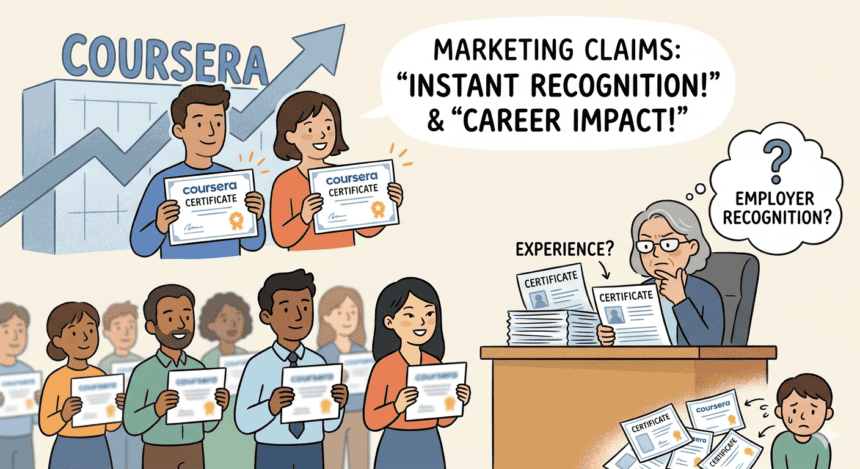

I remember the first time I added a Coursera certificate to my résumé. It felt like placing a small but meaningful flag. The logo of a known university sat next to my name. The course title sounded technical enough to catch a recruiter’s eye. I had spent weeks watching lectures, taking quizzes, and finishing assignments. When I downloaded the certificate, it felt official. It felt earned. More importantly, it felt like proof that I was keeping up in a fast-moving world.
- The Promise Economy of Online Credentials
- The Supply Shock Nobody Talks About
- What Employers Say Versus What They Do
- The Assessment Problem
- The Platform Paradox
- Skill-Based Hiring Is Real, But It Is Not What You Think
- The Inflation of Achievement
- Regional Reality: The India Effect
- Marketing Versus Lived Experience
- What Actually Works
- So, are Coursera Certificates Worth It?
At the time, I believed something simple. If I learned useful skills and earned recognized certificates, employers would notice. The logic seemed clean. Effort leads to skill. Skill leads to recognition. Recognition leads to opportunity. Platforms like Coursera built an entire ecosystem around that idea. And to be fair, it is not entirely wrong.
But over time, the story began to feel incomplete. The more I looked at job postings, spoke to hiring managers, and listened to other learners, the more I noticed a quiet disconnect. Certificates were everywhere. Recognition was not.
This is not a story about failure. It is a story about mismatch. Between what is promised and what is actually rewarded.
The Promise Economy of Online Credentials
The pitch behind online certificates is elegant because it taps into a real anxiety. The world is changing quickly. Skills become outdated. Degrees take years. Many people cannot afford to step away from work to study full time. Coursera offers a way out of that trap. Learn on your schedule. Gain relevant skills. Earn a certificate that signals readiness.
Coursera’s own reports reinforce this narrative. According to coverage by Inside Higher Ed1, a large majority of employers say they view microcredentials positively and are more likely to consider candidates who hold them. The article outlines how institutions and employers are increasingly aligned around short-form credentials as part of workforce development.
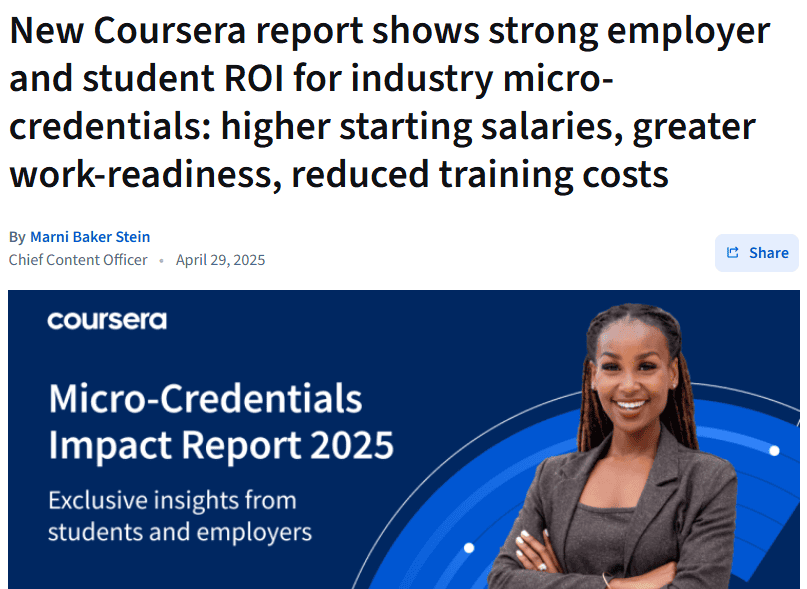
Coursera2 also highlights internal data suggesting that professional certificates can lead to improved job readiness and even higher starting salaries. Their own blog emphasizes return on investment for learners, framing certificates as both practical and economically beneficial.
There is even independent academic work that supports some of these claims. A study hosted on arXiv3 found that learners who shared online credentials were slightly more likely to report new employment within a year. The increase was modest, around 6 percent, but it suggests that certificates are not irrelevant.
All of this creates a powerful story. It is not just about learning. It is about mobility. About moving from one career to another. About closing the gap between where you are and where you want to be.
But the strength of that story also hides its limitations.
The Supply Shock Nobody Talks About
At first, certificates were novel. Not many people had them. That gave them weight. They signaled initiative and curiosity. They stood out on a résumé.
That is no longer the case.
Coursera has scaled to over 100 million learners globally, with rapid growth in regions like India, where access to flexible education is in high demand. Reports like this one in EdTechReview4 highlight the surge in adoption among both students and employers.
When something becomes common, its meaning changes. Economists would describe this as a supply shock. The number of credentials increases faster than the number of opportunities that treat those credentials as special. As supply rises, differentiation falls.
I started to notice this in subtle ways. Certificates were no longer a talking point in interviews. They became a line item. Something expected, but not impressive. Like listing basic software skills. Necessary, but not sufficient.
This is the first stage of dilution. Not disappearance, but flattening.
What Employers Say Versus What They Do
There is a consistent pattern in how employers talk about certificates versus how they use them. In surveys, they are supportive. They like the idea of continuous learning. They appreciate candidates who take initiative. They recognize that skills can be developed outside traditional institutions.
But hiring is not a survey. It is a decision under uncertainty.
When a hiring manager reviews candidates, they look for signals they trust. Signals that reduce risk. A degree from a well-known university. Work experience with measurable outcomes. A referral from someone inside the company. A portfolio that shows real work.
A Coursera certificate does not carry the same weight because it does not answer the same questions. It tells the employer that you completed a course. It does not reliably tell them how deeply you understood the material or how well you can apply it.
Coursera5 itself frames certificates as something that can strengthen an application rather than guarantee results. Their employability page emphasizes alignment with job skills and pathways rather than direct hiring outcomes.
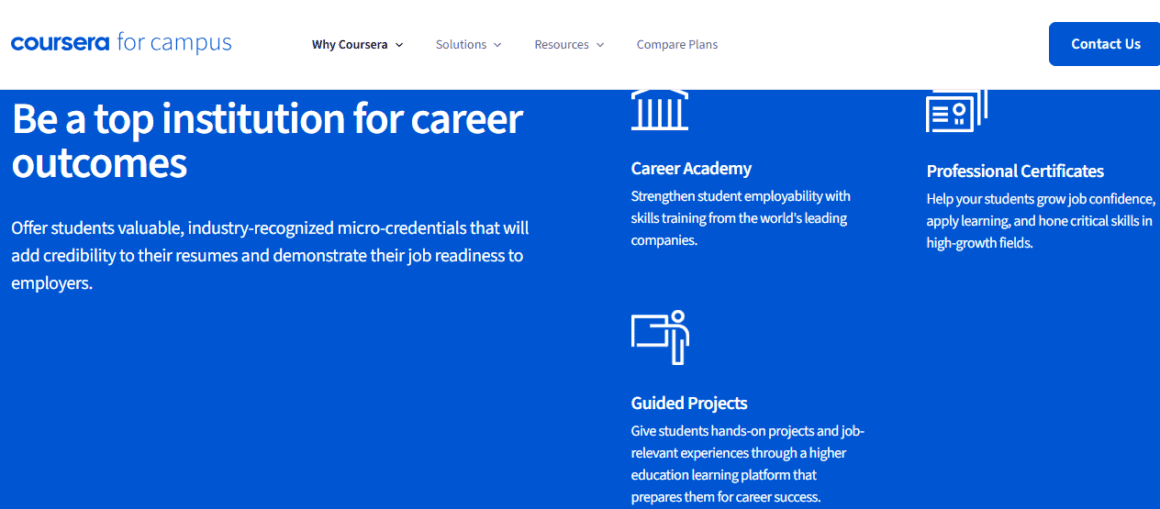
That distinction is important. Strengthening is not the same as deciding.
The Assessment Problem
One of the reasons certificates struggle to gain stronger recognition is the nature of the assessment on the platform. Coursera courses are designed to scale. That means relying on tools that can handle thousands or millions of learners at once.
Most courses use a combination of quizzes, auto-graded assignments, and peer-reviewed projects. These methods are efficient. They allow learners to progress quickly. But they also introduce variability.
Peer grading can be inconsistent. Automated quizzes often test recall rather than deep understanding. Projects are sometimes guided to the point where they become exercises rather than original work.
From a learning perspective, these methods can still be valuable. They introduce concepts. They build familiarity. They create structure.
From an employer’s perspective, they raise questions. How rigorous was the evaluation? How much independent thinking was involved? How transferable are these skills to real-world problems?
These questions do not have clear answers, and that uncertainty weakens the signal.
This concern shows up in online discussions. On forums like Reddit6, learners often express skepticism about the value of certificates. One user described them as feeling “almost meaningless” because the system can reward minimal effort. Another pointed out that skills matter far more than certificates when it comes to job performance.
These are not formal studies, but they provide insight into how the system is experienced from the inside.
The Platform Paradox
Coursera’s biggest advantage is also a source of ambiguity. The platform partners with top universities and companies. Courses are often created by respected faculty or industry professionals. Seeing names like Stanford or Google on a certificate adds credibility.
But the credential itself is not issued in the same way as a traditional degree or corporate training program. It exists in a middle space. It is associated with institutions, but mediated by the platform.
For employers, this creates uncertainty. What exactly does the certificate represent? Is it equivalent to a university course? Is it a simplified version? How standardized is the experience across learners?
Without clear answers, employers tend to treat these certificates as supplementary. Useful, but not decisive.
Skill-Based Hiring Is Real, But It Is Not What You Think
There is a genuine shift happening in hiring. Many companies are focusing more on skills and less on formal degrees. Research has shown that certain high-demand skills, especially in areas like artificial intelligence, can command strong wage premiums.
Coursera aligns well with this shift. It offers courses in exactly these areas. It allows learners to acquire new skills quickly.
But there is an important distinction. Employers are not moving from degrees to certificates. They are moving from credentials to evidence.
Evidence means proof of work. Projects, portfolios, and real-world problem solving. It means showing not just that you learned something, but that you can use it effectively.
A certificate can point toward this evidence, but it cannot replace it.
The Inflation of Achievement
Another factor that contributes to dilution is the way learning is structured and rewarded on the platform. Coursera uses elements of gamification to keep learners engaged. Progress tracking, completion badges, certificates. These features are effective. They create a sense of progress and accomplishment.
Coursera7 also promotes digital badges as a way to recognize achievement and support a culture of continuous learning.
But recognition is not the same as validation. A badge acknowledges completion. It does not necessarily validate mastery.
When many people earn the same badge, it stops distinguishing them. It becomes part of the baseline rather than a standout feature.
Regional Reality: The India Effect
In markets like India, the dynamics of certificate value become even more complex. Competition for jobs is intense. Employers often rely on degrees and experience as primary filters because they are easy to verify and compare.
A Coursera certificate can help at the margins. It can show initiative. It can provide talking points in interviews. But it rarely overrides more traditional signals.
Discussions in Indian workplace forums reflect this reality. Some users note that while certificates are useful for learning, many companies do not place significant weight on them during hiring.
This creates a situation where certificates are common and visible, but not decisive.
Marketing Versus Lived Experience
Coursera’s marketing focuses on outcomes. Improved job prospects. Higher salaries. Increased confidence. These outcomes are real, but they are also broad.
Coursera8 reports that a high percentage of learners achieve “positive outcomes.” These include learning new skills, gaining confidence, and exploring new career paths.
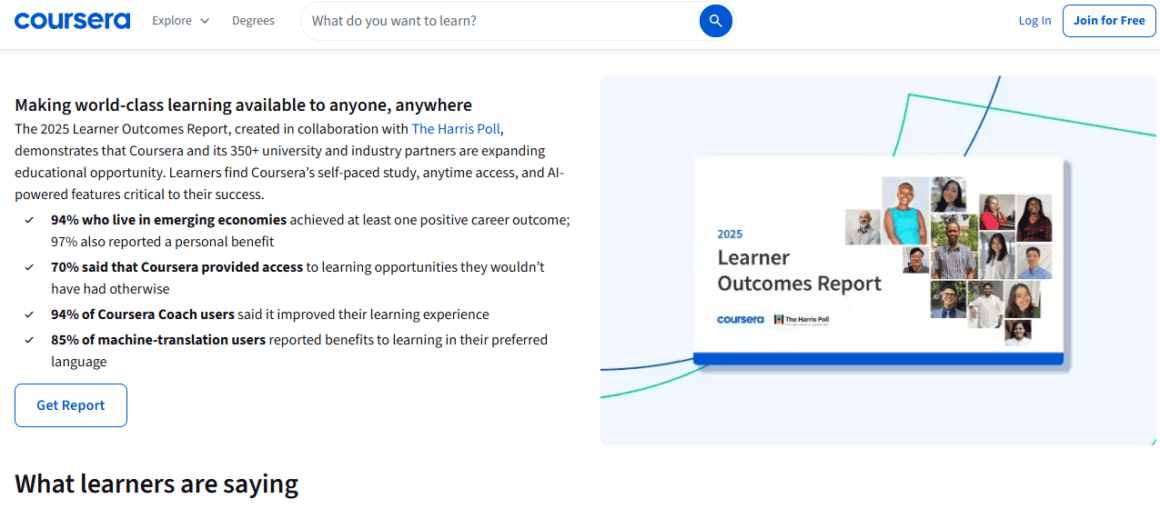
The key point is that not all positive outcomes are employment outcomes. A learner may feel more confident or knowledgeable without immediately securing a job. These are valuable gains, but they are different from what many people expect when they enroll.
This is where expectations and reality diverge.
Every credential has a limit to how much value it can add. For Coursera certificates, that limit appears relatively early.
The first certificate can signal initiative. It shows that you are proactive about learning. It may help you stand out slightly.
Additional certificates add less value. At some point, they become repetitive. A long list of similar credentials can even create the impression that you are collecting certificates rather than applying knowledge.
Employers tend to look for depth. They want to see how you have used your skills in meaningful ways. One strong project can often carry more weight than multiple certificates.
This is the signaling ceiling. Beyond it, the marginal value of each additional certificate declines.
What Actually Works
If certificates are not enough on their own, what makes the difference?
From what I have observed, three factors consistently matter.
First is proof of work. Real projects that demonstrate your ability to apply knowledge. These do not need to be large or complex, but they need to be authentic.
Second is context. Being able to explain what you learned, why it matters, and how you used it. This turns abstract knowledge into practical understanding.
Third is differentiation. Experiences that are harder to replicate. Internships, freelance work, contributions to open-source projects. These signals are rarer and therefore more valuable.
Certificates can support all of these, but they cannot replace them.
Coursera itself appears to be evolving. There is increasing emphasis on learning pathways, integration with degree programs, and partnerships with companies for internal training.
This shift suggests a recognition that the value of certificates is stronger within structured systems. Inside a company, a certificate can signal completion of a training program. Inside a university, it can contribute to a larger credential.
Outside these systems, the certificate competes with many other signals. Its value becomes more relative.
So, are Coursera Certificates Worth It?
The answer depends on how you define worth.
If you expect a certificate to directly lead to a job, you may be disappointed. The link between certificates and hiring is indirect and influenced by many other factors.
If you see certificates as tools for learning and as part of a broader strategy, they can be very valuable. They provide structure, access to high-quality content, and a way to build foundational knowledge.
The key is to move beyond the certificate. To use it as a starting point rather than an endpoint.
I still take online courses. I still believe that platforms like Coursera have changed education in meaningful ways. They have made learning more accessible and flexible. They have opened doors that were once closed.
But I no longer see certificates as assets in themselves. I see them as records. Evidence that I engaged with a topic.
What matters more is what comes after. The projects you build. The problems you solve. The ways you apply what you have learned.
In a hiring landscape that increasingly values proof over promise, that distinction matters. And it is one that no certificate, on its own, can bridge.
Sources
- Weissman, Sara. “Coursera Report Shows Strong Support for Microcredentials” 27 May 2026, www.insidehighered.com/news/quick-takes/2025/05/01/coursera-report-shows-strong-support-microcredentials. Accessed 19 May 2026. ↩︎
- Stein, Marni Baker. “New Coursera report shows strong employer and student ROI for industry micro-credentials: higher starting salaries, greater work-readiness, reduced training costs” Coursera Blog, 30 Apr. 2025, blog.coursera.org/new-coursera-report-shows-strong-employer-and-student-roi-for-industry-micro-credentials-higher-starting-salaries-greater-work-readiness-reduced-training-costs/. Accessed 20 May 2026. ↩︎
- Athey, Authors:Susan. “The Value of Non-Traditional Credentials in the Labor Market” 5 Nov. 2025, arxiv.org/abs/2405.00247. Accessed 20 May 2026. ↩︎
- EdTechReview, “Just a moment…” www.edtechreview.in/trends-insights/coursera-survey-shows-high-demand-for-professional-certificates-among-indian-employers-students/. Accessed 20 May 2026. ↩︎
- “Improve Student Employability” Coursera, www.coursera.org/campus/employability. Accessed 20 May 2026. ↩︎
- Reddit, www.reddit.com/r/coursera/comments/1ojvs48/courseras_system_is_broken_and_certificates_are/. Accessed 20 May 2026. ↩︎
- “The Value of Digital Badges in Corporate Learning” Coursera, 25 June 2025, www.coursera.org/enterprise/articles/digital-badges. Accessed 20 May 2026. ↩︎
- “2025 Learner Outcomes Report” Coursera, www.coursera.org/explore/learner-outcomes. Accessed 20 May 2026. ↩︎


