
Walk into any Fiverr community forum, and you’ll feel a familiar, heavy anxiety shared by freelancers everywhere. It isn’t the gut-punch of a one-star review or the bitter disappointment of a canceled order. Instead, it’s a completely different kind of dread. You log in one morning, pull up your gig dashboard, and the numbers just sit there: zero impressions. Not down from yesterday. Not trending slowly south over a week. Zero. As if the platform had simply decided, overnight, that you do not exist.
- The Platform That Runs the Show
- February 2024: The Day Everything Changed
- The Success Score: What It Is, What It Hides
- The Ghost in the Machine: Private Reviews
- Gig Rotation: The Designed Instability
- The Ads Question: Is Fiverr Starving Organic Reach?
- The Sellers Who Disappear
- The Structural Problem No Optimization Fixes
- What Sellers Have Learned to Do
No email. No warning. No policy violation flag on the account. Just silence where there used to be income.
I have spent weeks reading through hundreds of these accounts. On the Fiverr Community forums, on Reddit’s r/Fiverr threads, and on Quora answers from sellers who have been on the platform for half a decade. The pattern is consistent enough to warrant a real question: is Fiverr’s ranking system making invisible decisions about people’s financial lives without giving them any meaningful way to understand, challenge, or recover from those decisions?
The answer, from everything I can find, is yes. And the story of how that system was built, and who it serves, is worth telling in full.
The Platform That Runs the Show
Fiverr is not a passive marketplace. This matters. When you understand how the platform generates revenue, the algorithm’s behavior stops looking random and starts looking logical. Just not in the way sellers hope.
According to Fiverr’s own investor relations data, as reported by Jobbers1, the company generates revenue by taking 20 percent of every completed transaction. That single fact structures everything. The algorithm is not designed to reward the best freelancer. It is designed to maximize completed orders. A gig that converts browsers into buyers is more valuable to Fiverr than a gig that is simply excellent. This is not a conspiracy. It is just a business model operating exactly as designed. But it creates a system where a freelancer’s visibility is tied not to the quality of their work, but to the platform’s own revenue calculations.
According to Value Invest Asia2, Fiverr now processes over 550 categories of service and facilitates hundreds of millions in quarterly revenue. It has, in its own telling, become a sophisticated global marketplace. What it has not become is transparent about the rules governing who gets seen.
February 2024: The Day Everything Changed
If there is a before and after in the modern Fiverr seller experience, it runs through February 14, 2024. Valentine’s Day. The date Fiverr chose to roll out what one writer at the unofficial Fiverr Voices3 publication on Medium called “cold, dead robotic AI hands” taking over the platform.
Fiverr quietly implemented the most significant platform changes in its history during February 2024. These were not minor tweaks. They represented a fundamental restructuring of how the platform evaluates and ranks sellers.
The centerpiece of that restructuring was a new metric called the Success Score.
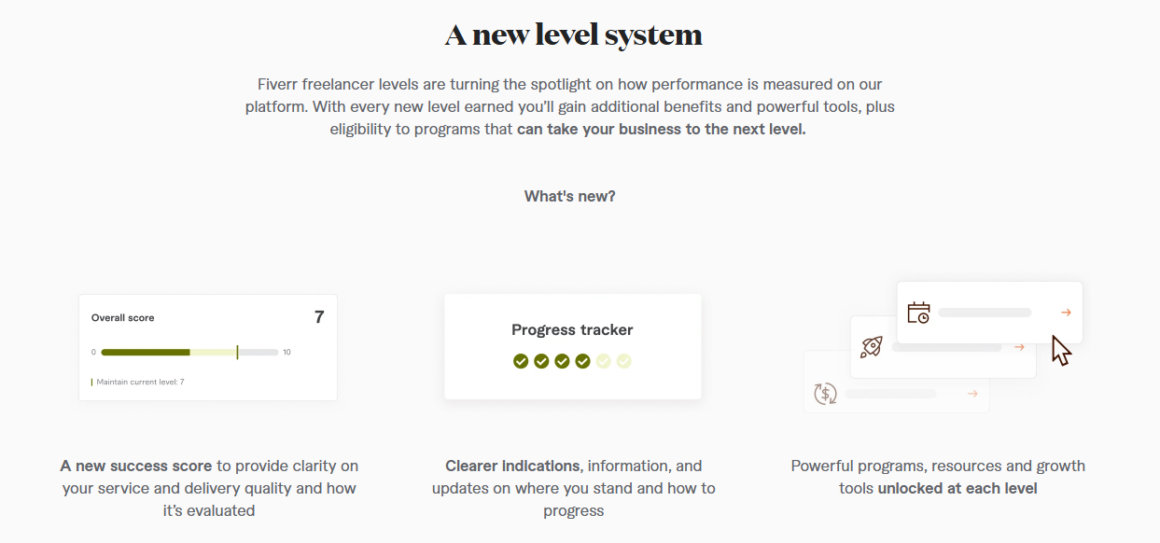
The most controversial change was Fiverr’s introduction of the Success Score, a mysterious 10-point rating system that heavily influences gig visibility.
The immediate aftermath was not subtle. Top-rated sellers experienced 80 to 90 percent drops in impressions. Pro sellers saw monthly impressions fall from 30,000 to 10,000. Established freelancers went from multiple daily orders to barely one per week.
These are not outliers. These numbers come from an analysis of over 500 seller reports aggregated from Reddit and Fiverr’s own forums. The scale of disruption was real, and the silence from the company was, to many sellers, the most disturbing part of all.
The Success Score: What It Is, What It Hides
Fiverr4 describes the Success Score as a tool that “evaluates each of your Gigs in key areas related to the order process and your relationship with clients.” On paper it sounds reasonable. In practice, sellers found themselves confronting a black box.
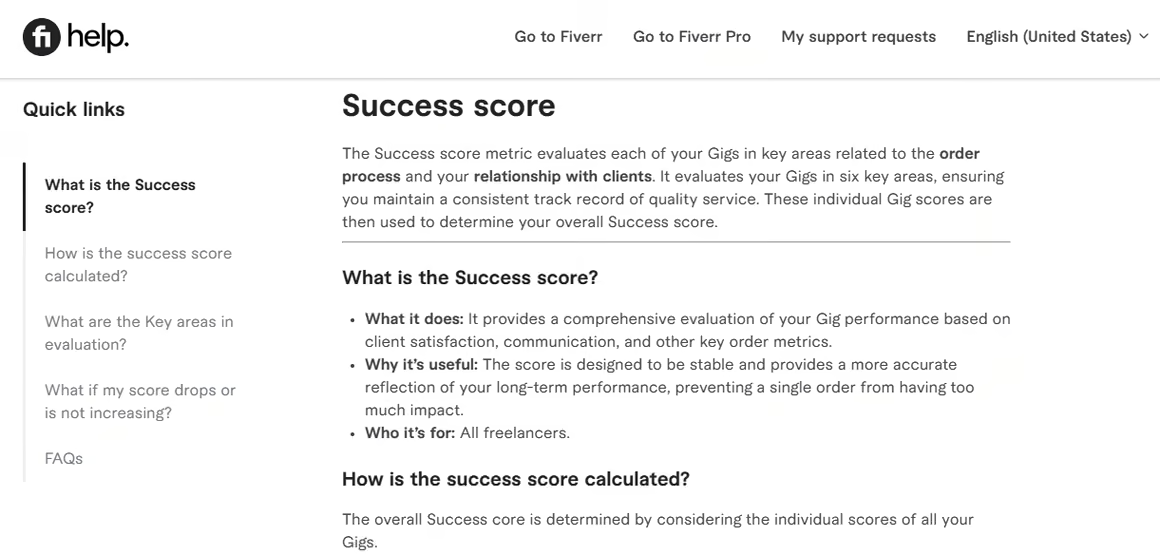
The Success Score is a 1-to-10 rating Fiverr calculates based on six performance areas: order completion rate, on-time delivery, communication quality, buyer satisfaction including both public and private reviews, revision handling, and dispute resolution.
The requirement thresholds are firm. A score of 5 out of 10 is required for Level 1, 7 for Level 2, and 9 for Top Rated. A seller can have a 4.8-star public rating and still carry a Success Score of 4 if sellers in their category consistently outperform them on private feedback, revision frequency, or cancellation rates.
That last detail is the one that matters. The Success Score is relative, not absolute. You are not being measured against a fixed standard. You are being measured against your competitors in your price bracket, and the benchmark moves without notice and without disclosure.
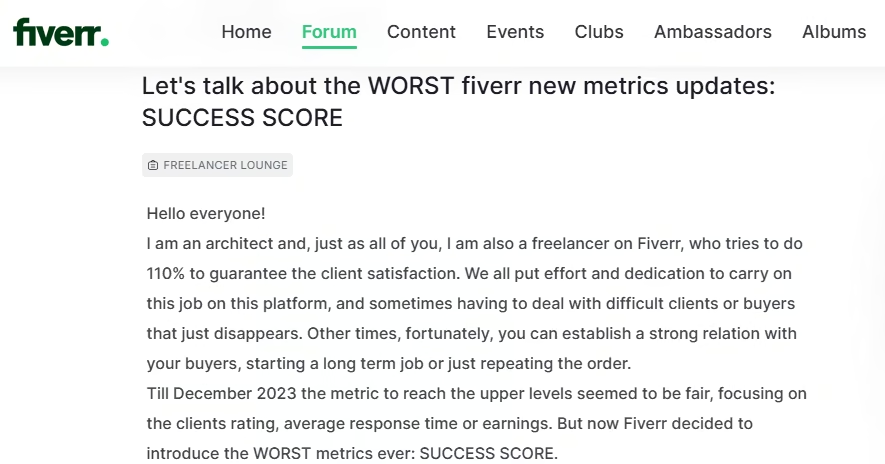
One seller on the Fiverr community forum5, with eight years on the platform and nearly a thousand sales and a 4.8 average rating, wrote that for the first time in years they had been completely removed from search results. They described the Success Score system as “opaque, unclear and pathetic.” The post drew dozens of replies from sellers with nearly identical stories.
Another seller posted that all their gigs had been removed from search results since early January. They had received one negative review from a buyer who, by the seller’s account, had threatened to leave a bad review unless given a lower price on a follow-up order. The seller cancelled that second order. Fiverr support told them the cancellation would not affect their account negatively. It did. The seller wrote:
“Won’t new successful orders affect my success score? It’s been 5 months since that bad incident; should I still be punished? While it was me who was exposed to abuse and I had to take care of myself, Fiverr did not and does not support me!”
The forum post has no resolution. There is no follow-up from Fiverr staff. The thread just sits there.
The Ghost in the Machine: Private Reviews
Here is the part of the Fiverr ecosystem that most sellers discover too late.
After every completed order, buyers have the option to leave a public review that the seller can see. They also have the option to leave a second, entirely separate, private review. The seller never sees this private review. They cannot respond to it. They cannot know what it said, when it was left, or how it was interpreted by the algorithm. But it affects their ranking directly.
Private ratings are anonymous feedback that clients can leave about their order. Unlike public reviews that focus on the overall experience working with you as a seller, private reviews focus on the overall quality of the actual delivery. Private ratings directly affect your Success Score, particularly the Client Satisfaction metric. This disconnect is often why sellers experience sudden drops in orders or reach despite having perfect 5-star ratings.
The weight of a private review is not uniform either. Not all buyers leave them. The percentage of private ratings received compared to total orders matters. New buyers’ ratings are weighted more heavily than repeat customers. Higher-priced and higher-volume orders carry more weight in the system.
What this means in practice is that a seller can have an unblemished five-star public record and still be quietly throttled into invisibility because a buyer left a lukewarm private rating that the seller has no way to see, understand, or address. This feedback helps Fiverr improve the buying experience and is never shared with the freelancer or other public users.
Fiverr does acknowledge this system exists. A post on the official community blog describes it as serving buyer honesty, pointing to the analogy of a restaurant where a customer tells the owner “everything was lovely” but never comes back. The point is that private ratings are meant to capture the truth behind the polished public review.
That logic is defensible on its own. What is harder to defend is a system where an unappealable private signal can functionally destroy someone’s business without them knowing it happened.
Gig Rotation: The Designed Instability
Even sellers doing everything right, with good scores and strong reviews, encounter ranking drops. Part of this is structural, and Fiverr has quietly acknowledged it.
Fiverr Gig Rotation means that Fiverr will periodically change the visibility of a seller’s gig on Fiverr’s marketplace. This is done by Fiverr automatically.
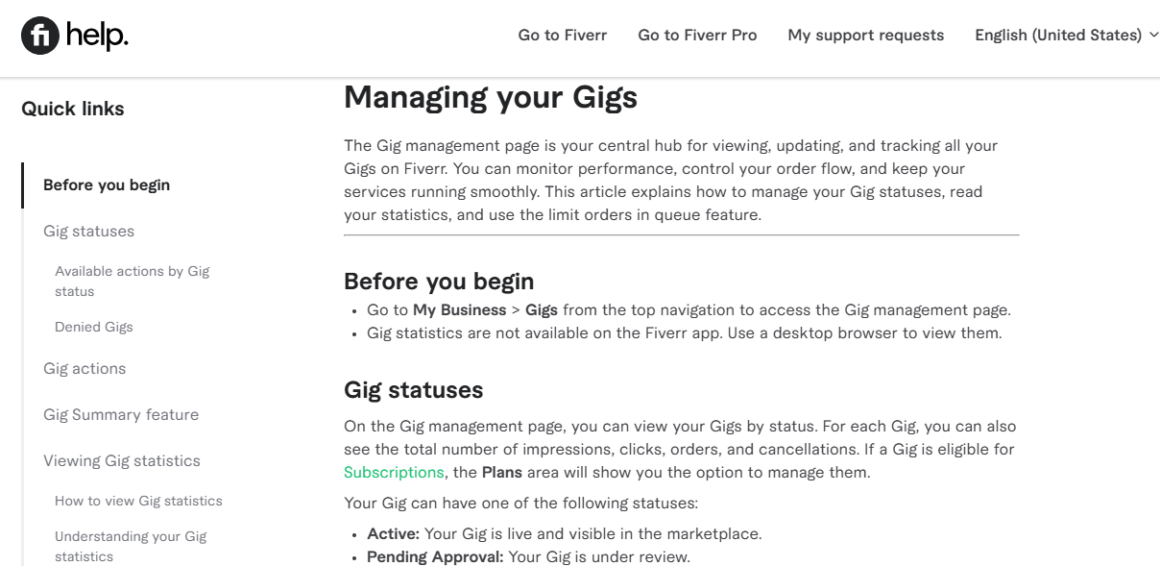
The platform does not publish a schedule or methodology for this rotation. The platform now rotates gigs dynamically, meaning your position could shift from page one to page ten within hours. One seller reported their Instagram growth gig fluctuating between page 7 and page 1 in a single day while maintaining steady impressions.
There are reasons to believe rotation serves a legitimate purpose: it gives new sellers a chance to compete, prevents established sellers from permanently locking down search results, and injects a kind of competitive pressure that keeps quality high. But it also means that position on page one is never stable. It cannot be treated as earned. It can be taken away at any moment for reasons that have nothing to do with the quality of work being sold.
Fiverr’s official community blog6 acknowledges that fluctuations in analytics are “completely normal, especially if you are reviewing them daily.” It adds that “seeing your impressions take a dip can be absolutely gut-wrenching. But it’s normal and happens even to the best of them.”
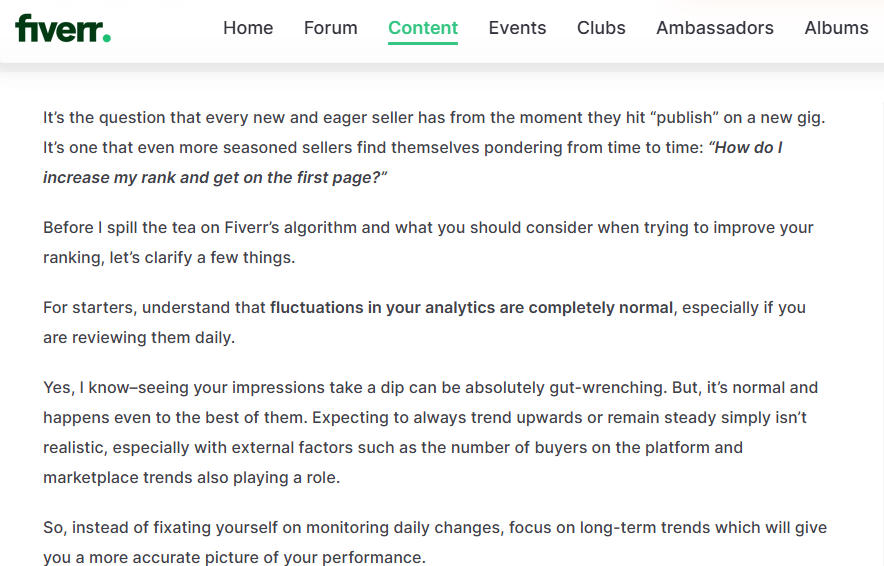
That is a remarkably casual framing for what amounts to unpredictable income instability affecting people who have built their primary livelihood on the platform.
The Ads Question: Is Fiverr Starving Organic Reach?
There is a harder question inside all of this, and it is one that Fiverr’s official blog7 began addressing directly in July 2025. The post, titled “When the Algorithm Isn’t Enough,” encourages sellers to consider Fiverr Ads when organic reach is insufficient.
In some cases, such as when your Success Score isn’t ideal, the market is oversaturated, or your Gig isn’t fully optimized, you might find that the algorithm alone isn’t enough to give you the visibility you need to attract consistent orders.
The implication is subtle but worth examining closely. Fiverr is telling its sellers that the organic ranking system may simply not work for them, and that they should pay for ads to compensate. Fiverr Ads operate on a cost-per-click model, where sellers bid to appear in promoted positions.
A higher bid cap helps you get a better ad placement. Factors that affect the bid calculation include conversion rate, the likelihood of receiving an order once the ad has been clicked, and revenue per click.
In October 2025, Fiverr8 increased its minimum ad bid and doubled the CPC cap from $3 to $6. That is a significant upward pressure on seller advertising costs.
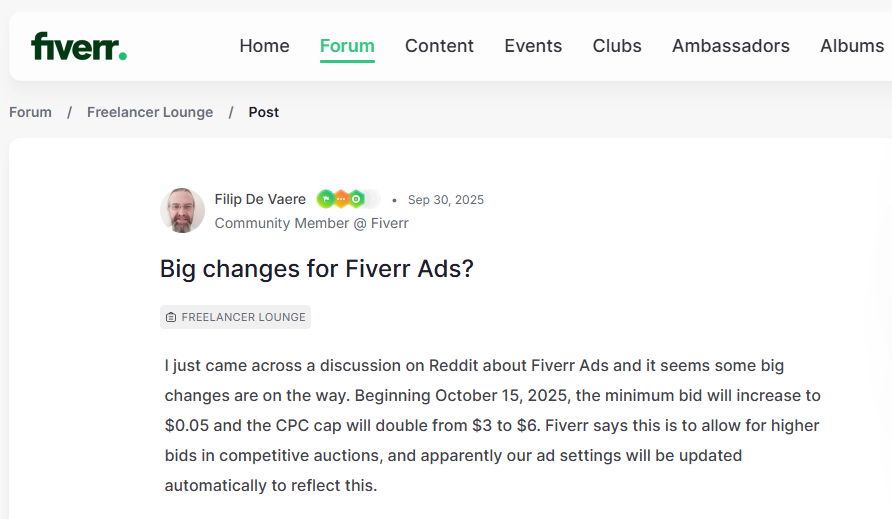
This is not a smoking gun. Platforms pushing promoted content over organic results is not new. Google, Facebook, Instagram, and every other major ad-supported platform have followed this trajectory. But in the Fiverr context, the dynamics are sharper. Sellers are not just losing organic reach to a general algorithm. They may be losing it to the algorithm of the same platform that then sells them the solution to the problem it helped create.
Nobody at Fiverr will say that publicly. Nobody is obliged to. But the pattern is visible enough that it is worth naming.
The Sellers Who Disappear
What I keep returning to, in all of this research, is not the algorithm. Algorithms are just math. What I keep returning to are the people.
A top-rated seller with years of consistent work and hundreds of five-star reviews posting to the Fiverr community forum9 in mid-2024 wrote:
“I am a Top Rated Fiverr seller but since 2024 started I have not been receiving as many impressions or orders as I used to get, and now at this point I have not been getting any orders lately, no impressions too. Even when I use promoted gig features.”
This person had done everything right, by every standard Fiverr had ever published. They had not violated a policy. They had not gamed the system. They had simply showed up, done good work, and then one day found themselves invisible.
A Pro-level web developer, quoted in an aggregated analysis of seller reports, put it plainly:
“I’m Pro level and my traffic is completely dead. Normal gigs that were ranking well are now deranked for no apparent reason.”
A Pro content writer said:
“During the AI boom, I used to get 3 messages per day. Now I only get messages from serious buyers, and impressions are way down.”
Then there is the seller on Fiverr’s community board who described their entire situation in a single forum post that contains one of the more quietly devastating lines I have encountered in this research:
“I saw in the Fiverr forum that other freelancers whose gigs were removed from search returned to normal after 6 months. Now all my income is from Fiverr.”
Six months of invisibility, with no policy violation, no recourse, no timeline, and a life built around the assumption that good work would be rewarded.
Fiverr’s official communications around ranking have followed a consistent pattern: acknowledge volatility as normal, emphasize seller quality as the primary lever, and point to Fiverr Ads as a supplemental tool.
Fiverr’s community blog10 says buyer satisfaction is key, that over-optimizing your profile can confuse the algorithm, that availability matters, and that long periods of inactivity may cause the algorithm to slow down pushing out gigs.
What the company does not say, and has never fully explained, is why sellers following all of this advice are still experiencing catastrophic drops. Many sellers report that following Fiverr’s official advice hasn’t restored their previous performance levels.
The company’s stated position on ranking drops is, in full:
“Fluctuations in gig performance are normal and expected. The marketplace is curated and personalized for each buyer. Focus on long-term trends rather than daily variations.”
This is advice that might make sense for a hobby project. It is less reassuring when someone’s rent depends on the number.
The Structural Problem No Optimization Fixes
There is a forum post from April 2024 on the Fiverr community board where the author writes that after extensive testing, they believe Fiverr’s AI that determines the Success Score has major flaws. They are not alone.
One particularly pointed observation comes from the community discussion around the new seller level system. A seller noted the apparent absurdity in the scoring: a gig with 2,000 orders, a five-star rating, and 50 percent returning customers had a Success Score of 4. A gig with 3 orders, a five-star rating, and zero returning customers had a Success Score of 8.
No explanation from Fiverr has resolved this.
The core issue is one of accountability. Fiverr is making consequential, income-affecting decisions through an automated system that it does not document, does not explain, and does not allow sellers to meaningfully appeal. If your Success Score drops to a critically low level, your account will be labeled low performance, and your visibility on the platform will be affected. Your level may change at any time due to periodic evaluations.
“At any time.” That phrase, buried in a help article, is the honest admission of what sellers are living with.
The platform holds all the information. It runs the scoring. It determines the penalties. It sells the remedy through Fiverr Ads. And it asks sellers to trust that this system is fair.
Fiverr is not unique in using opaque algorithmic systems to govern worker visibility. Study from Sage Journals11 shows that Uber, DoorDash, and TaskRabbit all operate similar black-box rating and deactivation systems. The academic literature on algorithmic management in the gig economy is now substantial, and it consistently finds the same thing: workers on these platforms bear enormous risk while having minimal visibility into the decisions that affect their income.
What distinguishes Fiverr from a ride-share app is the nature of the work. Fiverr sellers are not performing standardized commodity tasks. Many have built genuine creative businesses, client relationships, and professional identities on the platform over years. They are closer to small business owners than hourly workers. The loss of ranking is not like a shift being cancelled. It is closer to a shop’s sign being taken down without explanation.
The question worth asking is not whether algorithms should govern platforms. Of course they should. The question is whether platforms governing people’s livelihoods have any obligation to make those algorithms legible, to provide meaningful appeals processes, and to communicate changes before they happen rather than after the damage is done.
The freelancers posting in Fiverr forums are not asking for perfection. They are asking for enough transparency to understand what happened to them and enough recourse to try to fix it.
What Sellers Have Learned to Do
In the absence of official clarity, sellers have developed their own informal knowledge base, passed through forum threads and YouTube tutorials and Discord servers. Some of it works. Most of it is speculation dressed as strategy.
The most consistent practical advice that surfaces is this: do not treat your Fiverr gig as a passive asset. The platform rewards activity, response speed, and conversion rate. Log in daily. Answer messages within the hour. Keep gig images and descriptions updated but not so frequently that the algorithm registers instability. Cultivate off-platform clients and bring them to Fiverr to place orders, which builds your review count without the uncertainty of cold buyer discovery.
For sellers whose Success Score has dropped, the practical advice is harder. Completing new orders successfully does help, but the timeline for recovery is unclear and appears to vary significantly by category and by the specific nature of what drove the score down. Some sellers report recovery in weeks. Others report no change after months.
The only universally acknowledged truth is that nobody outside Fiverr’s engineering team actually knows how the algorithm works, including many of Fiverr’s own support staff, who frequently deflect questions about ranking with the same boilerplate advice sellers have already tried.
Fiverr is a public company. It reports to shareholders. It has made genuine investments in the quality of its marketplace, and the Success Score, for all its flaws, represents a real attempt to move beyond the five-star inflation that plagued the platform for years. These things are true.
Also true: the company built a system that can take away someone’s livelihood overnight, without warning, without explanation, and without meaningful recourse. It then asked those same people to pay for ads to recover the visibility the system had removed.
The sellers losing income over opaque scores and unexplained rotations are not asking Fiverr to abandon its business model. They are asking for something more basic: tell us what happened. Tell us what we need to do. Tell us how long it will take. Give us something to work with besides a forum post and the advice to stay patient.
That is not an unreasonable ask. The question is whether a platform like Fiverr12 with 4 million active sellers and hundreds of millions in quarterly revenue has any incentive to answer it.
Based on everything I have found, the answer is not encouraging.
Sources
- Jobbers, www.jobbers.io/the-complete-fiverr-gig-optimization-guide-2026/. Accessed 31 May 2026. ↩︎
- Value Invest Asia, valueinvestasia.com/all-you-need-to-know-about-fiverr-before-you-invest/. Accessed 12 July 2026. ↩︎
- Medium, medium.com/fiverr-voices/about. Accessed 12 July 2026. ↩︎
- Fiverr, help.fiverr.com/hc/en-us/articles/21965360854673-Success-score. Accessed 12 July 2026. ↩︎
- “Forum” Fiverr Community, community.fiverr.com/public/forum/topics/general-discussion-6725424fc419a91d7d350df1. Accessed 12 July 2026. ↩︎
- “Understanding the Fiverr algorithm: what impacts your ranking” Fiverr Community, 28 Nov. 2024, community.fiverr.com/public/blogs/understanding-the-fiverr-algorithm-what-impact-your-ranking-2025-06-02. Accessed 12 July 2026. ↩︎
- “When the algorithm isn’t enough: Tips on how to boost your Gig visibility” Fiverr Community, 24 July 2025, community.fiverr.com/public/blogs/when-the-algorithm-isnt-enough-tips-on-how-to-boost-your-gig-visibility-2025-07-23. Accessed 12 July 2026. ↩︎
- “Big changes for Fiverr Ads?” Fiverr Community, 30 Sept. 2025, community.fiverr.com/public/forum/boards/freelancer-lounge-sry/posts/big-changes-for-fiverr-ads-lpmtxkltie. Accessed 12 July 2026. ↩︎
- “Became the Level Two Seller and still not receiving any orders” Fiverr Community, 3 July 2026, community.fiverr.com/public/forum/boards/ask-the-community-xsm/posts/became-the-level-two-seller-and-still-not-receiving-any-orders-yyyvnha8ru. Accessed 12 July 2026. ↩︎
- Fred. “Client Satisfaction is key to success” Fiverr Community, 8 Jan. 2025, community.fiverr.com/public/forum/boards/freelancer-lounge-sry/posts/342730-client-satisfaction-is-key-to-success?comment=2124185&do=findComment. Accessed 12 July 2026. ↩︎
- Sage Journals, journals.sagepub.com/doi/full/10.1177/2378023119870041. Accessed 12 July 2026. ↩︎
- “How many seller active on fiverr everyday ?” Fiverr Community, 19 Oct. 2024, community.fiverr.com/public/forum/boards/ask-the-community-xsm/posts/339152-how-many-seller-active-on-fiverr-everyday. Accessed 12 July 2026. ↩︎