
The message was short. A seller had shipped a pair of Nike Air Yeezy 2 “Red Octobers” to StockX. They were listed at $9,200. Input1 reported that came back was a note saying StockX had received a “random pair of sneakers with the label for this sale.” The sale could not be completed.
The seller said StockX lost his shoes. StockX said it ran a thorough internal investigation and found no evidence of that. It added that when sellers violate its terms, it takes appropriate action. The seller went public. The company held its line. The shoes never came home.
I don’t know who was telling the truth. Neither does anyone outside the building. That is the point of this piece.
The authentication marketplaces run on a simple trade. You hand over your goods. They check the goods. If the goods pass, you get paid. If they fail, you get a penalty, a returned box, or nothing at all. In a dispute, the checker is also the judge. Every photo, every scan, every note is theirs. The seller holds a tracking number and a memory.
I spent weeks reading the policies, the court filings, the company reports and the complaints. I wanted to know what a “no” costs a seller on StockX and GOAT, how often it happens, and who gets to say it is wrong.
The Deal Nobody Reads Twice
Here is how it works. A buyer places an order. The seller ships to a verification center, usually within two business days. Staff inspect the item against condition guidelines. If it passes, it goes to the buyer and the seller is paid. StockX2 says verification teams inspect each item before it ships on.
On the way in, the seller carries all the risk. The package can be lost. It can be damaged. It can fail. The seller has not been paid, and the money the buyer sent sits with the platform.
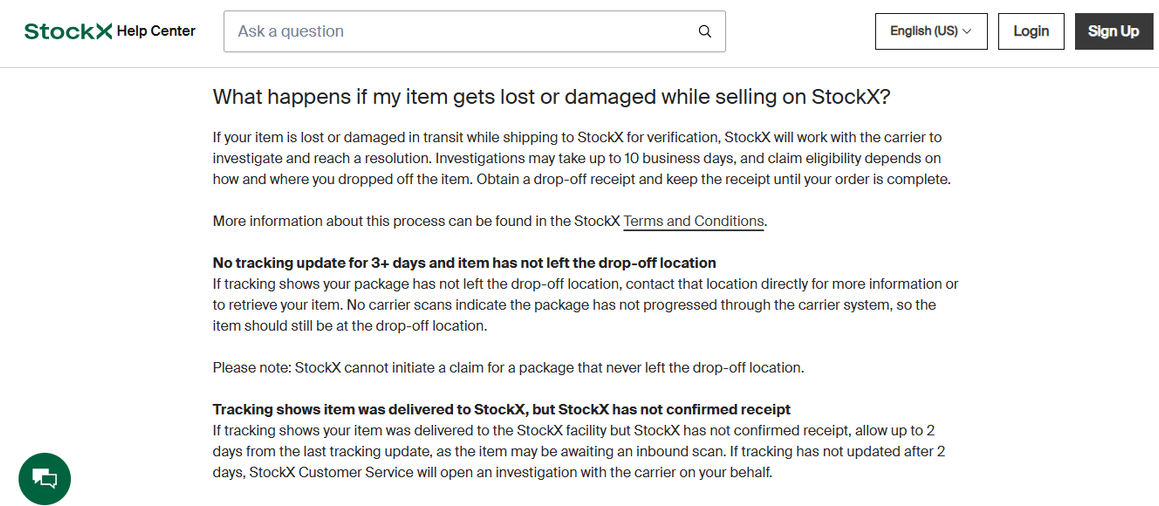
StockX3 does cover some of this. It has a claims process for items lost or damaged in transit. But the rules are narrow. Claims need active carrier tracking. A damaged return needs a photo of the full shipping box. If the return goes to a PO box, StockX says it cannot process the claim. If the seller uses an unverified address, the seller gives up the right to claim.
None of that is unreasonable on its own. Every marketplace needs rules. But read together, they describe a system where the burden of proof sits on the person who has the least evidence. I think that is the core of the whole matter. A seller can follow every rule and still lose, and the proof of what happened lives in a warehouse the seller will never enter.
What a No Costs on StockX
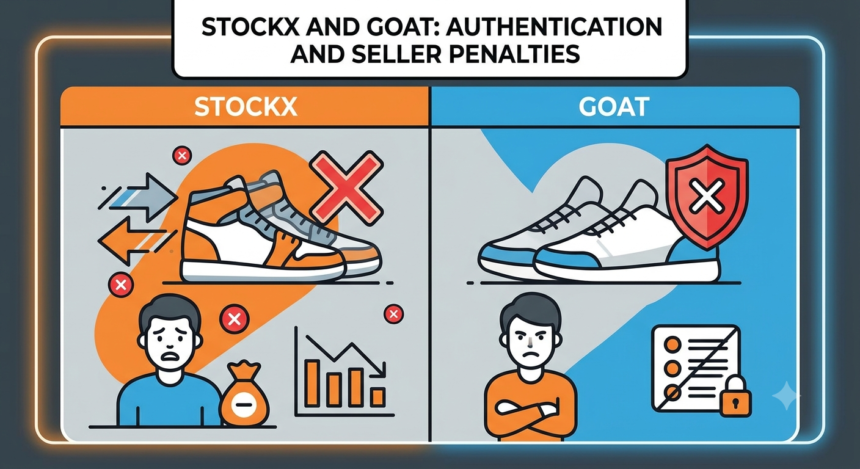
Start with the number. StockX’s seller rules page says a failed sale may carry a penalty fee of $15. It applies if the seller ships late. It applies if the item does not meet StockX’s condition guidelines. It applies if the item does not match the listing “in any way.”
The fee comes out of your payouts first. If those are not enough, StockX charges the card on file. It will not push a payout below $20. It may batch charges daily or weekly and retry failed ones. If it cannot collect, it may block you from placing asks or suspend the account.
Fifteen dollars sounds small. It is not the real cost.
Take a $200 pair of sneakers. At Level 1, StockX’s4 seller program charges a 9 percent transaction fee. Add the 3 percent processing fee and, by my arithmetic, the cut is $24 on a sale that goes through. A failed sale pays nothing. You still paid to ship. You lose days. Your cash was tied up in a pair you now have to list again. And you owe $15.
Now take a $60 tee. The same $15 is 25 percent of its value. The fee is flat, so it is lightest on the expensive items and heaviest on the cheap ones. I could not find any language on the page that scales it.
Then there is the question of what you get back. The seller page says StockX5 cannot guarantee your original receipt will return. A separate help article says that in most cases a failed item is returned to the address on the account. But the penalty page also says StockX has no obligation to return items that do not match their description. That covers items that are not new, are the wrong size, or lack the original box. It also covers counterfeits, which StockX may hand to the authorities at the seller’s expense.
So the rule is “usually you get it back.” The fine print says “not always.”
Repeat failures carry a heavier price. StockX’s6 page on account holds says repeated incomplete sales are the most common reason sellers get suspended. It does not give a number. It says suspension depends on “the number of failures and their severity.” A seller cannot know the line until they cross it.
There is a second penalty ladder for volume sellers. Level 3 to 5 sellers who fail to ship 5 percent or more of orders in a month pay a penalty fee the next month on each unfulfilled sale. That rule is about shipping, not authentication. But in practice both lead to the same place: a seller who cannot close sales.
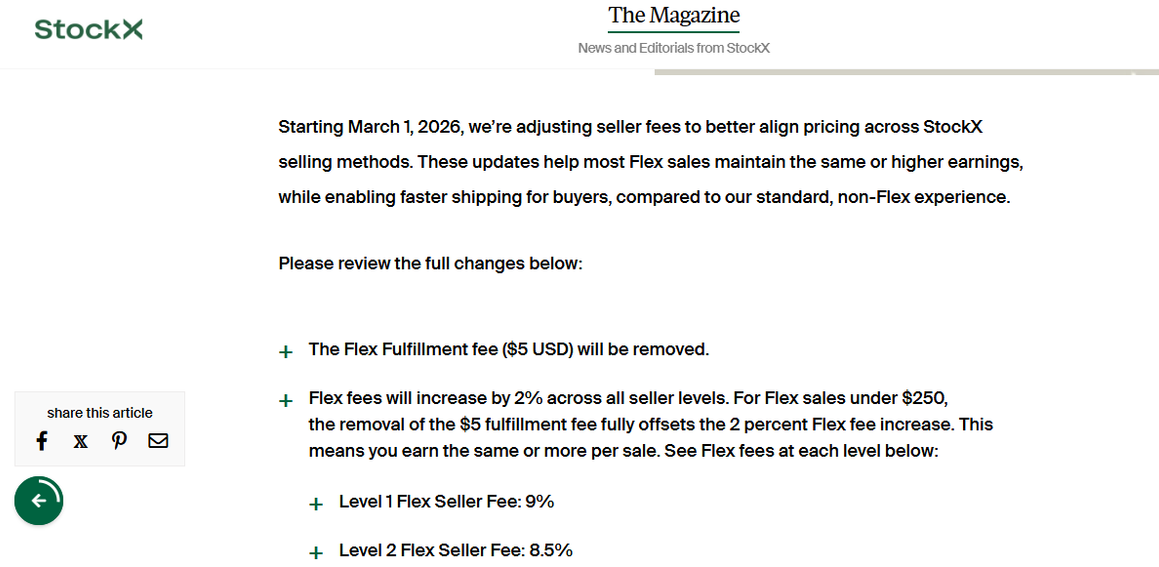
The 2026 changes did not touch the penalty. They did move the ground under it. As of March 1, StockX’s7 seller program update raised Flex fees by two points, dropped the $5 Flex fulfillment fee, and lifted the US standard shipping fee from $4 to $5. It also ended early payouts on standard sales. Sellers are now paid once the item passes verification.
Read that last line again. The platform has tied your money to its own verdict. Nothing moves until the inspector says yes.
Flex sellers have a wrinkle of their own. Under StockX’s verification rules, if a failed item turns out to be the wrong product, size or color, the platform may add it to your Flex account with the right details. You can sell it again. You still get charged the penalty fee.
Most Rejections Are Not Fakes
When people talk about authentication, they talk about counterfeits. The numbers say something else.
StockX publishes an annual report on its own rejections. According to SGI Europe8, in the 2023 edition, it said it rejected nearly $90 million in products. The top reason was manufacturing defects at 27 percent. Fakes came second at 20 percent.
In 2024, StockX9 reported more than 400,000 rejected products worth nearly $85 million. The leading reason was signs of previous wear at 29 percent. Suspected fakes were second at 19 percent. The 2024 report from Footwear Magazine10 says the company rejected more than 370,000 products worth nearly $74 million.
Do the division. About $200 per rejected item. That is the average pair of sneakers on the platform.
I want to be careful here. Those reports describe rejections, not penalties. They do not say how many sellers were charged, or how many appealed. And the reporting windows differ, so I would not read a trend into the dip from 2024 to 2025. What I will say is this. If roughly four in five rejections are for something other than a suspected fake, then the system is mostly a condition inspection. The word “authentication” does a lot of work it does not do.
StockX knows this. In a 2023 interview with the newsletter The Kicks You Wear11, its director of sneakers and collectibles, Drew Haines, explained why the company moved from promising “100% authentic” to calling items “StockX Verified.” He said authentication undersells what happens. In his words, it is a “multi-point inspection.” He said the top reason for failure is not fakery but a quality control problem with the product. The checks cover size, style code and even whether a shoe smells funny.
I understand the logic. It is more honest. But think about what it means for a seller. A seller who ships a real pair can fail. A seller who ships an honest, brand-new pair can fail. The label says “authentic,” but the test is “perfect.”
And perfect is a matter of opinion. StockX’s12 guide to sneaker boxes says every pair must arrive in “mint condition,” box included. It lists examples that will likely pass and examples that will likely fail. Minor single-corner damage is fine. Animal damage is not. A size 9 shoe in a size 13 box fails. A missing box label fails. Then comes the line that matters most. StockX reserves the right to decide whether wear and damage warrant a pass, and says a final call cannot be made until the item is in hand.
That is not a rulebook. That is a judgment.
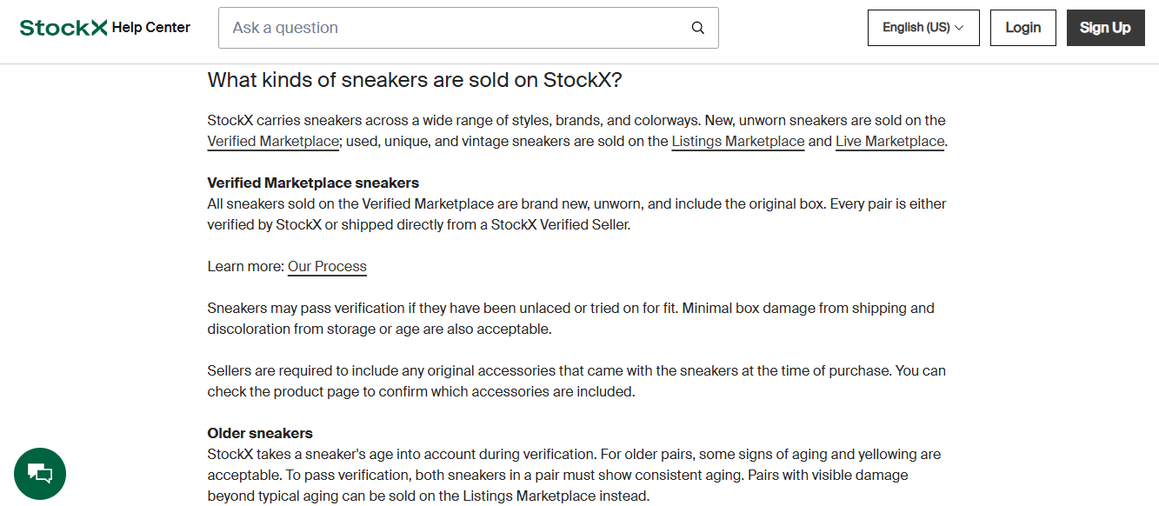
There is a further tension. StockX’s13 page on which sneakers it sells says a pair may pass even if it has been unlaced or tried on for fit. Yet signs of previous wear are the top reason for rejection. Where does “tried on” end and “worn” begin? The company does not say. I suspect the answer changes by inspector, by shift, and by the pair.
Say you disagree. What then?
StockX14 has a help article for exactly that. Every failure is reviewed by at least two separate teams. A verification expert flags the problem. A quality assurance team takes a second look and makes the final call. If you think they are wrong, you contact customer service with your order number, the reason given, photos of the item, and your argument.
If the appeal wins, StockX sends a label. You ship the item back for re-verification. You are paid once it arrives and passes. If the appeal fails, the decision is final.
I want to give StockX credit. A second review is better than none. But look at the word “independent.” Both teams work for StockX. They are independent of each other. They are not independent of the company, which holds the item, wrote the rules, and earns its fee only when sales close.
And look at who must produce photos. The seller does. The help page I read says nothing about showing the seller the photos StockX took when it rejected the pair. The seller has to argue against a decision whose evidence stays behind the counter.
The failed-sale rules for buyers raise another question. When a purchase fails, StockX15 tries to match the buyer with a new seller at the original price. The buyer never pays more. Good for the buyer. But what if the market has moved up in the meantime? The page does not say who covers the gap. I would like to know.
GOAT Keeps a Score
GOAT works differently. It does not lean on a flat fee. It keeps a number.
Every GOAT seller starts with a rating of 90. According to the GOAT’s16 current fee policy, updated August 1, 2026, each cancellation costs 10 points. Each successful sale adds 2. At 90 or above, you pay a 9.5 percent commission plus a seller fee. Between 70 and 89, it jumps to 15 percent. From 50 to 69, 20 percent. Below 50, 25 percent, and the account may be reviewed for suspension. In the United States, the seller fee is $5 for prepaid shipping and $0 for drop-off. Cashing out costs 2.9 percent.
Run the numbers. One cancellation takes you from 90 to 80. Your commission rises from 9.5 to 15 percent, a jump of 5.5 points on every sale. It takes about five good sales to climb back. If each one is a $200 pair, that is roughly $55 in extra commission, on top of the sale you lost. That is my math, not GOAT’s, and the real figure depends on when the rating is applied. But it shows what the design does. The penalty is not a fee. It is a tax on your future, charged slowly, one sale at a time.
I find this version quieter than StockX’s. A $15 charge shows up on a statement. A higher commission looks like a cost of doing business. A seller may never connect the two.
Here is what I could not find. GOAT’s current policy speaks only of cancellations. An older version of the same page, effective in 2020, said commissions could rise based on “seller cancellations and verification issues.” The new text drops the second half. GOAT’s support page17 on higher commissions also speaks of cancellations. So does a failed authentication count as a cancellation? Does it cost the same 10 points? I could not find a plain answer from GOAT. I could not find a published dollar figure for a failure, either.
If I were a seller, I would want that in writing.
GOAT’s18 own description of its checks adds to the puzzle and its Assurance of Authenticity page says products are verified by digital authentication, in-hand verification, machine learning, or a mix. Then it adds a line that stopped me. Some products are verified by methods that “do not include physical examination of the product.”
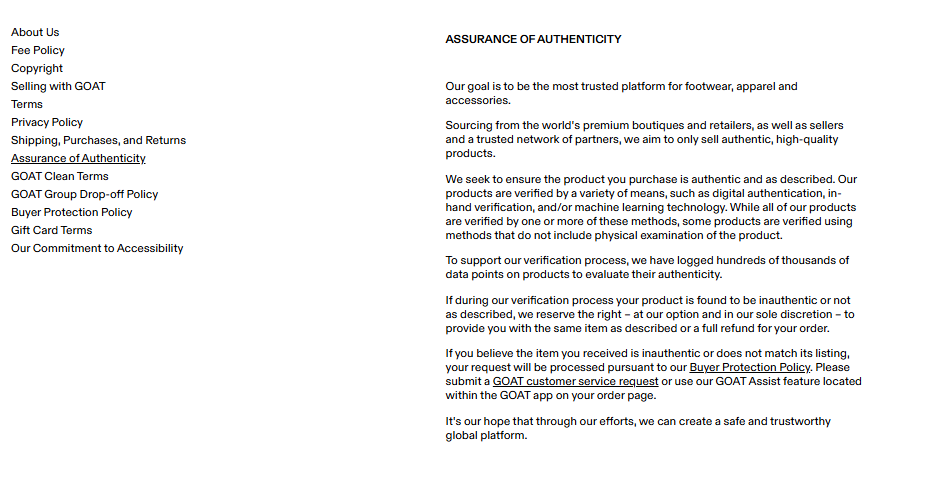
That is honest. It also means a rejection on GOAT may not come from a person holding your shoe. It may come from a pattern in photos and data. Appealing a verdict like that is a different task.
GOAT has other levers. One third-party summary of GOAT’s terms, from ConductAtlas19, says failing periodic ID checks can restrict selling or freeze balance withdrawals. I would treat that as a pointer to the terms, not as the terms. But it shows how many ways a seller’s money can stop.
The company has also been on the wrong side of a regulator. In December 2024, the Federal Trade Commission20 announced that GOAT would pay $2,013,527 in refunds over its shipping practices. The agency said GOAT shipped 37 percent of “Instant” orders late and failed to give buyers the choice to cancel for a refund. GOAT disputed the framing and, according to PYMNTS21, said its review showed 99.84 percent of products shipped or arrived in time. The order settled the complaint.
That case was about buyers. Yet it sheds light on sellers. When a seller cancels, a buyer waits. One reviewer on Trustpilot22 wrote that a seller “cancelled and then placed them back up for sale for double the price.” The rating system exists to discourage that kind of move. I think it is fair to punish cancellations. My concern is that the same lever is pulled for a different kind of “no,” where the seller did nothing wrong.
I wanted voices from the people who ship the boxes. The loudest I found were not on StockX or GOAT. They were on eBay’s seller forum, where eBay’s sneaker program uses outside authenticators. The posts are about a different company. But they describe the same fear, and some of the posters name StockX and GOAT as the alternative.
One seller wrote that his shoes failed, then came back as a different pair. In his words, he “got someone else’s shoes returned to me.” The eBay23 thread says he had listed the shoes on StockX and GOAT too.
Another poster, whose sizing error led to a rejection and a mismatched return, said he would rather “pay the fees on StockX or GOAT than ever deal with ebay again.”
A third described a damaged-box rejection and said customer service could only say “we have to go by what the authenticator says.”
That last line is the one that sticks. It is the sound of a system with no door.
Not everyone is angry. A poster in a thread about condition-based rejections noted:
“I’ve conducted 4-5 transactions through StockX without any issues.”
I give that weight. Most sales on these platforms go through. The reports say so. A complaint thread is not a census.
On the GOAT side, the pain I found leaned toward buyers. One review on Trustindex24 said “you are not able to make contact with a physical person” at the company. A seller who needs to dispute a rating cannot assume a better door.
On the day of delivery I received one pair and an interior door with my tracking number for the second pair of shoes on it. Between photos showing the discrepancy GOAT was no help. You are not able to make contact with a physical person to rectify the issue. Even with the attached photos showing the tracking number attached to this massive box they advise its not the same number when you can clear see it is.
I should be plain about the limits. Forum posts are claims, not findings. I have not seen the items or the inspection photos in any of these cases. What the posts do show is a pattern worth testing, not a verdict.
In March 2025, a federal judge in New York found that StockX had sold 37 pairs of counterfeit Nikes, according to Bloomberg Law25. The ruling came despite the “100% authentic” claims the company had made. Complex26 reported that four pairs went to Nike investigators and 33 to a third-party buyer, Roy Kim. In August 2025, the two companies settled on confidential terms and said they had “resolved this lawsuit amicably.” StockX argued the fakes were a tiny share of the 17.8 million Nike sneakers it reviewed during the case, and said it has stopped more than $80 million in suspected counterfeits since 2016.
Both things can be true. A tiny error rate can still cost a company a court loss.
Here is what I take from it. Think about the two ways an inspector can be wrong. One: a fake passes. The company pays. It pays in lawsuits, in headlines, in angry buyers. Two: a real, clean pair fails. The seller pays. The company pays a little, in goodwill, but it also keeps its brand clean and collects a fee.
When one kind of error is expensive to the house and the other is cheap, I would expect the house to lean toward saying no. I do not think anyone sits in a room and plans that. It is not malice. It is incentive. A rational inspector who gets blamed for the fake that slips through, and never for the real pair that gets rejected, will rule on the side of caution.
Can I prove it? No. The numbers do not show a surge after the ruling. StockX’s reported rejections fell between the two most recent reports, and the windows are not clean. What I can say is that the system has no outside check that would catch such a lean if it existed. The company does not publish how many rejections are reversed on appeal. It does not publish how many sellers were charged. Without those two figures, nobody can tell a strict inspector from a wrong one.
That is the real problem. It is not that StockX or GOAT must be unfair. It is that they cannot be shown to be fair.
What Should Be Changed
The fixes are not hard to name.
Show sellers the evidence. If a pair fails, send the seller the inspection photos and the reason in plain words. StockX already shares a failure reason. Add the images.
Publish the reversal rate. Tell the public how many appeals succeed. A high number would show the first call is shaky. A low number would show it is sound. Either way, we would know.
Scale the penalty. A flat $15 treats a $60 tee and a $1,200 grail alike. Tie it to the type of fault. A late shipment is not a counterfeit. A scuffed box is not a fraud.
Use a reviewer who does not work for the company. Even a small outside panel for high-value disputes would change the feel of the process.
On GOAT, say in writing how a failed authentication affects a seller’s rating, and how fast a seller can climb back. A score is only fair if people can read the scoring.
None of this would stop fakes. It would stop the arguments about whether the stoppers are honest.
I keep thinking about the seller with the $9,200 pair. Maybe he was lying. Maybe StockX was. Maybe a box was swapped by a thief at a loading dock. I will never know, and neither will you.
That is how these markets feel from the outside. You send something valuable into a building. A verdict comes back. If the verdict is yes, you are paid and forget the whole thing. If it is no, you learn how much power sits on the other side of the door.
Most sales pass. The reports say so. Most sellers will never feel any of this. But a market is judged by how it treats the people it says no to. Right now, those people have a $15 charge, a rating that quietly bleeds, a final decision, and a reply that says they have to go by what the authenticator says.
I think they deserve to see the photos.
Sources
- Servantes, Ian. “StockX: We didn’t lose a seller’s $9K Nike Air Yeezy 2 ‘Red October’ sneaker” 25 June 2021, www.inputmag.com/style/stockx-nike-air-yeezy-2-red-october-seller-lost-internal-investigation. Accessed 16 Oct. 2026. ↩︎
- “What does the verification process entail for sellers?” stockx.com/help/articles/What-does-the-verification-process-entail-for-sellers. Accessed 16 Oct. 2026. ↩︎
- “What happens if my item gets lost or damaged while selling on StockX?” stockx.com/help/articles/What-happens-if-my-item-gets-lost-or-damaged-while-selling-on-StockX. Accessed 16 Oct. 2026. ↩︎
- “What is the StockX Seller Program? What are Seller Levels?” stockx.com/help/articles/what-is-the-stockx-seller-program-what-are-seller-levels/GxEAYgDuR2eIVkqFHHqTyw. Accessed 17 Oct. 2026. ↩︎
- “What happens when a seller breaks the rules?” stockx.com/help/articles/what-happens-when-a-seller-breaks-the-rules. Accessed 17 Oct. 2026. ↩︎
- “Why is my account on hold or suspended?” stockx.com/help/articles/why-is-my-account-on-hold-or-suspended. Accessed 17 Oct. 2026. ↩︎
- StockX, stockx.com/news/updates-to-the-stockx-seller-program/. Accessed 17 Oct. 2026. ↩︎
- SGI Europe, www.sgieurope.com/stockx-rejected-30-million-worth-of-fake-sneakers-over-the-last-12-months/103252.article. Accessed 17 Oct. 2026. ↩︎
- StockX, stockx.com/about/stockx-verification-report-reveals-platform-stopped-over-40000-suspected-fake-sneakers-from-entering-the-market-in-the-last-year. Accessed 17 Oct. 2026. ↩︎
- Team, FM. “StockX Unveils 2025 Report After Blocking 370K Fakes Worth $74M in US” Footwear Magazine, 8 June 2025, footwearmagazine.com/stockx-unveils-2025-report-after-blocking-370k-fakes-worth-74m-in-us/. Accessed 17 Oct. 2026. ↩︎
- Sykes, Mike D. “The Kicks You Wear, Vol. 290 — Taking Stock with StockX 📈” The Kicks You Wear, 12 June 2023, kyw.substack.com/p/the-kicks-you-wear-vol-290-taking. Accessed 17 Oct. 2026. ↩︎
- StockX, stockx.com/news/how-to-follow-stockxs-condition-requirements-for-sneaker-boxes. Accessed 17 Oct. 2026. ↩︎
- “What kinds of sneakers are sold on StockX?” stockx.com/help/articles/what-kinds-of-sneakers-are-sold-on-stockx. Accessed 17 Oct. 2026. ↩︎
- “I sold an item on StockX and it failed the verification process, however I believe it should have passed. What can I do?” stockx.com/help/articles/i-sold-an-item-on-stockx-and-it-failed-the-verification-process-however-i-believe-it-should-have-passed-what-can-i-do. Accessed 17 Oct. 2026. ↩︎
- “As a buyer, what happens to my order if an item fails verification?” stockx.com/help/articles/as-a-buyer-what-happens-to-my-order-if-an-item-fails-verification. Accessed 17 Oct. 2026. ↩︎
- GOAT, www.goat.com/fees. Accessed 17 Oct. 2026. ↩︎
- GOAT, support.goat.com/hc/en-us/articles/115004610507-Why-is-my-commission-higher-than-9-5. Accessed 17 Oct. 2026. ↩︎
- GOAT, www.goat.com/verification. Accessed 17 Oct. 2026. ↩︎
- “No longer published: GOAT clause” ConductAtlas, 12 Oct. 2026, conductatlas.com/platform/goat/goat-terms-of-use/identity-verification-via-persona-with-suspension-consequences/. Accessed 17 Oct. 2026. ↩︎
- FTC, www.ftc.gov/node/86828. Accessed 17 Oct. 2026. ↩︎
- “FTC Orders GOAT to Pay $2 Million, Alleging Shipping Violations | PYMNTS.com” FTC Orders GOAT to Pay $2 Million, Alleging Shippi, 2 Dec. 2024, www.pymnts.com/legal/2024/ftc-orders-goat-to-pay-2-million-alleging-shipping-violations/. Accessed 17 Oct. 2026. ↩︎
- Trustpilot, ca.trustpilot.com/review/goat.com?page=5. Accessed 17 Oct. 2026. ↩︎
- “eBay Community | eBay Community” EBay Community, community.ebay.com/t5/Selling/Issue-with-Authentication-program-and-support-will-do-nothing/m-p/33275595/highlight/true. Accessed 17 Oct. 2026. ↩︎
- “GOAT Reviews – 1.1/5 from 895 Customer Reviews” Trustindex, www.trustindex.io/reviews/www.goat.com-1/fi. Accessed 17 Oct. 2026. ↩︎
- Levy, Annelise. “Nike, StockX Settle NFT, Counterfeiting Lawsuit Ahead of Trial” 2 Sept. 2025, news.bloomberglaw.com/ip-law/nike-stockx-settle-nft-counterfeiting-lawsuit-ahead-of-trial. Accessed 17 Oct. 2026. ↩︎
- Deng, Victor. “Nike and StockX Settle Trademark Lawsuit” 30 Aug. 2025, complex.com/sneakers/a/victor-deng/nike-stockx-lawsuit-counterfeit-sneakers. Accessed 17 Oct. 2026. ↩︎