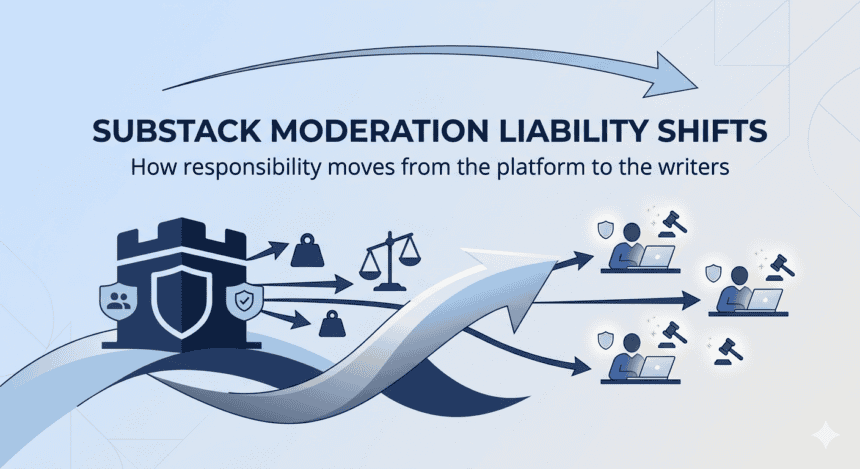

The first thing Substack tells you when you sign up is that you own your content. The second thing, buried deeper in their Terms of Use1, is something rather more consequential: posts on Substack “are the sole responsibility of the person or organization from whom such content originated.” That is not a minor footnote. It is the foundation of an entire business model built on the principle that the platform is a neutral pipe and the writers flowing through it are the ones who will answer for whatever comes out the other end.
- The Platform That Does Not Want to Be a Publisher
- The Moderation That Writers Must Do Themselves
- The Case That Proved the Shield Works — For the Platform
- The Nazi Newsletters and the Question Nobody Wanted to Answer
- When the Writer Is Also the Publisher: The Legal Exposure Gap
- ‘You Own What You Create’ and Every Problem That Comes With It
- The Custom Terms Solution and Its Limits
- Section 230, the Section That Doesn’t Protect You
- The Competitor Calculus
- The Philosophical Defense, and Why It Partially Holds
- What Writers Are Signing Up For, in Plain Terms
I spent several weeks reading through Substack’s policy documents, legal filings, forum threads, and the public statements of its founders, trying to understand exactly how much responsibility a writer takes on when they publish there. The answer, I found, is: almost all of it. Substack has engineered one of the most elegant liability transfers in modern media, all wrapped in the language of liberation.
This is not necessarily a scandal. It may not even be wrong. But it is underappreciated, and in a media environment where independent writers are becoming the primary publishers of record on topics from politics to epidemiology to foreign policy, it is worth understanding precisely what “independence” costs you on Substack’s terms.
The Platform That Does Not Want to Be a Publisher
Substack launched in 2017 with a clean pitch: writers deserved a direct relationship with their readers. No algorithms burying your work. No editor with an agenda. No company telling you which words to use. You write, readers pay, Substack takes ten percent and stays out of the way.
That hands-off philosophy, which Substack’s2 co-founders Chris Best and Hamish McKenzie codified in a 2020 blog post on content moderation, is more than an editorial stance. It is a legal strategy. Section 230 of the Communications Decency Act grants online platforms immunity from liability for content created by their users, as long as the platform does not act as the content’s creator. The law’s central language, which legal scholar Jeff Kosseff famously called “the twenty-six words that created the internet,” states that no provider of an interactive computer service shall be treated as the publisher of information provided by another content creator.
Substack’s entire content philosophy is calibrated to keep that immunity intact. The less the platform decides, edits, promotes, or curates, or at least, the less it appears to do so, the stronger its Section 230 protection. The writers, by contrast, hold no such shield against their readers, subjects, or critics.
“You and you alone are responsible for the content you publish on Substack, and liable for any harm caused by the content you publish.” — Substack Content Guidelines
That quote is not from a footnote. It appears in plain English on Substack’s public content guidelines page3. The sentence is brief, declarative, and total. It shifts the entire legal exposure from the corporation earning revenue from that content onto the individual producing it.
The Moderation That Writers Must Do Themselves
When Substack expanded from newsletters into a broader social platform, complete with comments, Notes, chat threads, and community spaces, it did not expand its moderation team proportionally. Instead, it handed writers a toolkit and called them the best possible moderators.
“Ultimately, we think the best content moderators are the people who control the communities on Substack: the writers themselves,” the company wrote in 2020.
This sounds democratic. It might even be right, in practice. A writer who covers rural healthcare probably does understand their comment section better than a Substack Trust and Safety team operating at scale. But there is a difference between understanding your community and being legally responsible for it.
Substack’s current content guidelines state explicitly:
“These guidelines also apply to Substack comments, notes, and other community surfaces. We believe that writers are responsible for moderating their own communities as they see fit.”
That is not a suggestion. Writers who fail to moderate their communities in line with Substack’s policies risk having their publications removed. The enforcement authority remains with Substack. The labor of moderation belongs to the writer.
In a comment thread on a Substack blog post4 about moderation tools, one user put the concern directly:
“How much of the responsibility to moderate will be given to the author of the Substack, and what does a minimum level of moderation look like?”
The concern is real. If a harassing comment sits in a writer’s section overnight because the writer was asleep, and the target of that harassment suffers documented harm, where does liability fall?
The answer, under Substack’s current framework, is: with the writer. The platform builds the room, collects the rent, and then hands the writer a broom.
The Case That Proved the Shield Works — For the Platform
In August 2024, a U.S. district court dismissed a defamation lawsuit against Substack in a case that illustrated the asymmetry precisely. According to Technology & Marketing Law Blog5, the case, Smith v. Substack Inc., involved a blog called CancelWatch, which published a post detailing a man’s online activities in unflattering terms. The plaintiff alleged that Substack should be liable because the post’s author had allegedly attempted blackmail before publishing.
The court ruled that Section 230 protected Substack’s decision to leave the post up. As legal blogger Eric Goldman noted in his analysis: “Substack merely decided whether or not to withdraw the post from publication, which is lawfully within the purview of a publisher.” Section 230, the court found, specifically protects these leave-up decisions. The platform walked away clean. The author of the CancelWatch post remained exposed.
This is precisely how the system is designed to work. Section 230, as the Congressional Research Service explained in a 2024 brief6, “does not remove users’ responsibility for their own content.” Individual writers who produce defamatory, harassing, or otherwise harmful content can still be held liable. The platform that distributes it cannot, so long as it did not create it. Substack’s hands-off approach to moderation is not idealism. It is sound legal engineering.
The Nazi Newsletters and the Question Nobody Wanted to Answer
In late 2023, journalist Jonathan M. Katz published an investigation in The Atlantic revealing that Substack was hosting and monetizing dozens of newsletters built around white supremacist content, including some that displayed Nazi imagery in their logos. According to TechCrunch7, the report triggered an immediate crisis, with nearly 250 Substack writers signing an open letter demanding clarity on why the company was profiting from white nationalism.
Hamish McKenzie’s initial response was to hold the line. The platform did not want to be in the business of deciding what ideas were acceptable. “We don’t like Nazis either,” he wrote, but Substack believed censorship made the problem worse. The message, essentially, was that writers with Nazi newsletters were responsible for their own content, and readers were responsible for not subscribing.
This position lasted until several high-profile writers threatened to leave. Then, in January 2024, NBC8 reported that Substack removed five publications it said had violated its existing rules against incitement to violence. It did not change its broader moderation philosophy. It did not ban “Nazi content” as a category. It removed five newsletters that, on closer inspection, had already crossed the line the platform had always maintained.
The episode was revealing not just for what Substack did, but for how the moderation responsibility worked in practice. The publications in question had been operating, monetizing, and growing on the platform. The onus to flag and remove them had not been felt by the platform until external pressure made inaction costly. The writers running those publications had been operating within Substack’s permissive framework all along. When the line was finally drawn, it was drawn by public embarrassment, not proactive moderation.
A second wave of departures followed in early 2025, as several prominent writers left the platform citing growing concerns about the political environment and Substack’s continued reluctance to take firmer positions on hate speech. Writers who remained, per Digiday’s reporting, were watching closely, trying to decide whether the platform’s tolerance for extremism contaminated their own reputations by association.
That is a reputational burden, too, that falls entirely on the writer. Substack has positioned itself as a neutral host. The writers, in the public eye, are the platform’s face.
When the Writer Is Also the Publisher: The Legal Exposure Gap
At a traditional media outlet, a reporter writes a story. A lawyer reviews it. An editor makes the final call. If the story defames someone, the company’s legal department handles the claim, and errors and omissions insurance covers the damages. The reporter may be embarrassed. They are rarely personally bankrupted.
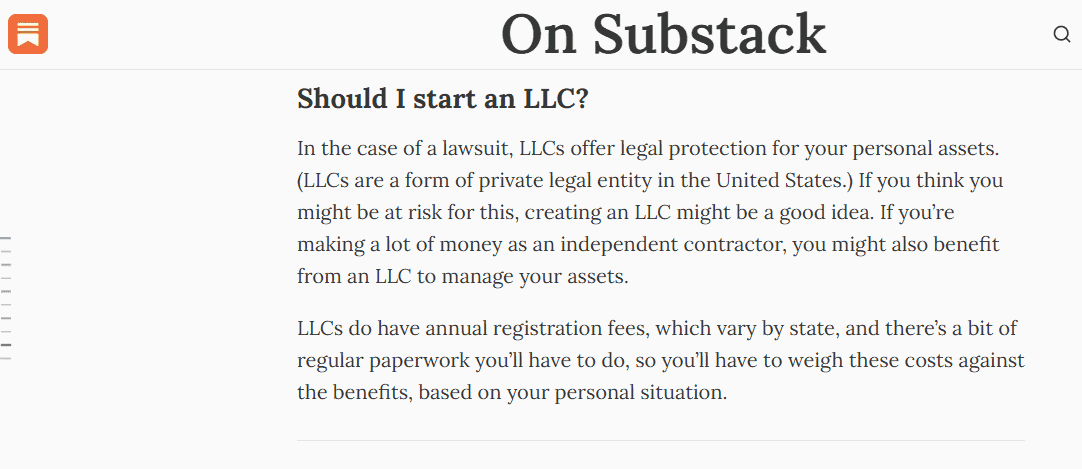
On Substack, the writer is the publication. Substack’s own legal guidance page9 advises writers to consider errors and omissions insurance, and suggests forming an LLC to protect personal assets “if you think you might be at risk.” That advice is sensible. It is also the platform telling its writers: you are on your own. Buy your own shield.
The Substack Defender program10, launched in 2020 and expanded in 2025 to cover writers in Canada and the UK, does provide some legal backstop. Since its launch, it has supported dozens of creators facing defamation, trademark infringement, and copyright infringement claims, and the platform will cover fees up to one million dollars in cases it chooses to accept. Judd Legum of Popular Information has called it “a tremendous program.” Dr. Katelyn Jetelina of Your Local Epidemiologist told Substack the program gave her “the confidence to pursue stories that matter, even when they challenge powerful interests.”
But Defender has critical limits. It is available only to writers with paid subscriptions enabled. Substack selects which cases it will support, on a case-by-case basis. There is no guarantee that your particular defamation claim, your particular copyright dispute, or your particular government pressure campaign will meet the bar. You are applying to your landlord for legal help against a tenant who is suing you for something that happened in the apartment the landlord owns.
In a Lawfare11 analysis of Substack’s content moderation views, legal scholars noted the inherent tension in Substack’s framing. The platform frames the reader-to-writer relationship as a private compact, almost like inviting someone into your home. But the infrastructure of that “home” is owned by Substack. The economics run through Substack. The discoverability tools are Substack’s. And yet the legal accountability, in the platform’s telling, belongs exclusively to the writer who accepted the terms.
‘You Own What You Create’ and Every Problem That Comes With It
The opening line of Substack’s Terms of Use is genuinely true: “First and foremost, you own what you create.” Copyright in your work remains with you. Your subscriber list is yours to take when you leave. The newsletter you built over five years belongs to you in a way that a column at a newspaper never could.
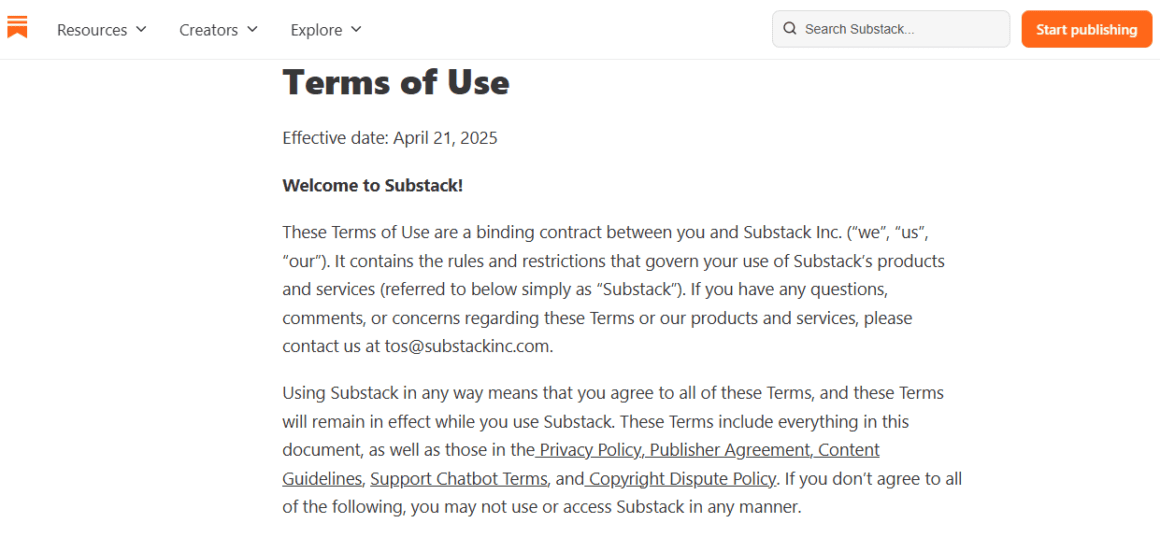
But ownership, it turns out, is a two-sided thing. You own the asset and you own the liability. Substack’s terms are explicit:
“Posts posted to Substack — including Creator publications — are the sole responsibility of the person or organization from whom such content originated. You access all such content at your own risk.”
The phrase “at your own risk” applies to readers. But the structure of the sentence makes the writer’s exposure plain. Substack is not liable for errors or omissions in any post. Readers release Substack from any damages connected to a post. The writer, who generated the content and who Substack has just told you owns it completely, retains all of that potential liability by default.
This is not unusual in tech. It mirrors how most user-generated content platforms work. What makes Substack distinctive is the pitch. When Twitter or Facebook put this language in their terms, nobody read it, because nobody expected those platforms to take any responsibility anyway. When Substack puts it in their terms, it is harder to notice because the platform has framed itself as an advocate for writers. The advocacy is real, up to the point where the platform’s own legal exposure begins.
In the comment section of a Substack post about community moderation, one reader compared the ideal to Wikipedia’s layered system, which federates responsibility to authors while providing automated backstops.
“They federate that responsibility to authors and the community,” the commenter wrote, “and unlike some social media platforms, Wikipedia has no concise summary of what is acceptable.”
The implication was clear: a federated model of responsibility, when done honestly, involves shared infrastructure and shared accountability. What Substack has built is something closer to franchising, where the brand owns the upside and the franchisee owns the risk.
The Custom Terms Solution and Its Limits
Some writers have responded to this gap by building their own legal frameworks on top of Substack’s. In March 2025, writer Karen Smiley12 published a detailed post on how she set up custom terms of service and a privacy policy on her Substack, following advice from legal-aware writers in the community. The idea is that writers can define their own refund policies, comment conduct expectations, and data handling practices, layered on top of Substack’s platform-level terms.
It is a genuinely useful exercise. But Smiley also noted the limits: “Someone who subscribes, but can’t be proven to have read or seen an article, could claim they never saw the custom Terms of Service.” And those custom terms govern the relationship between the writer and their readers. They do nothing to change the relationship between the writer and Substack, or between the writer and any third party who might bring a legal claim over published content. You can add a privacy policy to your Substack. You cannot thereby limit your defamation exposure.
Smiley’s post also flagged something that gets little attention in coverage of Substack’s moderation debates: the platform’s policies are designed, as she put it bluntly, “to protect the company.” That is not a criticism. Companies have legal obligations to their shareholders. But it is worth naming. When Substack says writers are the best moderators, part of what it means is that writers are the most convenient moderators from a legal standpoint. Delegating moderation downward moves accountability downward too.
Section 230, the Section That Doesn’t Protect You
The broader irony of Substack’s legal position is that Section 230, which has protected the platform from liability in cases like Smith v. Substack, would not protect an individual Substack writer in the same way. Section 230’s immunity covers “providers and users of interactive computer services.” A writer on Substack is arguably a user of Substack’s service, but when they publish content they authored, they are the information content provider. And the law explicitly does not protect information content providers from liability for their own content.
As the Congressional Research Service’s 2024 overview of Section 230 makes clear: the immunity “does not remove users’ responsibility for their own content.” A Substack writer who publishes defamatory material can still be held liable for that material. The platform that distributes it cannot. This is the deal.
Section 230 reform has been a political football for years, and the legal landscape is shifting. A Third Circuit ruling in 2024 on platform design liability suggested that platforms could face liability not for what users say, but for how their algorithmic design amplifies harmful outcomes. If that theory gains ground, platforms with active recommendation and discovery features, including Substack’s growing social layer, may find their Section 230 shield more complicated than it once appeared. Writers, who create the content rather than design the system, would be largely unaffected by this shift. The liability story could evolve, but its basic direction for writers is unlikely to change: they will remain on the exposed end of the arrangement.
The Competitor Calculus
It is worth considering what the alternatives offer. Ghost, the open-source newsletter platform that many writers have moved to after leaving Substack, operates on a fundamentally different model. Ghost is software, not a hosted platform. You run it yourself, on your own server, or through a managed hosting provider. There is no Ghost Terms of Service governing your content because Ghost the company is not hosting your content. The legal exposure is the same as running your own website, which means you have no platform at your back and no Defender program to call.
Beehiiv, another Substack competitor that has actively courted disaffected writers, has taken a different marketing angle. According to Digiday13, Beehiiv has positioned itself as a service or software rather than a social platform, precisely to sidestep the moderation debates that have repeatedly embarrassed Substack. Whether that distinction will hold up legally in the long run remains to be seen.
What none of these alternatives change is the fundamental structure of the independent writer’s legal exposure. When you are your own publisher, you own your liabilities. The question is not whether Substack is better or worse than the alternatives. The question is whether writers who sign up for any of these platforms understand, clearly, what they have agreed to own.
The Philosophical Defense, and Why It Partially Holds
It would be dishonest not to acknowledge that Substack’s philosophy has genuine merit. Substack’s14 2021 post on moderation decisions articulates something worth taking seriously: that writers should own their work, and that ownership means something. A platform that pre-screens everything a writer publishes, that reserves the right to edit, redact, or contextualize content before it reaches readers, is not a neutral host. It is an editorial partner. And editorial partners take on editorial liability.
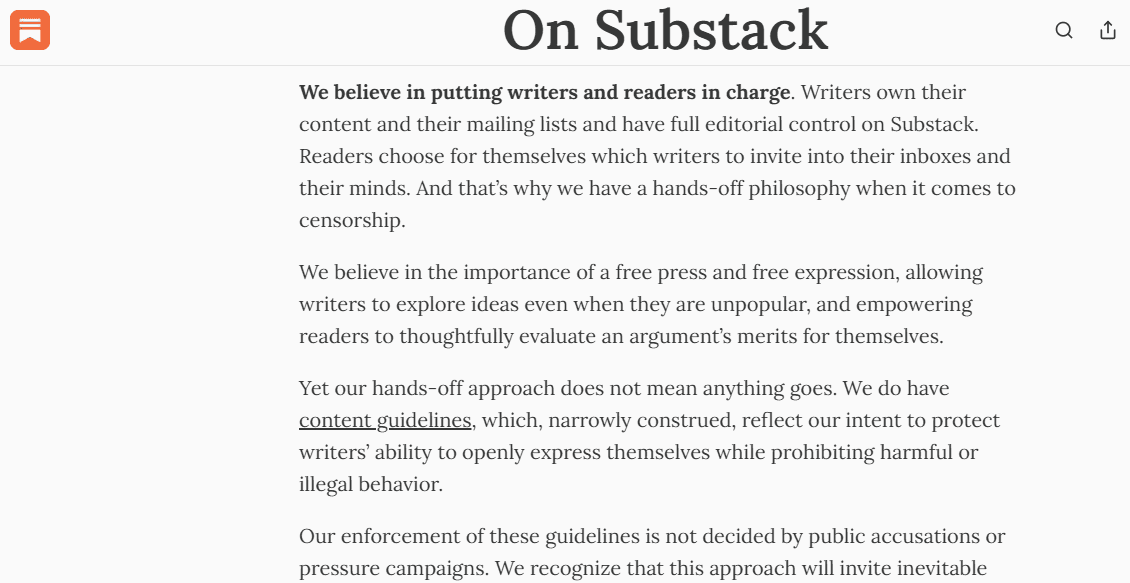
If Substack moderated aggressively, it would weaken its own Section 230 protection and arguably become liable for everything it approved. The hands-off model is not only ideologically convenient for a company that has attracted a lot of writers who felt suppressed elsewhere. It is structurally necessary for a company that cannot afford to review the output of millions of publications and would be destroyed by the liability if it tried.
Substack’s approach echoes Reddit’s longtime policies around moderation, where subreddit moderators do the day-to-day work and the platform reserves only the power to remove communities that cross hard lines. The difference is that Reddit users moderate communities of other users. Substack writers moderate communities built around their own reputations, their own published work, and their own legal names.
I think the hands-off philosophy, taken on its own terms, makes a coherent argument for the kind of internet worth having. What it does not do is make a coherent argument for why the writer should be the one holding the bag when things go wrong. Those are two separate questions, and Substack has answered the first one much more thoughtfully than the second.
What Writers Are Signing Up For, in Plain Terms
After reading through all of it, I think the situation can be summarized plainly. When you publish on Substack, you get a real tool, an audience, a payment processor, a discovery platform, some legal backup, and a very clean user interface. What you also get is the full weight of publisher liability for everything that appears under your name, including the comments your readers leave in your comment section, the newsletter editions you write at midnight and send before a lawyer can read them, and the opinions you express about powerful people who can afford expensive attorneys.
Substack takes ten percent of your subscription revenue and retains Section 230 immunity. You keep ninety percent and retain all the exposure. Whether that is a good deal depends on what you’re publishing and how much you earn. For a writer generating serious investigative journalism about corporate misconduct, it is a deal worth scrutinizing carefully. For a writer sharing weekly reflections on gardening or personal finance, the risk profile is probably manageable.
What it is not, in either case, is a partnership in the full sense of the word. Substack is a platform that has built its success by being genuinely useful to writers, and then structured its terms to ensure that the writers, not the platform, are responsible for whatever that usefulness produces.
That is not unique to Substack. It is the architecture of the modern internet. But it is worth knowing, before you hit publish.
Sources
- “Terms of Use” substack.com/tos. Accessed 14 Apr. 2026. ↩︎
- Best, Chris. “Substack’s view of content moderation” 22 Dec. 2020, on.substack.com/p/substacks-view-of-content-moderation. Accessed 14 Apr. 2026. ↩︎
- “Content Guidelines” substack.com/content. Accessed 14 Apr. 2026. ↩︎
- Richardson, Bailey. “Making writers’ lives easier” Making writers lives easier, 16 Feb. 2024, on.substack.com/p/support-for-writers/comments. Accessed 14 Apr. 2026. ↩︎
- Goldman, Eric. “Section 230 Helps Substack Defeat a Defamation Claim-Smith v. Substack” Technology & Marketing Law Blog, 13 Aug. 2024, blog.ericgoldman.org/archives/2024/08/section-230-helps-substack-defeat-a-defamation-claim-smith-v-substack.htm. Accessed 15 Apr. 2026. ↩︎
- Benson, Peter J. “Section 230: A Brief Overview” 2 Feb. 2024, www.congress.gov/crs_external_products/IF/PDF/IF12584/www.congress.gov/crs_external_products/IF/PDF/IF12584/IF12584.2.pdf. Accessed 15 Apr. 2026. ↩︎
- Hatmaker, Taylor. “Substack won’t commit to proactively removing Nazi content, ensuring further fallout” TechCrunch, 9 Jan. 2024, techcrunch.com/2024/01/09/substack-nazi-content-policies-controversy/. Accessed 15 Apr. 2026. ↩︎
- Ingram, David. “Substack said it removed some newsletters after criticism about Nazi content” 9 Jan. 2024, www.nbcnews.com/tech/tech-news/substack-removed-newsletters-criticism-nazi-content-rcna132963. Accessed 15 Apr. 2026. ↩︎
- Team, Substack. “Your legal questions, answered” On Substack, 20 Feb. 2020, on.substack.com/p/your-legal-questions-answered. Accessed 15 Apr. 2026. ↩︎
- “Defender” Substack, pages.substack.com/defender/. Accessed 15 Apr. 2026. ↩︎
- Schulz, Jacob. “Substack’s Curious Views on Content Moderation” Lawfare , 4 Jan. 2021, www.lawfaremedia.org/article/substacks-curious-views-content-moderation. Accessed 15 Apr. 2026. ↩︎
- Smiley, Karen. “Transparency and protection for Substack writers” Everyday Ethical AI, 10 Mar. 2025, karensmiley.substack.com/p/transparency-and-protection-for-substack-writers. Accessed 15 Apr. 2026. ↩︎
- Lee, Alexander. “Creators are ditching Substack over ideological shift in 2025” 1 Apr. 2025, digiday.com/media/creators-are-ditching-substack-over-ideological-shift-in-2025/. Accessed 15 Apr. 2026. ↩︎
- Team, Substack. “How we approach moderation decisions” On Substack, 25 Mar. 2021, on.substack.com/p/how-we-approach-moderation-decisions. Accessed 15 Apr. 2026. ↩︎