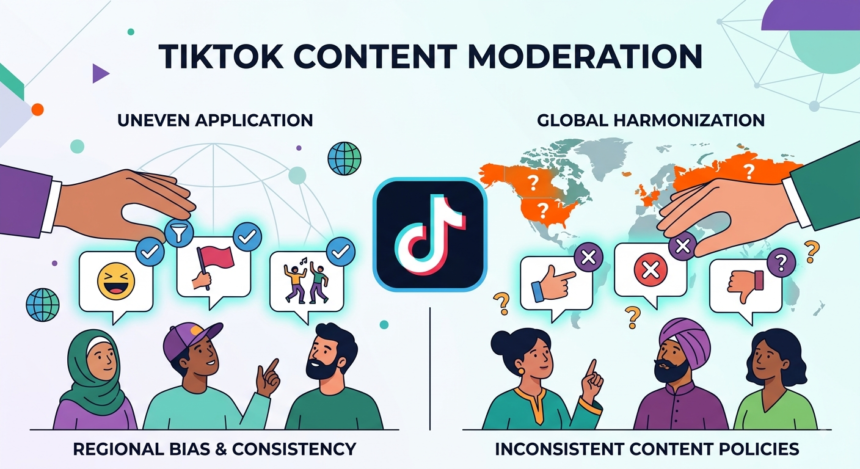

I spent three weeks reading leaked moderation manuals, court filings, academic papers, and the raw, unfiltered comments of the people who make TikTok what it is. What I found was not a single villain. It was something harder to name and harder to fix. A machine built in Beijing and Los Angeles, trained mostly on English, staffed by underpaid workers in Nairobi and Manila, and pointed at a billion people who do not speak, look, or live the same way. The result is a platform that treats a teenager in Ohio differently than a teenager in Nairobi, and treats both differently than a journalist in Gaza. Nobody designed this on purpose, not exactly. But nobody stopped it either.
The App That Ate the World
TikTok crossed a billion monthly users years ago and never slowed down. It is now the place where a fifteen-year-old learns a dance, a small business finds its first customers, and a war gets narrated in real time by the people living through it. Scale like that comes with a cost. Every minute, TikTok has to decide what millions of new videos mean, whether they break a rule, and whether a human or a machine gets to make that call. Most of the time, it is a machine. And the machine was trained somewhere. It carries the fingerprints of the people who built it and the language they built it in.
That is the quiet problem underneath every TikTok moderation scandal of the last six years. The company has never had one moderation system. It has had a patchwork of them, stitched together country by country, language by language, and the seams show.
What Got Leaked
In December 2019, the German outlet Netzpolitik1 published internal TikTok guidelines that told moderators to flag videos from users with visible disabilities, including autism and Down syndrome, as “Risk 4.” A Risk 4 label meant the video would only be shown inside the country it was uploaded from, capping its reach at a fraction of the platform’s global audience. Fat users and LGBTQ users landed on a similar list, tagged as vulnerable to bullying by default, whether or not anyone had actually bullied them.
Three months later, The Intercept2 obtained a wider set of documents that filled in the picture. CNET3 reported that moderators were told to suppress videos showing “abnormal body shape,” “ugly facial looks,” an “obvious beer belly,” dwarfism, wrinkles, and eye disorders.
The instructions did not stop at people. They extended to backgrounds. A video shot in a home with cracked walls or “disreputable decorations” could be quietly throttled. Rural poverty was penalized unless the scenery was, in the document’s words, beautiful enough to be exempted. One line stated plainly that if the shooting environment was not good, the video would be “not worthing to be recommended to new users.” I have read a lot of corporate documents in this job. I have never seen one admit its own bias in language this blunt.
TikTok told The Intercept the rules were an early and clumsy attempt to prevent bullying and were no longer active. Maybe that is true. But the instinct behind the rules, protect the platform’s image by hiding the people who do not fit it, did not disappear with the document. It resurfaced later in subtler forms, and creators noticed.
Shadows Without Explanations
Ask any TikTok creator what “shadowban” means and they will not need a definition. It is the word for a punishment nobody confirms is happening. Your videos stop landing on the For You page. Your views drop by ninety percent overnight. Your account looks normal from the outside. TikTok has said, repeatedly, that it does not shadowban. A spokesperson told Fox News Digital4 the company only acts against creators who repeatedly break the rules, and that those creators are notified. Ask the creators and you get a different story, delivered from every corner of the political and cultural map.
Conservative influencers say it happens to them. Radio host Victor Nieves told Fox News5 that being conservative on TikTok means getting censored, shadow-banned, and watching your content disappear, over and over. Golf influencer Paige Spiranac and LSU gymnast Olivia Dunne have both publicly wondered aloud why their videos suddenly stopped performing, with no rule violation in sight.
Black creators say it happens to them too, and academic research backs up the pattern. A 2023 study published in the Proceedings of the ACM6 on Human-Computer Interaction interviewed Black content creators and found a recurring belief, stated by one participant almost word for word as the paper’s title: TikTok has a vendetta against Black creators. The researchers pointed to earlier work by Haimson and colleagues showing that Black users, transgender users, and users promoting conservative politics all experience disproportionate content removal compared to other groups on the same platforms. One theory researchers keep returning to involves African American Vernacular English. Speech patterns common among Black creators appear more likely to get flagged by automated systems trained overwhelmingly on standard English, a mismatch that has nothing to do with the actual content of what is being said and everything to do with how it is said.
I do not think TikTok’s engineers sat down and decided to build a system that punishes AAVE. I think they built a system trained on the internet’s loudest, most standardized dialect and never checked what got left out. That is a different kind of failure. It is not smaller.
Palestine and the Limits of Neutrality
No case exposes the regional fault lines in TikTok moderation like the coverage of Gaza. In 2021, a report found that former moderators had been instructed to leave up violent content depicting harm to Palestinians while enforcing stricter rules on comparable graphic material elsewhere, according to Middle East Online7. That inconsistency became a flashpoint again after October 2023, when Human Rights Watch reviewed 1,050 cases of online censorship across sixty countries and concluded that Meta was systematically suppressing Palestinian voices. Anadolu Agency8 posted that Meta’s content moderation practices have systematically restricted Palestinian voices on Facebook and Instagram.
TikTok users described the same experience in their own words. Pro-Palestinian hashtags stopped trending. Accounts vanished with no explanation. Journalists reporting from Gaza said their reach collapsed the moment their coverage turned political.
The most visible casualty was Bisan Owda, an Emmy-winning Palestinian journalist with 1.4 million followers, whose account was permanently banned in what Middle East Online9 described as a moment that “ignited widespread outrage.” Owda said the removal came without a clear reason and that she believed it followed political pressure tied to Israel. A 2025 Global Voices report cited in the same coverage documented what it called ongoing digital erasure, pairing account suspensions of Palestinian voices with what it characterized as leniency toward hateful content aimed at them.
I want to be careful here, because this is the kind of story where certainty is cheap and evidence is contested. TikTok has denied deliberately suppressing any side of the conflict. Malaysia’s communications minister publicly accused both TikTok and Meta of restricting pro-Palestinian content, and Meta called the claim baseless. Nobody has produced a smoking gun memo that says “suppress Gaza coverage.” What exists instead is a mountain of individual testimony, a pattern researchers keep documenting across platforms, and a company that has never fully explained how its “borderline content” rules get applied when the borderline runs through a live war.
That ambiguity is not neutral. A platform that will not explain its decisions has, functionally, decided that explanation is not owed to the people affected by them.
China’s Long Shadow
TikTok cannot escape its parent company. ByteDance is headquartered in Beijing, and for years critics have argued that this fact alone shapes what disappears from the app. Former employees said the platform censored content sensitive to Beijing, including discussion of the Hong Kong protests, alongside political discussion that had nothing to do with China at all. That same year, TikTok suspended the account of Feroza Aziz, a teenager who used a fake eyelash tutorial to smuggle in a message about Xinjiang internment camps. The company called it a moderation error and restored her account after the backlash went viral, which is its own kind of tell. Errors that happen to align with the political interests of a company’s home government deserve a second look.
The Wall Street Journal10 reported in 2020 that some TikTok users had started performing pro-Beijing views specifically to avoid getting shadowbanned, a strategy that only makes sense if creators believed, correctly or not, that political alignment affected visibility. Around the same time, the Times of India reported that TikTok was suppressing content related to the Sino-Indian border dispute. TikTok has consistently denied that Beijing directs its moderation decisions and has pointed to the creation of regional trust and safety hubs as evidence of decentralization. But a company can build regional offices and still inherit the instincts of the culture that built its first rulebook.
If the China question is about political will, the Global South question is about resources, and it might be the more consequential story of the two, because it touches the most people with the least attention.
Africa is home to more than two thousand languages. According to a 2025 study cited by Global Voices11, only forty-two African languages show up in any meaningful way across major AI systems, and just four, Amharic, Swahili, Afrikaans, and Malagasy, are handled with real consistency. That leaves more than ninety-eight percent of the continent’s languages essentially invisible to the systems deciding what stays online.
Global Voices12 told the story of a moderator hired at TikTok’s Kenya hub who spoke Amharic but was handed videos in Luo, Dholuo, Kikuyu, and Dinka, languages he could not understand. When nothing looked visibly wrong and nobody had reported the clip, he left it up. When reports piled up, he took it down. That was the whole system. Jackson Busolo, a Kenyan creator who posts political commentary in Swahili, woke up one morning to find his account gone with no warning and no explanation. It came back eventually, after an appeal, and he never learned why it disappeared in the first place. TikTok’s own enforcement data shows the platform removed more than 450,000 videos from Kenya alone in the first quarter of 2025, climbing to 592,000 by the second quarter. Most of that enforcement, the company says, comes from automated systems built for languages the automation barely understands.
More recent reporting by Fintech Association of Kenya13 shows that TikTok removed a record 884,591 videos in Kenya during the first quarter of 2026, about 8% more than in the previous three months, as it tightened enforcement of its Community Guidelines
The people asked to catch what the machines miss are not treated much better. In Nairobi, TikTok outsources most of its moderation work to Teleperformance, a French company. Former employees told the Christian Science Monitor14 their starting salary was about $300 a month, for shifts reviewing roughly 500 videos each, or one every minute for nine hours straight. Total accuracy at that pace, the former employees said, is not possible. A separate investigation by Coda Story15 spoke with a 28-year-old moderator, using a pseudonym out of fear of retaliation, who described reviewing footage of rape, child sexual abuse, and a woman taking her own life in front of her children. “You become a different person,” she said. “I’m numb.” The Center for Democracy and Technology’s16 research on low-resource languages found the same pattern repeating from country to country. Moderators pulled from one nation are handed content from an entire region, dialect gaps and all, with little training in the cultural context that would let them tell a joke from a threat.
This is the part of the story that gets the least attention, and I think that is because it does not produce a clean villain. There is no leaked memo ordering anyone to underpay Kenyan moderators or ignore Dholuo. There is just a business decision, repeated at every level of the company, to spend less on the parts of the world that generate less advertising revenue. The bias is not in a line of code. It is in a budget.
What Users Are Actually Saying
Forums and comment sections are where this frustration lives in its rawest form, unfiltered by press releases. On threads about shadowbanning, the advice users trade with each other is telling in itself: check your account status, remove anything that might be flagged, wait two weeks, appeal, wait again. A guide on getting “unshadowbanned” lays out the process like a bureaucratic ritual, because that is what it has become for millions of people who have no other recourse. One newsletter, 20 Minutes Into the Future17, summed up the mood after tracking the leaked documents: TikTok’s algorithm and moderators, in this reading, tend to suppress the poor, the transgender, the disabled, and people of color, while favoring an audience that is, in the writer’s words, privileged, white, and able-bodied.
I do not take every anonymous complaint online as gospel. People blame the algorithm for ordinary bad luck all the time. But when a pattern shows up across conservative creators, Black creators, disabled creators, Palestinian journalists, and Kenyan moderators, all describing the same basic experience of invisible, unexplained suppression, the coincidence stops being a coincidence. It starts looking like a design flaw with many symptoms and one root cause: a platform that never built a consistent, transparent, well-resourced way to explain its own decisions to the people it affects.
TikTok’s position, stated over and over across years of scrutiny, is that its rules are published, its appeals process is real, and its moderation is handled by regional trust and safety hubs staffed by experts, not dictated from Beijing. There is something to this. The company did shut down the “ugly, poor, disabled” livestream rules once they became public. It did build out regional operations after the 2019 leaks. A 2024 academic study at Wiley18 mapping TikTok’s moderation controversies in South and Southeast Asia found that the platform tends to localize its rules based on pragmatic necessity, avoiding political fights rather than picking sides in them, which is a less sinister explanation than outright bias, even if the outcome for users looks similar either way.
But localization without adequate investment is its own kind of failure, maybe a worse one, because it hides behind the language of care. Telling users their content is being reviewed by a regional hub does not mean much if that hub is a Nairobi call center paying $300 a month to workers reviewing a video every sixty seconds in a language they do not speak. Publishing community guidelines does not mean much if a Palestinian journalist can lose 1.4 million followers overnight with no specific violation ever named.
An Honest Ending
I do not think TikTok wants to silence disabled creators or Palestinian journalists or Kenyan comedians. I think TikTok wants growth, wants advertisers, wants to avoid political headaches in whatever country it is trying to expand into next, and those incentives, applied at a billion-user scale without the money or staffing to apply them carefully, produce the same effect as bias, whether anyone intended it or not. Intent matters less than most people think. The person whose income disappears because an algorithm trained mostly on English cannot parse their dialect does not experience a design limitation. They experience a punishment.
The fixes people keep proposing are not exotic. Pay moderators enough to do the job carefully. Hire people who actually speak the languages they are reviewing. Publish real data on what gets removed, from where, and why. Give users a specific reason when their account disappears, not a form letter. None of this requires new technology. It requires TikTok deciding that the parts of the world generating less revenue deserve the same care as the parts generating more. So far, the evidence suggests that decision has not been made.
There is a version of this story where I tell you TikTok is uniquely bad, worse than Meta, worse than X, a rogue actor among otherwise responsible platforms. I don’t think that’s true, and I don’t think it’s useful. Human Rights Watch found the same suppression patterns on Meta’s apps. X users have made identical shadowban complaints for years. The underlying economics are the same everywhere: platforms built for global scale, moderated with resources scaled for wherever the advertising dollars are thickest. TikTok is not an outlier. It is the clearest current example of a problem every major platform shares, mostly because TikTok’s leaks have been unusually detailed and its user base unusually vocal about documenting what happens to them.
That is, in a strange way, a kind of opportunity. A problem this well documented is a problem that is hard to deny. Every leaked memo, every academic study, every Kenyan moderator willing to risk their job to talk to a reporter, adds one more brick to a case that no spokesperson’s denial can fully knock down. Regulators in Malaysia have noticed. Researchers at Brookings and the Center for Democracy and Technology have noticed. Unions are forming in Nairobi. None of that guarantees change. But it means the gap between what TikTok says about its moderation and what its own users experience is no longer a private frustration traded in comment sections. It is a public record, growing longer every year, and at some point a record that long stops looking like a series of unfortunate mistakes and starts looking like a policy.
The algorithm does have an accent. It just never had to admit it out loud. Maybe, eventually, the weight of everyone saying so at once will make that harder to avoid.
Sources
- Köver, Chris. “TikTok curbed reach for people with disabilities” Netzpolitik.Org, 2 Dec. 2019, netzpolitik.org/2019/discrimination-tiktok-curbed-reach-for-people-with-disabilities/. Accessed 21 Aug. 2026. ↩︎
- Biddle, Sam. “TikTok Told Moderators: Suppress Posts by the “Ugly” and Poor” 16 Mar. 2020, theintercept.com/2020/03/16/tiktok-app-moderators-users-discrimination/. Accessed 21 Aug. 2026. ↩︎
- “Cnet” This comes after TikTok was reportedly suppressing, www.facebook.com/cnet/posts/this-comes-after-tiktok-was-reportedly-suppressing-videos-from-users-it-deemed-t/10158621333587275/. Accessed 30 Oct. 2026. ↩︎
- Gaydos, Ryan. “Olivia Dunne wonders if she’s ‘shadow banned’ as TikTok videos fail to score 1M views” Fox News, 21 Dec. 2023, noticias.foxnews.com/sports/olivia-dunne-wonders-shes-shadow-banned-tiktok-videos-fail-score-1-million-views. Accessed 21 Aug. 2026. ↩︎
- Cina, Matteo. “Conservative TikTok influencers claim platform discriminates against right-leaning voices” Fox News, 28 June 2023, foxnews.com/politics/conservative-tiktok-influencers-platform-discriminates-against-right-leaning-voices.amp. Accessed 21 Aug. 2026. ↩︎
- ACM, dl.acm.org/doi/pdf/10.1145/3610169. Accessed 21 Aug. 2026. ↩︎
- “US ownership of TikTok leads to bans on Palestinian influencers, journalists” 30 Jan. 2026, middle-east-online.com/en/us-ownership-tiktok-leads-bans-palestinian-influencers-journalists. Accessed 21 Aug. 2026. ↩︎
- “Anadolu Agency” Metas content moderation practices…, www.facebook.com/anadoluagencyenglish/posts/-metas-content-moderation-practices-have-systematically-restricted-palestinian-v/1390542573264755/. Accessed 30 Oct. 2026. ↩︎
- “US ownership of TikTok leads to bans on Palestinian influencers, journalists” 30 Jan. 2026, middle-east-online.com/en/us-ownership-tiktok-leads-bans-palestinian-influencers-journalists. Accessed 21 Aug. 2026. ↩︎
- WSJ, www.wsj.com/articles/tiktok-users-gush-about-china-hoping-to-boost-views-11592386203?eafs_enabled=false. Accessed 30 Oct. 2026. ↩︎
- 20 Apr. 2000, globalvoices.org/2026/04/20/africa-has-2000-languages-ai-content-moderation-covers-fewer-than-20/. Accessed 21 Aug. 2026. ↩︎
- 20 Apr. 2000, globalvoices.org/2026/04/20/africa-has-2000-languages-ai-content-moderation-covers-fewer-than-20/. Accessed 30 Oct. 2026. ↩︎
- “Fintech Association of Kenya” Fintech Association of Kenya, www.facebook.com/FintechAssociationOfKenya/posts/. Accessed 30 Oct. 2026. ↩︎
- Owino, Vincent. “When TikTok failed them, Kenyans began policing their own feeds” CSMonitor.com, 24 Mar. 2026, www.csmonitor.com/World/Africa/2026/0324/tiktok-moderation-teleperformance-swahili-language-ai. Accessed 21 Aug. 2026. ↩︎
- Hellerstein, Erica. “In Nairobi’s Silicon Savanna, African workers are taking on Big Tech” Coda Story, 11 Oct. 2023, www.codastory.com/authoritarian-tech/kenya-content-moderators/. Accessed 21 Aug. 2026. ↩︎
- CDT, cdt.org/insights/content-moderation-in-the-global-south-a-comparative-study-of-four-low-resource-languages/. Accessed 21 Aug. 2026. ↩︎
- Harvey, Daniel. “TikTok’s big bias problem” 20 Minutes into the Future, 19 May 2020, 20minutesintothefuture.substack.com/p/tiktoks-big-bias-problem. Accessed 21 Aug. 2026. ↩︎
- Wiley, onlinelibrary.wiley.com/doi/full/10.1002/poi3.388. Accessed 21 Aug. 2026. ↩︎