

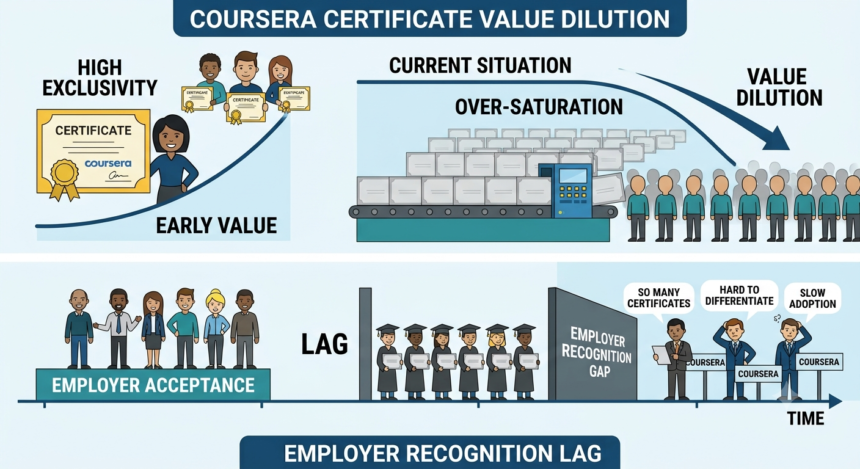

I have a Coursera certificate sitting in a folder I never open. It says I completed a course on Basic Spanish. I remember almost none of it. What I remember is the feeling of finishing it: a small, cheap hit of accomplishment, followed by the vague sense that I had bought something rather than earned it. I was not wrong to feel that way, and I am far from alone.
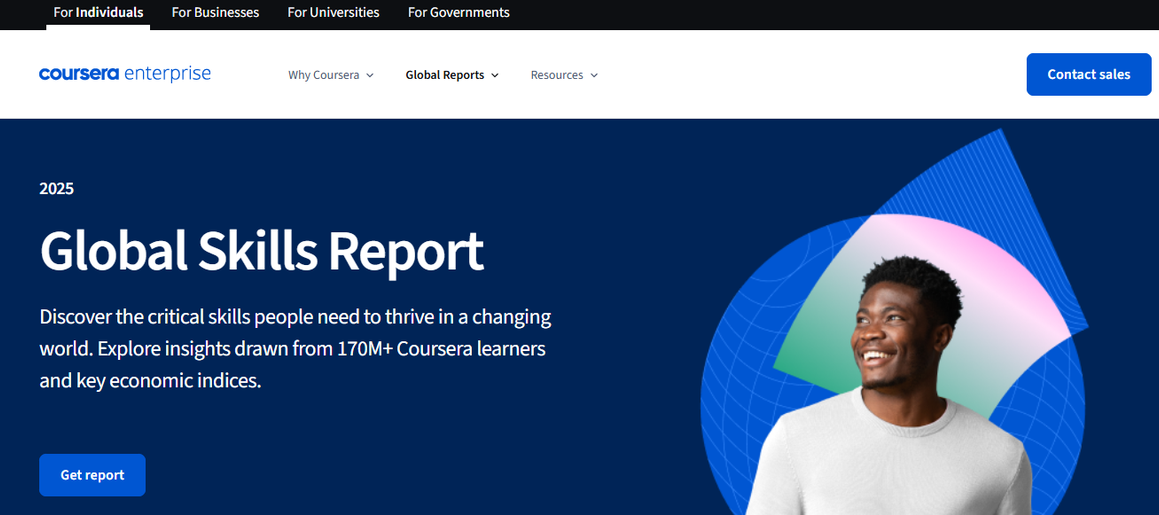
Coursera1 now counts more than 170 million registered learners worldwide.
That number alone should tell you something is off. When a credential is held by a population larger than the United Kingdom, the word “credential” starts to strain under the weight. A signal that everyone is sending is not a signal anymore. It is background noise.
This piece is about that noise, and about the gap between what Coursera promises and what a hiring manager in Ohio or Bangalore or London actually does when a certificate lands on her desk. It is not a hit piece on online learning. Some of what happens on that platform is genuinely useful. But the marketing has outrun the mechanism, and the workers paying $49 a month to close that gap deserve a clearer picture of what they are buying.
A Platform Built on Volume
The company’s business model rewards enrollment, not outcomes. According to ICEF2, they boast of more than 8 million GenAI enrollments and 12 new GenAI learners signing up every minute across nearly 700 courses. Those are impressive numbers for a shareholder call. They are close to meaningless as a measure of whether any given certificate helps a specific person get a specific job.
I want to be fair here, because the temptation in this kind of story is to flatten a real institution into a punchline. Coursera did not set out to dilute anything. It set out to make the world’s best courses cheap and available, and on that count it has succeeded past what anyone predicted in 2012. The problem is what happens after the course ends, when a learner tries to convert a completion badge into a job offer, and discovers that the market has not agreed on what that badge is worth.
What the Economists Actually Found
Most of the debate about MOOC certificates runs on vibes. A Stanford economist and a Northeastern researcher decided to test it with real data instead.
Susan Athey and Emil Palikot3 ran a randomized experiment with more than 800,000 Coursera learners, most of them from developing countries and without college degrees. Half were nudged to add their new certificate to LinkedIn with fewer clicks. The other half were left alone. Then the researchers tracked who got hired.
The topline result sounds encouraging. Learners who shared their credential were about 6 percent more likely to land a new job within a year, and 9 percent more likely to land one that actually matched their certificate’s field. Read that as a headline and you would think the case is closed: certificates work.
Read the rest of the paper and the picture gets more complicated, and more honest. The gains were not spread evenly. They were almost entirely concentrated among the learners who had the weakest resumes to begin with. For workers in the top third of predicted employability, meaning people who already had strong work histories or degrees, the effect of adding a certificate was statistically indistinguishable from zero. The researchers even ran the numbers through an AI resume-scoring model and found that a credential added 15 to 20 points to a weak profile, and nothing, or occasionally a negative amount, to a strong one.
I sat with that finding for a while, because it cuts against the story Coursera tells about itself and also against the story critics tell. The certificate is not worthless. It is not a golden ticket either. It functions almost exactly like a patch, filling a hole in a resume that has one, and doing nothing for a resume that does not. Athey and Palikot call this a “salience” effect. A hiring manager skimming a stack of applications notices the certificate mainly when there is nothing else to notice. That is a real and useful thing for someone breaking into a field with no other proof of skill. It is not the universal career accelerant the marketing implies.
The Forums Say What the Surveys Will Not
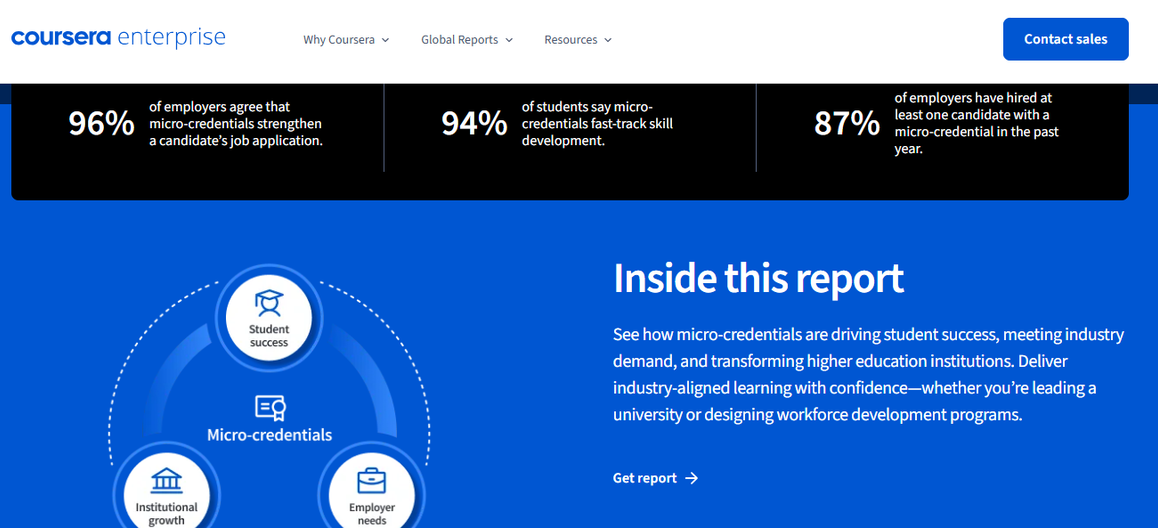
Corporate research surveys tend to produce corporate-friendly numbers. Coursera’s4 own Micro-Credentials Impact Report claims 96 percent of employers say they would pay more for a candidate with a micro-credential. I believe that survey was conducted honestly. I also believe it measured stated intent, not what happens when a real recruiter opens a real applicant tracking system at 4:45 on a Friday with 300 resumes left to clear.
Go to the places where hiring managers and engineers talk without a marketing department listening, and the tone changes fast. On the professional forum Blind5, where users verify employment to post, one thread asked whether anyone cares about Andrew Ng’s popular machine learning certificate on Coursera.
The top response was dismissive.
Certificates mean you are noob. Would actually count negatively IMO.
Other commenters piled on, with one calling the credential “embarrassing” and arguing it signals a beginner rather than a professional, and another saying a candidate who lists it while claiming real experience looks like someone padding a thin resume with “proficient in Microsoft Office.” A few pushed back, noting the knowledge gained in the course can matter in an interview even if the certificate itself does not, but the consensus leaned skeptical.
A separate Blind6 thread about the Meta-branded Coursera certificate for backend development got a blunter verdict. A commenter told an unemployed job seeker the certification itself was “kinda useless” and that actual projects mattered far more. Another claimed:
Projects and practical experience is more useful.
Another said:
To be honest, the coursera certification is kinda useless
Older forums tell a similar story with less edge. On a long-running AnandTech7 thread about whether to list a Coursera class on a resume, one longtime member suggested that whether the credential helps depends entirely on what the rest of the hiring committee’s resumes look like. If everyone else at the school has an unaccredited certificate too, he wrote, “fly your Coursera flag with pride.” If they went to schools with real admissions standards, maybe don’t talk it up too much. That is credential inflation described in plain English by someone who has never heard the term. Value is relative to what everyone else is holding, and right now almost everyone is holding one.
Even Hacker News8, a forum that leans generous toward continuing education, has been arguing about this since Coursera launched. There were positive outlooks as well. One user wrote:
Considering that the Coursera certificates require you to take a class (usually taught by experts in the respective field) as opposed to cramming for a certification exam, I’d say it’s a good bit more valuable.
One early commenter, an employer himself, said he viewed most for-profit certifications as a mild negative signal, name-checking a few he considered worthless, and predicted it would take time to see which bucket Coursera’s certificates fell into. That comment is more than a decade old. The bucket has largely been decided, and it split down the middle: useful for entry-level and underrepresented candidates, close to noise for anyone with a stronger alternative signal, which is roughly what Athey and Palikot’s data later proved with a randomized trial instead of a hunch.
Employers Are Not Lying When They Say “It Depends”
I looked for the kind of source every article like this leans on, the recruiter willing to say what a company’s official statement will not. What I found, largely through publicly posted interviews rather than an official statement, was consistency in the ambivalence itself.
According to RGPM9, Matt Erhard, a managing partner at a staffing firm, told one interviewer that Coursera and Google-branded certifications are not typically “game changers” in his hiring process, and that in most roles the underlying technical ability matters far more than whether a candidate has a certificate proving it. He allowed that continuing education is a mildly positive signal about a candidate’s attitude, but was clear that a certificate rarely moves someone from the reject pile to the interview pile on its own.
A separate set of interviews conducted for a career-advice outlet produced a similar number from the recruiter side: a Medium10 article claimed that roughly 60 percent of employers say they recognize the Google Career Certificate name, but only about a quarter treat it as a significant factor in an actual hiring decision. Recognition and weight are two different things, and the industry has been sloppy about conflating them. Coursera’s marketing leans hard on the first number. The people doing the hiring live inside the second one.
This is the recognition lag in a sentence: employers know the brand exists, roughly the way they know a stock photo exists, and that recognition has not yet translated into a shared standard for what any specific certificate should mean for a callback.
The Irony Sitting Inside Coursera’s Own Catalog
Here is a detail that made me laugh out loud when I found it, and then stopped being funny the longer I sat with it. Coursera11 sells a one-hour guided project that teaches you to build a resume specifically designed to beat an applicant tracking system, the same kind of automated filter that a mountain of other Coursera certificates are quietly getting buried by.
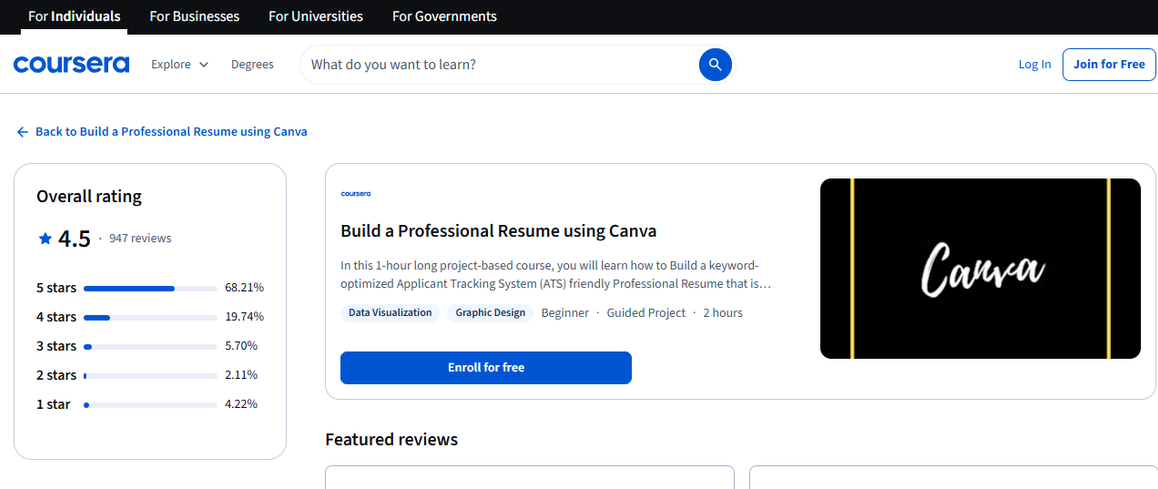
The course description states plainly that ATS software screens resumes at 99 percent of Fortune 500 companies. The platform, in other words, has identified the exact mechanism that flattens the value of its own credentials into keyword soup, and turned that mechanism into a $1 upsell. That is not a conspiracy. It is just what happens when a business model is optimized for enrollment volume rather than for any individual learner’s outcome.
None of this is unique to Coursera. It has a name in labor economics: credential inflation, sitting downstream of a much older idea called signaling theory, first formalized by the economist Michael Spence in the 1970s. The basic logic is simple. When a credential is scarce, it tells an employer something real about the holder, because only certain people could get it. When everyone can get it, cheaply, at their own pace, with no admissions committee standing in the way, the credential stops separating anyone from anyone else. It becomes what economists call a pooling equilibrium. Strong candidates and weak candidates end up holding the identical piece of paper, so the paper stops doing the one job a credential is supposed to do.
A 2022 paper in the European Sociological Review12 lays out the mechanism with more precision than I can manage in a paragraph, but the short version tracks what the forums have been saying for a decade in cruder language. As the supply of credentialed workers grows, the “informational content” of any single credential shrinks. Employers respond by hunting for the next scarce signal to sort candidates with, whether that is a name-brand employer on a resume, a referral from someone they trust, or increasingly, a portfolio the applicant actually built with their own hands. The certificate becomes table stakes rather than a differentiator, which is a nicer way of saying it becomes close to worthless as a standalone signal.
Coursera’s own growth numbers are, unintentionally, the best evidence for this theory that exists. A credential that 26 million new people acquired in a single year, as Coursera added in 2024 alone, cannot function as a scarcity signal by definition. Scarcity and eight-figure annual enrollment growth are not compatible ideas.
Who Benefits, and Why That Matters
I do not want to leave the impression that the certificate is a scam, because the Athey and Palikot data does not support that conclusion, and neither does the rest of the honest research on this topic. A 2014 survey of 103 human resources professionals cited previously found MOOCs were viewed favorably on a resume in general, even as respondents doubted they demonstrated specific job-ready skills the way a traditional credential might. A 2019 study found people rate online degree programs as less legitimate than conventional ones, which tracks with what recruiters told journalists directly. None of that adds up to worthless. It adds up to conditional.
The condition, based on the best evidence available, is this: a Coursera certificate helps most when you have almost nothing else. It helps a self-taught worker in a country where a traditional degree was never financially reachable. It helps a career-changer with a thin resume prove they can finish something structured. It does close to nothing for a computer science graduate from a strong program who is already competitive without it, and in the worst case, stacking too many of them on a resume can read as compensating for a weakness rather than demonstrating a strength, exactly the pattern one Blind commenter flagged when he called it “weak relevant experience” at best.
That heterogeneity is the actual story, and it is a more useful one than either “credentials are dead” or “credentials are the great equalizer.” Both of those are marketing pitches dressed up as conclusions. The real finding is narrower and more interesting: a light-touch credential is most valuable exactly where traditional signals fail, which happens to be exactly where the people who need help most are standing.
The Lag Employers Won’t Admit to
Here is the part I think gets underreported. Employer recognition of new credentials does not move at the speed of the credentials themselves. A university degree took decades, in some cases a century, to build the shared understanding that makes it legible across an entire labor market. Everyone roughly agrees what a mechanical engineering degree from a reputable state school signals, because that agreement was built slowly, tested against generations of actual hires, and reinforced by accreditation bodies nobody in HR has to think twice about.
Coursera certificates have existed in their current form for barely over a decade, and the specific professional certificates from Google, IBM, and Meta are younger still. There has not been enough time, or a wide enough dataset of real hiring outcomes, for the market to converge on a shared standard. Individual hiring managers are each running their own private experiment, forming their own private opinion, based on the one or two candidates with that certificate they happened to interview. That is why the interviews I found are so inconsistent. One recruiter has seen a Google certificate work well for a remote candidate and recommends it without reservation. Another calls the identical credential a keyword that gets a resume noticed and nothing more. Neither is lying. They are both reporting a genuinely fragmented, unsettled market, and the fragmentation itself is the recognition lag.
That lag will eventually close, the way it closed for other new credentials before it. It will close faster for some certificates than others. The ones tied to a name-brand employer with skin in the game, Google’s own hiring pipeline being the clearest example, have a real chance at building consistent legibility over time, because Google has an incentive to make its own certificate mean something specific. The generic university-branded course completions, the kind that make up the overwhelming majority of what Coursera sells, have no such champion pushing for a shared standard, and I suspect a meaningful share of them never develop one.
There is also a quieter, structural reason the lag persists longer than anyone at Coursera would like to admit. Traditional degrees carry accreditation bodies, state oversight, and decades of alumni outcomes that regulators and researchers have picked apart in public. A hiring manager who has never heard of a specific state school can still trust the category, because the category itself has been audited from the outside for a century. Coursera’s certificates carry none of that external scrutiny. The completion rate, the difficulty of the final assessment, and the rigor of the grading are all set internally, by the same company that profits from selling the credential in the first place. That is not evidence of bad faith. It is simply a conflict of interest that no outside accreditor exists yet to check, and until one does, every hiring manager is left to grade the grader on their own, one resume at a time.
I keep coming back to my own unopened folder. I finished that course because I wanted to learn something, and on that count it delivered. Where it did not deliver was the thing I secretly wanted underneath the stated goal, which was a shortcut past the slow, boring work of building a portfolio a hiring manager could actually evaluate on its own terms.
The research is fairly blunt about what actually moves a hiring decision once you strip away the marketing on both sides. It is prior work experience. It is a portfolio with specific, checkable output. It is a referral from someone already inside the building. A certificate can supplement those things for a candidate who has none of them yet. It cannot replace them, and the data on strong resumes seeing “near-zero” or negative returns from an added certificate is about as close to a settled empirical fact as this subject offers.
Coursera is not going anywhere, and it should not. Democratizing access to a Stanford professor’s lecture notes is a genuinely good thing, one of the rare unambiguous wins of the internet era. What deserves more scrutiny is the gap between that access and the promise, implicit in every enrollment email and every “boost your career” push notification, that finishing the course and clicking share is the same thing as being qualified. It is not, and the platform’s own commissioned research proves it is not, once you read past the topline number into the tables in the back.
The paper trail is real. Whether it leads anywhere still depends, stubbornly and almost entirely, on how thin the rest of your resume was before you started.
Sources
- “Global Skills Report 2025” Coursera, www.coursera.org/skills-reports/global. Accessed 28 Aug. 2026. ↩︎
- “The surging demand for skills training in a rapidly changing global economy” Market intelligence for international student recr, 11 July 2025, monitor.icef.com/2025/07/the-surging-demand-for-skills-training-in-a-rapidly-changing-global-economy/. Accessed 28 Aug. 2026. ↩︎
- arXiv, arxiv.org/pdf/2405.00247. Accessed 28 Aug. 2026. ↩︎
- “2025 Micro-Credentials Impact Report” Coursera, www.coursera.org/enterprise/resources/ebooks/micro-credentials-report-2025. Accessed 28 Aug. 2026. ↩︎
- “Your Anonymous Workplace Community” Blind, www.teamblind.com/post/people-care-about-coursera-certifications-x5w6x52c. Accessed 28 Aug. 2026. ↩︎
- “Your Anonymous Workplace Community” Blind, www.teamblind.com/post/thoughts-on-coursera-certification-d8wrbmvy. Accessed 28 Aug. 2026. ↩︎
- “Checking your browser” forums.anandtech.com/threads/would-you-put-coursera-classes-on-your-resume.2381804/post-36334801. Accessed 28 Aug. 2026. ↩︎
- Hacker News, news.ycombinator.com/item?id=4632190. Accessed 28 Aug. 2026. ↩︎
- Harrin, Elizabeth. “Are Google Career Certificates Worth It?” 12 Aug. 2026, rebelsguidetopm.com/google-certificates-employability/. Accessed 28 Aug. 2026. ↩︎
- Medium, medium.com/@studyyellow3/i-spoke-to-hiring-managers-about-the-google-certificate-heres-what-they-actually-said-6040966c77d8. Accessed 28 Aug. 2026. ↩︎
- “Learner Reviews & Feedback for Build a Professional Resume using Canva Course” Coursera, www.coursera.org/projects/build-a-professional-resume-using-canva/reviews. Accessed 28 Aug. 2026. ↩︎
- OUP, academic.oup.com/esr/article/38/6/904/6523878. Accessed 28 Aug. 2026. ↩︎


