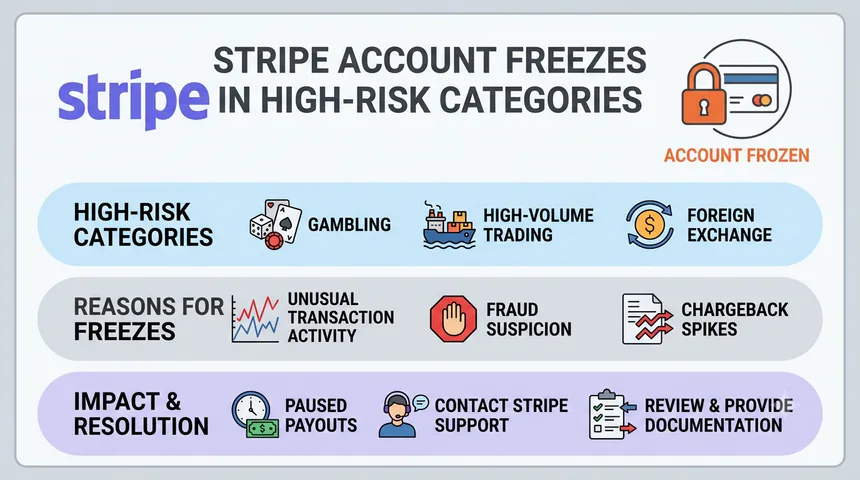

On March 24, a Swedish founder named Melker Wendelbo got an email from Stripe asking for documents. His company, an AI video generation startup called Zorq AI, had grown fast since launching in November. Fast growth, in Stripe’s automated risk models, looks a lot like fraud. According to Hacker News1, four days later, on March 28, Stripe closed the account for good. The reason given was “unacceptable level of risk.” The balance left behind was 803,043 Swedish kronor, roughly $85,000. Stripe told him in writing that if funds remained after refunds went out, they would not be made available to him.No clause was cited. No specific violation was named.
I’ve spent the last few weeks reading through hundreds of pages of Stripe’s own policy documents, court filings, Hacker News threads, and legal guides written for merchants who got caught in this exact machine. What I found is a payments company that has become, almost by accident, one of the most powerful private courts in American commerce. It decides who gets to sell things online. It decides how fast. And when it decides you’re a risk, it can hold your money for months, sometimes years, with a process that looks less like banking and more like a black box with a complaint form taped to the front.
I want to be upfront about my own bias here. I’ve never run a Stripe account. I write about platforms for a living, and after this many hours inside forum threads describing frozen payrolls and canceled vendor payments, I came away thinking the company has built something structurally unaccountable. That’s a conclusion, not a premise. Read the sourcing and see if you land somewhere different.
What “High Risk” Actually Means
Stripe doesn’t publish a single definitive list of who gets flagged and who doesn’t. What it does publish is a document called the Prohibited and Restricted Businesses list2, and it’s worth reading in full if you’ve ever wondered why your perfectly legal supplement company got shut down overnight. The company frames its mission in almost civic terms. It wants to be accessible infrastructure, like roads or telecommunications networks, and it says explicitly that it tries to avoid becoming an arbiter of political legitimacy.
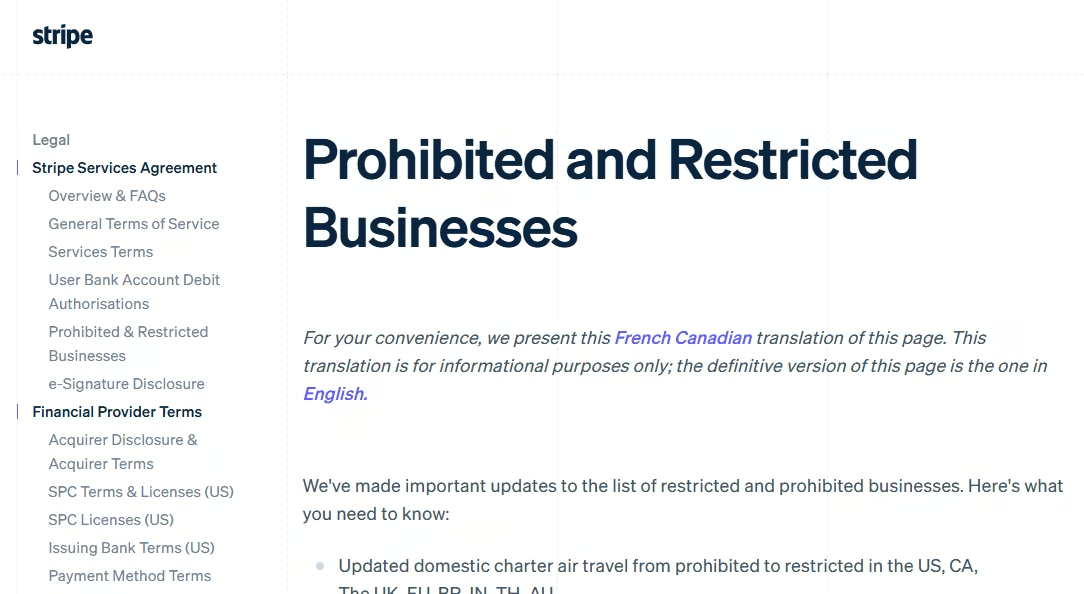
That framing sits oddly next to the actual list. Nutraceuticals and supplements are effectively banned, because Stripe’s policy targets “pseudo-pharmaceuticals or nutraceuticals that are not safe or make harmful claims,” a category broad enough to sweep in FDA-compliant companies that never made an unsafe claim in their lives. Commercial airlines, cruise lines, and timeshares are out. Debt collection, credit repair, and telemarketing are out. CBD is restricted to a narrow set of countries and license holders. Adult content, gambling, firearms, and most cryptocurrency activity are gone entirely, alongside stranger inclusions like bail bonds and pay-in auctions.
Stripe prohibits many legal U.S. industries, not just illegal activity. That’s the sentence that should stop you. This isn’t a list of crimes. It’s a list of categories Stripe’s underwriters have decided carry too much dispute exposure or reputational drag relative to the fees they’d collect. Stripe3 is extremely sensitive to industries, behaviors, and risk signals that could lead to financial losses, and when your business lands in one of those categories, the platform can add reserves, delay payouts, or shut you down without much warning.
Even legal categories that Stripe does support get a second tier of suspicion. One merchant guide at Chargeback4 noted that a stunning share of ordinary e-commerce falls under this umbrella: ninety percent of e-commerce businesses are considered high-risk by Stripe’s internal standards. Coaching, courses, paid Discord communities, financial education, and anything resembling “make money online” content get lumped into elevated risk categories, alongside more obvious flags like sudden volume spikes or high dispute rates.
The Reserve, and the Catch-22 Inside It
Here’s the mechanism that does the actual damage. When Stripe decides your account carries risk, it doesn’t usually just close you down. First it takes a bite. This is called a reserve, and Stripe’s5 own support documentation describes it as a temporary hold on a portion of a business’s funds, used to cover potential losses from disputes.
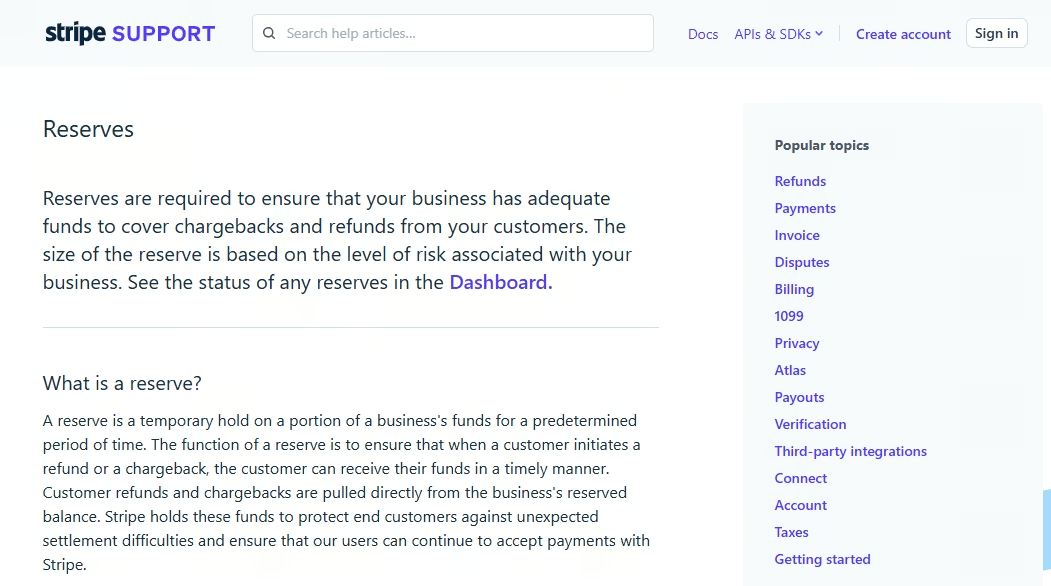
In practice, that hold can run from five to ten percent of transaction volume for thirty to one hundred eighty days, though other accounts describe rolling reserves stretching much further. Indie Hackers6 noted that in certain cases Stripe may hold funds for up to two years if it believes there is significant risk of future disputes.
Reserves come in two flavors. A rolling reserve continuously releases old funds as it grabs new ones, so a business can watch a percentage of every single sale disappear into a sliding window that never quite closes. A flat reserve is a lump sum held indefinitely against a specific balance. Either way, the money isn’t gone. It’s suspended in a kind of financial purgatory, and the release date is frequently vague, subject to revision, or tied to conditions Stripe never fully explains.
This is where the catch-22 shows up, and it shows up constantly in merchant accounts of what actually happened to them. A legal guide at Terms Law7 aggregating dozens of these cases described one recurring pattern almost verbatim across different businesses. Stripe froze funds citing a rising dispute rate, but the disputes only arose because the frozen funds prevented order fulfillment. Read that twice. The freeze causes the very outcome the freeze was supposedly protecting against. A merchant can’t ship the product because the money to buy inventory is locked up. Customers, understandably, start disputing charges for orders that never arrive. Stripe then points to the rising dispute rate as justification for the freeze it just caused.
There are also cases with zero disputes at all, where an account was closed anyway, and the merchant was told to wait 120 days, only to keep getting “new reasons to wait indefinitely once that window passed. Another case involved $16,448 held since June, with a release date that slid from October to January and then stopped being mentioned altogether.
Stripe’s own support forum is a strange place. Employees show up there, occasionally, mostly to redirect people elsewhere. One merchant guide advising founders on how to talk to Stripe support noted this dynamic directly, observing that Stripe’s staff appear on the r/Stripe subreddit8, though they mostly guide people toward other contact channels. The real conversations happen on Hacker News, where founders with nothing left to lose post the whole story, invoice numbers and all.
One post that made the front page in late 2025 came from a founder running an EU-based Stripe Connect platform. A customer had been silently deactivated with the reason listed as simply”Other.” He described the aftermath in blunt terms: he contacted Stripe by chat, learned nothing, and watched days pass while his own customer’s business bled out.
Another founder, this one running the AI video platform I opened with, posted the full breakdown of his $85,000 hold to Hacker News9 and asked the crowd a direct question: had anyone successfully challenged Stripe’s fund withholding under EU payment regulations? The replies are their own kind of document. One commenter’s advice was blunt.
“You have to sue them. If you don’t sue them, they’ll keep doing it.”
Another founder chimed in with an origin story that’s become a genre of its own on that site, describing how a friend’s legitimate business in China got shut down and simply moved to a competitor called Creem, and closing with a line that’s hard to shake:
“Stripe cares about big business. Startups can’t really be moving the needle much for them anymore.”
A separate thread from a small gym software company described two local gyms, both with eleven months of clean account history, suspended overnight with payouts blocked over what the founder called a flawed new fraud detection rollout. The pattern across threads, across years, across totally unrelated industries, is remarkably consistent. Something changes, an algorithm fires, a human never quite gets involved, and the merchant is left performing customer service archaeology, trying to reconstruct what exactly tripped the wire.
When the Freeze is Political, Not Financial
Not every freeze is about chargebacks. In 2018, Stripe cut off the far-right social network Gab.com, and the Hacker News discussion around that decision still reads like a preview of arguments that would define the next several years of platform politics. One early comment asked the question that has never really been resolved: why are we letting payment processors control what kind of content people are allowed to, when tech platforms face constant scrutiny over the same kind of moderation power.
That tension came back around in a bigger way this year. In 2026, the Federal Trade Commission sent letters to the CEOs of Visa, Mastercard, PayPal, and Stripe. FTC10 Chair Andrew Ferguson demanded the companies stop denying services to customers on political or religious grounds, warning that any move to “deplatform customers or deny them access to financial products or services” could trigger an FTC investigation under the agency’s unfair and deceptive practices authority. The letter specifically called out the risk of payments providers who turn a blind eye when financial institutions debank consumers for those reasons. No specific incident was cited against any of the four companies, but the letters landed at a moment when debanking had become a live political issue on both sides of the aisle, with the Trump Organization pursuing similar allegations against Capital One in a separate case.
That same regulatory scrutiny has started showing up in a more concrete place: Stripe’s attempt to become an actual bank. Late in 2025, Stripe applied for a national trust bank charter from the Office of the Comptroller of the Currency, and four separate organizations filed formal opposition. The National Community Reinvestment Coalition argued the charter would hand Stripe “legitimacy it does not deserve” given the company’s history of legal trouble. The Independent Community Bankers of America went further, calling the application “dangerous regulatory arbitrage.” The Bank Policy Institute warned that approval could significantly increase risks to the U.S. financial system. Whatever you think of those groups’ own incentives (traditional banks have obvious reasons to want a slower-moving competitor), the fact that Stripe’s merchant track record became a load-bearing argument in a federal banking application tells you something about how far this pattern has traveled.
The Flipcause Case
The clearest window into how Stripe actually behaves under pressure comes from a bankruptcy filing, not a subreddit. Flipcause, a donation platform that had processed nonprofit payments through Stripe for twelve years, got a warning letter from Mastercard in October 2025 after a New York charity complained it wasn’t receiving its donations on time. Stripe opened an investigation. According to Oakland Voices11, on December 3, Stripe told Flipcause it had received “additional notifications from our financial partners concerning serious matters related to your account.”
Three days later, Stripe cut off new transaction processing with what Flipcause’s own dashboard message described as minimal notice. Stripe also froze the reserve, citing the elevated risk level associated with the business, and said it would keep monitoring processing behavior before deciding when, or if, to release the money. Flipcause filed for bankruptcy. Its attorney asked the court to compel Stripe to release just $50,000 so the company could operate for three more weeks. The judge declined to even hear the motion, citing lack of notice, and told Flipcause to go find unsecured debt instead. In its own 13-page objection, Stripe argued it had terminated the contract before the bankruptcy filing, meaning the funds couldn’t legally be pulled back into the estate, and separately claimed it faced up to $6 million in potential chargebacks and fines from the relationship, an amount that dwarfed the roughly $790,000 to $1.45 million still sitting in reserve.
Whether Stripe’s numbers hold up under scrutiny is genuinely unclear from the public record. What’s clear is the imbalance of the fight. A twelve-year merchant relationship, a functioning nonprofit payment platform, several charities relying on it, and a company that could unilaterally decide the relationship was over, then successfully argue in federal bankruptcy court that its own contractual termination shielded the money from the very organizations that had earned it.
Trying to Get the Money Back
If you get frozen, your options are narrower than you’d hope. Stripe’s Services Agreement12 requires arbitration through the American Arbitration Association for most disputes, and one legal guide for merchants pursuing recovery noted the filing math involved an initial fee of $1,450 for monetary claims under $75,000, with an additional final fee if a hearing gets scheduled. Class actions are typically waived in the contract language, meaning each merchant is fighting alone, and Stripe’s terms generally impose a one-year contractual limitation period on bringing a claim at all, a window that can override longer statutes that would otherwise apply.
One recurring theme across the legal guides I read was how much leverage comes simply from public visibility. A guide cataloging real merchant cases described one $400,000-plus hold that was only resolved after Hacker News front-page exposure. That’s not how a functioning dispute process is supposed to work. It’s how a PR crisis response team works. The founders who get their money back quickly tend to be the ones who can generate enough public attention that the freeze becomes a reputational cost rather than just a risk-management line item.
For those without a viral post to fall back on, the guidance is grimly procedural. Take screenshots of the freeze notification immediately. Export ninety days of transaction and dispute history before anything else. Keep every communication. Submit a formal demand letter citing the implied covenant of good faith, since California’s implied covenant doctrine limits Stripe’s contractual right to hold funds “as reasonably necessary,” with holds beyond 120 days lacking documented risk justification becoming vulnerable to challenge. None of this is fast. None of it is guaranteed.
I don’t think Stripe is acting in bad faith, exactly, and I want to be careful not to flatten this into a simple villain story. The company processes an enormous volume of legitimate commerce, and the chargeback and fraud problem it’s trying to solve is real. Massachusetts13 fined Stripe $120,000 in 2020 for inadequate risk monitoring after it processed payments for a fraudulent cryptocurrency scheme called PlexCoin, and the state’s attorney general alleged Stripe knew or should have known of the fraud in time to prevent harm to consumers but failed to catch it. So the incentive to over-flag isn’t paranoid. It’s a company that got burned for under-flagging and has swung hard in the other direction, using automated systems that are cheaper to run than human judgment at scale.
But that’s exactly the problem. The system optimizes for Stripe’s own risk exposure, not for the merchant’s survival, and it has almost no meaningful mechanism for a merchant to be heard before the decision lands. A frozen founder isn’t dealing with a loan officer who can be reasoned with. They’re dealing with a model that flagged an anomaly, and a support team that, by multiple accounts, functions mostly as a message-forwarding service between the merchant and a black box.
What strikes me most, after reading this much of it, is how similar the stories sound no matter the industry. A gym in a small town. An AI video startup in Sweden. A twelve-year-old donation platform serving actual charities. A social network nobody here needs to defend to feel the discomfort of the precedent. Different businesses, different politics, same mechanism. Money goes in, a model gets nervous, and the person on the other end of that decision finds out they have almost no standing to argue back in real time.
I don’t have a tidy resolution to offer. The regulatory pressure is building, slowly, in FTC letters and OCC charter objections and state settlements that trickle out years after the fact. Whether any of that translates into a merchant actually getting a phone call before their payroll disappears, I genuinely don’t know. Neither, it seems, does anyone else who’s been through it.
Sources
- “Stripe withheld $85k from our EU platform” Hacker News, news.ycombinator.com/item?id=47565502. Accessed 7 July 2026. ↩︎
- “Prohibited and Restricted Businesses” Stripe, stripe.com/en-ca/legal/restricted-businesses. Accessed 7 July 2026. ↩︎
- “Stripe: The state of online fraud” stripe.com/guides/state-of-online-fraud. Accessed 8 July 2026. ↩︎
- Sterling, Theodore. “How to Avoid Issues as a Stripe High-Risk Business” www.chargeback.io/blog/stripe-high-risk-business-what-it-means. Accessed 8 July 2026. ↩︎
- “Reserves – Frequently Asked Questions” Frequently Asked Questions : Stripe: Help & Suppor, support.stripe.com/questions/reserves-frequently-asked-questions. Accessed 8 July 2026. ↩︎
- “Stripe’s 210 Day Hold Practices (yes you read that right)” Indie Hackers, 24 Dec. 2019, www.indiehackers.com/post/stripes-210-day-hold-practices-yes-you-read-that-right-a77dba9917. Accessed 8 July 2026. ↩︎
- Tokmakov, Sergei. “Stripe Froze Your Money? Here’s How to Get It Back” ToS Watchdog, 3 Mar. 2025, terms.law/2025/03/03/when-stripe-holds-your-money-the-definitive-legal-guide-to-getting-your-funds-released/. Accessed 8 July 2026. ↩︎
- Reddit, www.reddit.com/r/stripe/. Accessed 4 Sept. 2026. ↩︎
- “Stripe withheld $85k from our EU platform” news.ycombinator.com/item?id=47565502. Accessed 4 Sept. 2026. ↩︎
- FTC, www.ftc.gov/news-events/news/press-releases/2026/03/ftc-chairman-andrew-n-ferguson-issues-warning-letters-ceos-paypal-stripe-visa-mastercard-about-debanking-american-consumers. Accessed 4 Sept. 2026. ↩︎
- Shabazz, Rasheed. “Why Stripe stopped processing payments for Flipcause” 10 Jan. 2026, oaklandvoices.us/2026/01/10/stripe-terminated-services-flipcause-bankruptcy-filings-reveal/. Accessed 5 Sept. 2026. ↩︎
- “Arbitration Agreement Terms” stripe.com/in/legal/consumer/arbitration. Accessed 5 Sept. 2026. ↩︎
- “Payment Processor to Pay $120,000 in Connection with Cryptocurrency Scheme” Mass.gov, 18 Sept. 2020, www.mass.gov/news/payment-processor-to-pay-120000-in-connection-with-cryptocurrency-scheme. Accessed 5 Sept. 2026. ↩︎