



I first encountered the phrase arbitration gap in a developer forum discussion about App Store rejections. It was not a formal legal concept, but rather a shorthand used by developers to describe a perceived disconnect between the existence of an appeal process and the likelihood of a different outcome.
On paper, Apple Inc. provides a structured review and appeal framework. The company publishes its App Store Review Guidelines and developers may respond to rejection notices through the Resolution Center and, if disagreement persists, escalate the matter to the App Review Board. Apple states that appeals are reviewed independently.
The structure reflects a formal chain of review. A submission is evaluated against published standards. If a violation is identified, the developer receives a written explanation citing the relevant guideline. The developer can reply with clarifications, technical documentation, or revised builds. If the issue remains unresolved, an appeal may be submitted for further consideration at a higher level.
From a governance perspective, this resembles a layered adjudication process. There is notice, an opportunity to respond, and a defined path for escalation. Apple also emphasizes consistency and user protection as central goals of its review system, framing the process as a balance between platform integrity and developer opportunity.
In design, the framework appears orderly and complete. The debate arises not over whether the process exists, but over how it functions in practice and how visible its outcomes are to the broader developer community.
However, discussions across forums and developer communities frequently reflect a shared perception that while the appeal mechanism is formally available, reversals are uncommon.
The Official Process Versus the Lived Experience
Apple’s review framework is clearly documented. An app is submitted. A reviewer evaluates it against published guidelines. If it fails to meet a standard, the developer receives a notice citing the relevant rule. The developer can reply with clarifications, context, and supporting material. If disagreement persists, the matter may be escalated to the App Review Board1.

From a governance standpoint, this structure resembles internal arbitration. There is notice. There is an opportunity to respond. There is escalation to a higher level of review.
On paper, this appears procedurally sound.
The friction emerges in what many independent developers describe as an arbitration gap. Not the absence of a formal channel, but the distance between the existence of that channel and visible evidence that it changes outcomes in a meaningful way.
Apple does not publish aggregate appeal statistics. There is no anonymized archive of App Review Board decisions. There are no public summaries explaining how particular guideline disputes were interpreted or resolved over time. In judicial systems, precedent shapes expectations. Even private arbitration institutions such as the American Arbitration Association publish caseload data and annual reports to anchor credibility. Transparency does not eliminate disagreement, but it clarifies patterns.
By contrast, the App Store appeal process functions largely out of public view. Developers are left to estimate probabilities based on personal experience and scattered community reports. The result is not necessarily unfairness, but opacity. And opacity creates room for inference.
In forums such as Reddit, particularly the r/iOSProgramming2 community, rejection stories appear regularly. Across dozens of threads, the tone is often measured rather than dramatic. Developers describe submitting additional screenshots, logs, and compliance explanations. Several report receiving responses they perceive as templated or repetitive.
Comments frequently echo a similar concern: that escalation feels procedural rather than substantive. Some speculate that appeals may be reviewed within the same structural hierarchy that issued the original decision. Others express uncertainty about how often reversals occur, or under what conditions they are most likely.
On Hacker News3, discussions around broad guidelines such as 4.3 on spam and duplicate apps often shift from technical compliance to interpretive ambiguity. Contributors note that flexible standards allow discretion. They also question how that discretion is calibrated on appeal. The recurring theme is not that rules exist, but that their application can feel unpredictable.
Threads on Stack Overflow4 and the Apple Developer Forums tend to focus less on fairness and more on tactics. Keep responses concise. Provide screen recordings. Avoid argumentative language. Frame clarifications around user benefit. What is rarely expressed is confidence in statistical odds of reversal. The strategy is pragmatic rather than optimistic.
There is no public evidence that Apple penalizes developers for appealing. The concern may be speculative. Its behavioral effect, however, is tangible. When platform dependence intersects with limited transparency, caution becomes rational.
This is the core of what many describe as the arbitration gap. The process exists. The steps are documented. Yet without published data, precedent, or visible decision logic, developers struggle to assess how the system behaves in aggregate. The gap is not procedural. It is informational.
Economic Finality in a Billion Device Ecosystem and The Shadow of High Profile Disputes
The App Store is not a niche marketplace. It is one of the largest digital distribution platforms in the world. In a 2021 newsroom release, Apple Inc.5 reported that the App Store ecosystem facilitated an estimated 643 billion dollars in billings and sales in 2020, based on an independent study conducted by Analysis Group. Apple later reported that developers generated approximately 1.1 trillion dollars in total billings and sales in 2022.

These figures refer to the broader ecosystem, including physical goods and services, digital goods and services, and in app advertising. In both reports, Apple emphasized that the vast majority of those billings flowed directly to developers and businesses, with Apple collecting commission only on digital goods and services sold through the App Store.The company has also reported more than a billion active iPhone devices globally. For an independent developer, access to that installed base is not incremental growth. It can determine whether a product survives.
Within that context, the arbitration gap takes on economic weight.
A rejection is rarely just a procedural setback. It can freeze a pending update. It can interrupt subscription momentum. It can delay features tied to a marketing launch or partnership announcement. In crowded categories such as productivity, fitness, or finance, timing often shapes ranking visibility and user retention. A delay of weeks can translate into lost positioning that is difficult to regain.
One founder of a niche productivity app described spending months building a system level integration. The app had passed review multiple times before. The update was rejected on the grounds that it duplicated core functionality. He submitted a detailed appeal explaining technical distinctions and user benefits. The response, he said, reiterated guideline language without directly engaging his argument.
“We could not wait indefinitely,” he explained. “We stripped the feature and moved on.”
Formally, the appeal channel existed. Practically, the business calculus overrode it.
This is what many developers describe as economic finality. Even if reversal is theoretically possible, the opportunity cost of waiting can make extended dispute irrational. Payroll continues. Marketing timelines advance. Competitors ship. In that environment, escalation becomes a luxury rather than a remedy.
Perceptions of the appeal system do not form in isolation. They are shaped by visible conflicts at the platform level.
In 2020 BBC6 reported that Epic Games deliberately bypassed App Store payment rules in its game Fortnite, prompting its removal from the store and a high profile legal battle with Apple Inc.. The case moved through federal court and drew global attention to questions of platform control, payment policies, and antitrust law.
Although the dispute centered on payments rather than routine app review decisions, it underscored a structural reality. Distribution on iOS devices ultimately rests within Apple’s discretion. If a multibillion dollar publisher must litigate publicly to challenge a policy, smaller developers may infer that internal appeal channels offer limited leverage.
Advocacy groups such as the Coalition for App Fairness argue that platform governance lacks sufficient external checks and balances. While the coalition includes large companies, its language about transparency and accountability resonates with independent developers who feel structurally dependent on a single gatekeeper.
None of this proves that the App Review Board is ineffective. It does, however, shape expectations. In a billion device ecosystem generating tens of billions in commerce, procedural access alone does not determine confidence. Visibility, predictability, and economic feasibility matter just as much.
This is where the arbitration gap widens. The formal mechanism exists. The economic realities surrounding it can render that mechanism functionally constrained.
Subjectivity in Guideline Enforcement
The App Store Review Guidelines7 are extensive and frequently updated. Yet several core provisions rely on interpretation rather than bright line rules. Standards addressing spam, duplication, and minimum functionality are intentionally broad. That flexibility allows Apple Inc. to respond to evolving tactics, automation tools, and shifting user expectations. It also creates room for disagreement.

Developers frequently point to guideline 4.3 on spam and guideline 4.2 on minimum functionality as recurring flashpoints. Agencies that build white label or semi customized apps for multiple clients argue that each deployment serves a distinct audience with tailored branding and content. Reviewers may view similar code bases or interface structures as template replication.
In discussions on Hacker News8, one commenter posed a question that captures the ambiguity: every calculator looks like a calculator, so where is the line between similarity and spam? Beneath the rhetorical tone sits a structural issue. When precedent is unpublished, how is consistency evaluated across cases that appear similar but are not identical?
In court systems, precedent narrows subjectivity by making prior reasoning visible. Parties can assess how similar disputes were interpreted. In the App Store context, precedent exists internally but is largely invisible externally. Developers cannot easily determine whether a prior approval signals tolerance for a design pattern or whether it was an exception tied to facts they cannot see.
The result feeds into the arbitration gap. The process offers escalation, yet the interpretive framework guiding outcomes is opaque. That opacity amplifies the perception that enforcement may vary depending on reviewer judgment, internal policy shifts, or category level priorities.
Transparency in governance is not simply an ethical aspiration. It functions as a risk management tool. Clear data and published reasoning reduce uncertainty, which in turn shapes business planning.
In a Yale Law Journal Forum9 article examining antitrust and digital platform governance, scholars analyzed information asymmetry when a single entity controls rulemaking, enforcement, and adjudication. Their argument was not that centralized control is inherently illegitimate. Rather, when discretion is concentrated, procedural clarity becomes central to institutional credibility.
Most developers do not argue that every rejection is unjustified. Many acknowledge that low effort clones, misleading interfaces, or policy violations should be filtered out. What they seek is visibility into how disputes are evaluated and how frequently initial decisions are reconsidered.
One developer summarized the sentiment pragmatically:
If reversals are rare, publish the number. At least we know where we stand.
In the absence of official statistics, speculation fills the void. Some community members estimate reversal rates below five percent. Others describe occasional successes after multiple iterations. Without aggregate data from Apple Inc., the narrative remains anecdotal, shaped by the most recent forum thread rather than by verifiable patterns.
This informational vacuum deepens the arbitration gap. It is not solely about whether appeals succeed. It is about whether participants can assess the system’s behavior with enough clarity to plan rationally. When enforcement is interpretive and precedent is unpublished, trust depends less on formal structure and more on perceived consistency.
The Role of Public Pressure
According to The Verge10, in 2020, the email service Hey became a flashpoint in debates about App Store governance. After its update was initially rejected over in app purchase rules, the dispute escalated publicly. Coverage in major outlets amplified the conflict. Within days, Apple Inc. and the app’s creators reached a resolution that allowed changes to move forward.
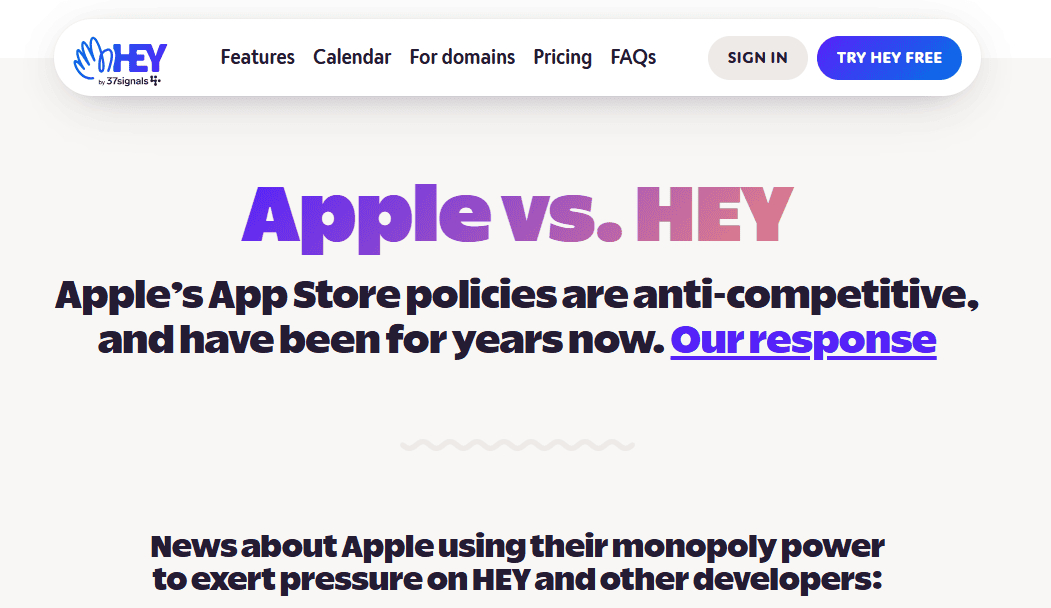
To outside observers, the sequence appeared instructive. Formal review had stalled. Public scrutiny followed. A compromise emerged.
Developers took note.
The conclusion many drew was not that Apple reverses decisions only under pressure, but that visibility can alter the dynamics of review. Media attention introduces reputational considerations that are absent from routine dashboard appeals. When a case becomes symbolic, it transcends guideline interpretation and enters a broader policy conversation.
The difficulty is scale. Most independent applications do not command national headlines. Their disputes remain confined to App Store Connect messages and private correspondence. There are no reporters covering a rejected meditation timer update or a niche budgeting feature flagged under guideline 4.3.
This perceived disparity reinforces the arbitration gap. The formal right to appeal exists for all developers. The practical leverage surrounding that appeal differs dramatically depending on audience size, brand recognition, and access to media amplification. Structural equality does not necessarily produce experiential equality.
Beyond media scrutiny, regulatory institutions are increasingly examining the governance of large digital platforms. In the European Union, the Digital Markets Act establishes obligations for designated gatekeepers, including requirements around interoperability, data access, and restrictions on certain self preferential practices.
While the Act primarily targets competition dynamics, its broader intent is to reduce asymmetry between dominant platforms and dependent businesses. Greater oversight can indirectly influence internal processes, including transparency around rule enforcement and dispute resolution.
For Apple Inc., compliance with evolving global frameworks may encourage additional procedural clarity over time. Regulatory pressure, market competition, and public debate all shape platform governance. None of these forces guarantee transformation, but they create incentives for refinement.
For now, many developers describe the system as stable yet opaque. Reviews follow documented guidelines. Appeals are available. Outcomes, however, remain largely invisible in aggregate. Until data, precedent, or structured reporting becomes more accessible, the arbitration gap will continue to be defined less by the absence of process and more by the limits of visibility surrounding it.
The Psychological Dimension
Beyond economics lies morale.
Independent developers often work alone or in very small teams. Many build at night after their primary jobs. They invest personal savings into design, infrastructure, and marketing. When a rejection email arrives, it is typically concise and courteous. It cites a guideline. It invites clarification. It closes professionally.
Its tone may be calm. Its effect often is not.
One developer described it as “a calm paragraph that ruins your week.” Another reflected,
“After two rejections, you start designing to avoid attention.”
Those statements capture something procedural language does not. The arbitration gap is not experienced only as a structural issue. It is felt as uncertainty.
When developers cannot see aggregate appeal outcomes or published precedent, each decision appears isolated and final. Over time, that uncertainty reshapes behavior. Rather than asking what users might value most, some begin by asking what is least likely to trigger scrutiny.
Risk avoidance becomes strategic. Features that overlap even loosely with native iOS functionality are reconsidered. Integrations that might be interpreted as duplicative are scaled back. Experimental interfaces are simplified. The internal question shifts from can we build this to will this survive review.
This does not require explicit prohibition. It emerges from inference.
The chilling effect is subtle. It does not appear in rejection statistics or public disputes. It surfaces in roadmaps quietly trimmed and ideas never submitted. Developers internalize perceived platform boundaries, even when those boundaries are not clearly articulated.
In that sense, the psychological dimension deepens the arbitration gap. The formal appeal channel may remain available. But when outcomes feel unpredictable and visibility is limited, morale adjusts first. Innovation narrows not because it is directly banned, but because it is preemptively constrained.
Toward a More Credible Appeal System
Most developers are not asking for automatic approval. They understand that a curated marketplace requires rules and enforcement. What many want instead is a clearer sense of how the appeal system works in practice and how often it truly changes outcomes.
Several practical reforms are frequently suggested in developer communities.
At present, there is no public data showing how many appeals are filed each year, how many decisions are reversed, or how long the process typically takes. By contrast, organizations such as the American Arbitration Association release annual caseload reports that outline volumes and outcomes. Those reports do not expose private details, but they give participants a baseline expectation. Similar reporting from Apple Inc. would not remove discretion, but it would reduce guesswork.
In court systems, published opinions help the public understand how rules are interpreted. Even when names and sensitive facts are removed, the reasoning remains visible. Developers often say that anonymized summaries of App Review Board decisions would help them understand how guidelines are applied in complex or borderline cases.
Many conflicts cluster around a handful of guidelines, especially those concerning spam, duplication, and minimum functionality. Clearer examples of what qualifies as acceptable variation versus prohibited replication could prevent repeated misunderstandings. Developers are generally willing to adapt. What they struggle with is ambiguity.
Written exchanges can be efficient, but they can also miss nuance. For technical disagreements, a short live conversation could ensure both sides understand the facts before a final decision is made. This would not guarantee approval, but it could reduce misinterpretation.
None of these changes would eliminate subjectivity. Judgment is part of any review system. What they would do is increase predictability.
Transparency does not weaken authority. In many institutions, it strengthens it. When people can see how decisions are made, even unfavorable outcomes feel more legitimate.
The scale of the App Store ecosystem underscores why this matters. According to Apple’s newsroom11 reporting, developers generated about 1.1 trillion dollars in total billings and sales in 2022, and more than 90 percent of that flowed directly to developers. Tech Crunch12 showed that small developers earning under 1 million dollars annually saw revenue growth of 71 percent between 2020 and 2022. Those numbers reflect real opportunity, but they also reflect deep dependence on continued access.
The arbitration gap is not about dramatic injustice. It is about probability and perception. When developers believe appeals rarely lead to reversal and reasoning remains opaque, they treat rejections as effectively final.
That belief shapes roadmaps. It influences hiring decisions and marketing budgets. It can determine whether a founder invests months building a bold feature or chooses a safer path instead.
An appeal channel clearly exists. The question many indie developers quietly ask is whether it functions as a genuine second look or simply confirms the original decision in most cases.
Until greater visibility is provided into how appeals work in practice, that question will continue to surface in developer forums, private Slack groups, and careful decisions to diversify onto other platforms.
Sources
- “App Review” Apple Developer, developer.apple.com/distribute/app-review/. Accessed 27 Feb. 2026. ↩︎
- Reddit, www.reddit.com/r/iOSProgramming/. Accessed 27 Feb. 2026. ↩︎
- “The App Review Guidelines at 4.3) Spam states: the App Store has enough … dati…” Hacker News, news.ycombinator.com/item?id=33167103. Accessed 27 Feb. 2026. ↩︎
- “Stack Overflow” Stack Overflow, stackoverflow.com/. Accessed 27 Feb. 2026. ↩︎
- “App Store developers generated $1.1 trillion in total billings and sales in the App Store ecosystem in 2022” Apple (IN), 28 Aug. 2023, www.apple.com/newsroom/2023/05/developers-generated-one-point-one-trillion-in-the-app-store-ecosystem-in-2022/. Accessed 27 Feb. 2026. ↩︎
- News, BBC. “Fortnite: Epic Games sues Google and Apple over app store bans” 14 Aug. 2020, www.bbc.com/news/technology-53777379. Accessed 27 Feb. 2026. ↩︎
- “Guidelines” Apple Developer, developer.apple.com/app-store/guidelines/. Accessed 27 Feb. 2026. ↩︎
- “What I’ve seen, the difference between spam detected or not is *https://www* bef…” Hacker News, news.ycombinator.com/item?id=47158063. Accessed 27 Feb. 2026. ↩︎
- Hovenkamp, Herbert. “Antitrust and Platform Monopoly” Yale Law Journal, 29 June 2021, yalelawjournal.org/article/antitrust-and-platform-monopoly. Accessed 27 Feb. 2026. ↩︎
- 25 June 2020, www.theverge.com/2020/6/25/21302931/hey-email-service-public-launch-apple-approves-app-fight-policy-price. Accessed 27 Feb. 2026. ↩︎
- “App Store developers generated $1.1 trillion in total billings and sales in the App Store ecosystem in 2022” Apple (GW), 25 Feb. 2026, www.apple.com/gw/newsroom/2023/05/one-point-one-trillion-generated-in-app-store-ecosystem-in-2022/. Accessed 27 Feb. 2026. ↩︎
- Mehta, Ivan. “Study says App Store revenue of small developers grew by 71% in last two years” TechCrunch, 11 May 2023, techcrunch.com/2023/05/11/study-says-app-store-revenue-of-small-developers-grew-by-71-in-last-two-years/. Accessed 27 Feb. 2026. ↩︎


