
For many inside and outside Amazon, the company’s late-2025 announcement that it would cut roughly 14,000 corporate jobs, which, according to AP News, is about 4 % of its white-collar workforce. So it came as quite a jolt. Leadership framed the reduction as part of a wider “leaner, faster” strategy tied to artificial intelligence adoption and efficiency gains. But for employees on the ground, the change felt abrupt, and the consequences are still rippling through support teams, quality assurance (QA) squads, and operations groups that once formed the backbone of Amazon’s day-to-day enterprise.
Amazon, one of the world’s largest private employers with around 1.56 million global workers and roughly 350 000 in corporate roles, has increasingly leaned on AI and automation to streamline work. CEO Andy Jassy’s internal messaging throughout 2025 made clear that generative AI and AI agents would reshape job responsibilities and, over time, reduce certain roles entirely.
Who Drove Amazon’s AI Efficiency Shift?
Amazon’s workforce reshaping did not emerge from a single product launch or sudden technological breakthrough. It was the result of a coordinated leadership strategy led from the top, shaped by executive priorities, investor expectations, and internal pressure to move faster with artificial intelligence.
According to The Washington Post, at the center of the shift is CEO Andy Jassy, who has repeatedly described AI as the most transformative force Amazon has encountered since the internet. Throughout 2024 and 2025, internal communications increasingly emphasized “doing more with fewer people,” reducing layers of management, and accelerating automation across teams that were once considered operational necessities rather than innovation engines.
Senior leadership across AWS, Retail, and Ads divisions played a key role in translating that vision into execution. Directors and VPs were tasked with identifying “efficiency opportunities,” a phrase employees say often became shorthand for headcount reduction, consolidation of teams, and replacement of human review processes with AI-driven systems. Support, QA, and operations functions were especially vulnerable because their work could be framed as repetitive, scalable, and measurable, the exact traits AI systems are marketed as excelling at.
Finance and strategy teams were also deeply involved. Multiple employees have described internal targets tied to cost-per-output metrics, productivity ratios, and automation coverage goals. In this environment, AI was not just a tool but a justification, a way to make reductions appear forward-looking rather than purely cost-cutting.
What made the transition especially jarring for many workers is that it happened quietly.
There was no single announcement that support or QA roles were being phased out. Instead, teams were trimmed, responsibilities redistributed, and expectations reset, often within weeks. Managers were instructed to adopt AI tools rapidly, even as their teams were being reduced, creating a sense that people were being asked to help train the systems that would make them redundant.
This was not an accidental drift toward automation. It was a deliberate organizational decision, driven by leadership’s belief that speed, scale, and AI-mediated efficiency mattered more than preserving traditional support and operations structures.

Why Amazon and Others Rely on Cheap Annotation Labor
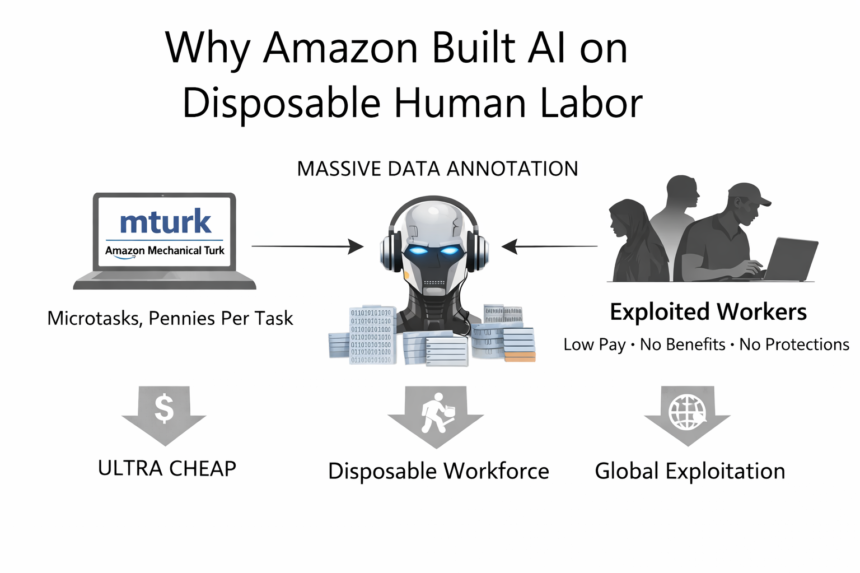
A core reason companies such as Amazon (through services like Amazon Mechanical Turk) and similar platforms exist is cost-efficiency. Machine learning systems require massive volumes of labeled data, yet training AI with human-level accuracy is still cost-intensive if done with salaried staff. Platforms like Mechanical Turk break work down into tiny “Human Intelligence Tasks” (HITs) that can only currently be done by humans and at extremely low cost, even when those tasks are repetitive and complex.
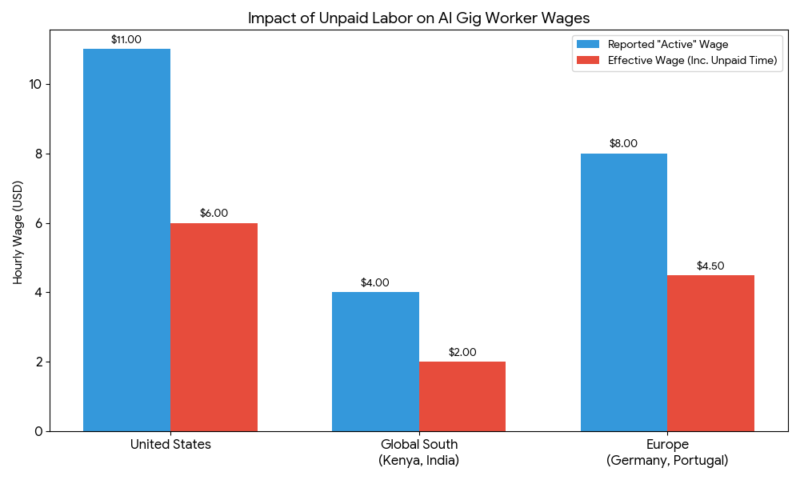
Statistical evidence paints a stark picture of this economy. A 2016 survey by the Pew Research Center on nearly 3,000 workers on Amazon’s Mechanical Turk found that over 50 % reported hourly earnings below $5 per hour, with wages in countries such as Argentina and Kenya falling as low as $1.70 – $2.00 per hour. More recent research on AI gig work across major platforms, including Amazon’s, found that when accounting for unpaid work such as searching for tasks and completing unpaid tests, workers averaged about $2.15 per hour.
Experts describe this model as a form of “artificial artificial intelligence,” where vast numbers of humans collectively feed the data needs of AI systems cheaply so companies can scale their models without the expense of full-time employees. One critic summarized the dynamic bluntly:
“So-called AI systems are fueled by millions of underpaid workers around the world, performing repetitive tasks under precarious labor conditions.”
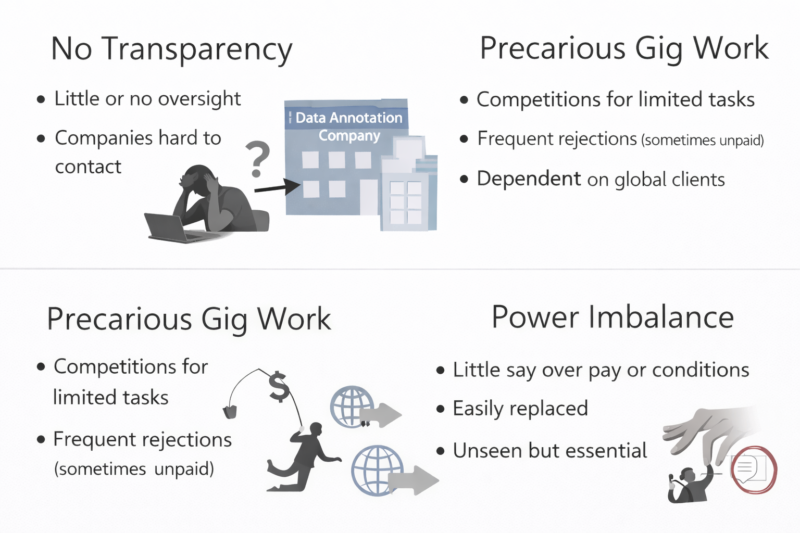
This cost-first approach has cascading effects: rates stagnate even as tasks become more demanding, with around 80 % of annotators reporting no pay increases despite rising task complexity. Meanwhile, the global nature of platforms like MTurk creates a competitive race to the bottom, driving wages down further as workers in high-wage regions compete with those in low-wage ones.
Taken together, these figures and firsthand accounts make clear why Amazon and its peers continue to rely on these models: they are dramatically cheaper and scalable compared with traditional employment structures, even though they leave much of the workforce underpaid and without basic labor protections.
The Numbers Behind the Narrative
The reported 14,000 job cuts aren’t an isolated tech phenomenon; they’re part of a broader wave of layoffs across major technology companies in 2025, tied in part to automation priorities. Industry trackers logged tens of thousands of layoffs over the past year, with many companies, including Microsoft and Meta, also trimming headcounts as they shift toward AI-driven products.
At Amazon, data on who exactly will be let go has been pieced together from internal reports, employee disclosures, and Reddit megathreads. One structured summary of layoff mentions, though not a precise internal source, suggested that roles across Stores / Core Retail / NA Stores, Ads & Marketing, and tech teams saw notable impacts, including engineers, analysts, and support personnel.
Meanwhile, India, which is a critical hub for Amazon’s operations according to The Wire, QA, and customer service support, saw around 1000 local layoffs as reported by Whalesbook. It occurred as part of this global drive, with mid-senior roles in Prime Video, AWS, and retail affected.
Even beyond job numbers, the fuss over AI cuts isn’t just about aggregates. In truth, it’s about the human experiences those figures represent.
One of the more shared posts came from the r/Layoffs subreddit, where an anonymous poster described seeing “an entire team, including their manager, get laid off right in front of her eyes — all within seconds.” The account continued: “They collected company laptops on the spot, and that was it.” The post, which quickly went viral, underscores the suddenness and blunt execution of many cuts.
This perspective that AI deployment is less mature and more about cost savings than genuine replacement was echoed by several others who questioned the sincerity and timing of AI as the stated rationale.
For many, the narrative isn’t about numbers but about loss of community and purpose, roles people trained for and proudly inhabited, suddenly being reclassified as expendable under the banner of efficiency.
There are also proactive sentiments. Some commenters pointed to collective action after the layoffs, with posts about joining responsible AI advocacy letters and encouraging solidarity, both within and outside Amazon.
And while much of the discourse focuses on layoffs, others highlight another dimension of this transformation: changing hiring practices and role expectations. Financial Express documented situations where job candidates faced downgraded offers or reduced paytied indirectly to shifts in role definitions and AI duties, a reminder that workforce reshaping is happening on more fronts than just layoffs.

Long before October 2025’s layoffs announcement, employees were discussing the company’s AI blitz on Reddit. A June megathread captured numerous employees debating CEO Andy Jassy’s comments about expected workforce reductions due to generative AI, with some joking about the absurdity of certain AI tools and others expressing very real anxiety about job security and workload increases. Many said AI tools weren’t yet capable of replacing their work, yet were being positioned as the future of operations.
Icy Tales talked to an employee in a senior position in Canada, who wished to remain anonymous. “It’s like AI makes word 20% more efficient because the rest is redundancy. But the management thinks they can make it 2-3x more productive, which just doesn’t cut it. It only adds pressure and we have to code with Claude and just keep checking information and edit on the go. Long term, that’s not a great prospect.”
AI in Action: Reshaping Roles and Daily Workflows
After Amazon announced plans to cut roughly 14,000 corporate jobs as per The Guardian’s report, the company made it clear that part of its long-term strategy involves leaning into AI and automation to increase efficiency and streamline operations. Amazon leadership framed this shift not as a cost-only exercise but as a fundamental change in how work gets done across support, QA, and operations roles. Senior leadership described AI as “the most transformative technology we’ve seen since the Internet,” and tied workforce restructuring to improvements in speed and decision-making.
Internal memos circulated ahead of the cuts advised remaining staff to “lean in on AI” and use automated tools to boost productivity and simplify existing processes, signaling that the company expects AI adoption to shape daily work routines.
But what does this transformation look like inside teams that once relied on human judgment and collaboration? The most vivid answers don’t come from press releases. They come from workers themselves.
Because Amazon employees often cannot share identities publicly, Reddit has become a primary venue for candid accounts of how these AI-linked shifts are reshaping work, in real time.
On r/amazonemployees, one comment with hundreds of upvotes laid bare the emotional and operational impact:
“My org was heavily impacted … a large number of talented, experienced people were let go, supposedly because of AI. … whole programs have effectively shut down overnight.”
This comment was echoed by others who said longtime teams were reduced to skeleton staff, with remaining employees scrambling to “keep the lights on” amid uncertainty and increased pressure.
Another comment offers a more skeptical take on leadership’s AI narrative:
“It seems like everybody is jumping to the conclusion that Amazon replaced 14,000 people with AI … This is not the case. Amazon … is cutting headcount and dumping even more into AI because they’re betting that it will eventually replace those people.”
This thread, one of the most upvoted on r/amazonemployees, highlights a common sentiment among workers that the company’s AI claims are premature or don’t yet reflect reality at the operational level.
Amazon’s customer service workforce also weighed in. On r/AmazonFC, a user reacted to the idea that AI could simply replace human roles:
“So, Amazon’s solution to adopting AI is to fire workers? … AI isn’t gonna run the company on its own, and pissing off your employees is never a good long-term strategy.”
This captures a key tension: while executives talk about AI “supplementing” work, many employees see the technology as a pretext for headcount reductions rather than a fully formed operational replacement.
Even those who didn’t get laid off aren’t as happy. Icy Tales knows of at least one employee who left the company because even though they got the ‘best performance’ recognition for the year, they got a 0% raise – the same as anyone else.
There are also posts tied directly to the process of exiting the company. One Redditor shared that their manager encouraged them to resign ahead of termination, a tactic some employees suspected was meant to reduce severance liability:
“Don’t resign! They’re trying to save money on severance — you won’t get notice pay if you resign.”
— Reddit comments advising a fellow employee amid layoff confusion.
Another subreddit thread called r/AmericanTechWorkers drew attention to a politically charged angle, where users noted that even as Amazon blamed AI for layoffs, the firm was sponsoring tens of thousands of H-1B visas, a fact some saw as contradictory to the narrative that human roles are being removed due to automation.
These comments don’t represent universal sentiment, but they offer a grounded, unfiltered sense of how Amazon’s workforce changes are perceived by those living them.
Amazon’s AI-linked workforce shifts are part of a larger pattern across the tech sector. TechCrunch estimates that over 91,700 tech jobs had been cut across more than 200 companies in 2025 alone, with many layoffs linked, at least rhetorically, to automation strategies.
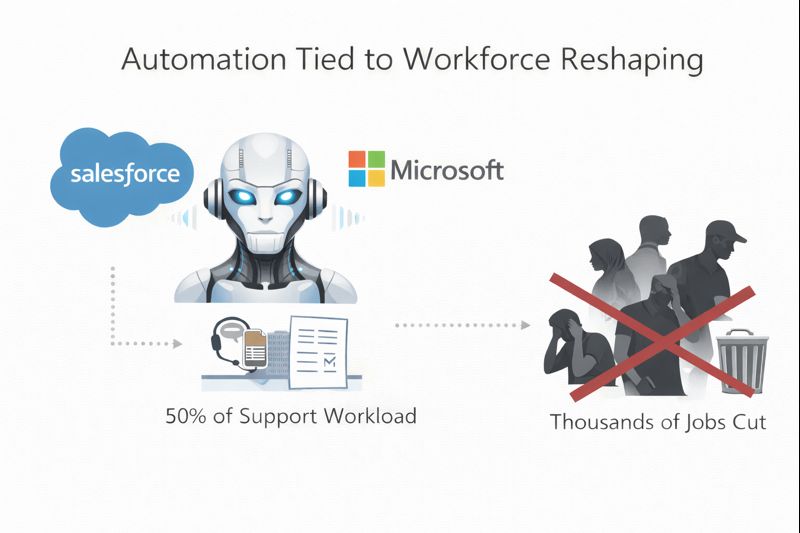
Executives at other firms like Salesforce and Microsoft have explicitly tied automation to workforce reshaping, with Salesforce reporting that AI now handles up to 50% of its customer support workload and prompting thousands of job eliminations.
Not every worker agrees that AI is the immediate cause of job losses. Some Redditors note that current AI tools are useful in limited contexts but far from capable of fully replacing skilled human work:
“I use AI every day … but every time I push it — even a little — it falls apart … it’s far from prime time and certainly not as capable or reliable as … a junior level recent graduate.”
This perspective, that companies may be blaming AI for deeper strategic and financial motives, is echoed by other employees who believe the layoffs are a cost-management play rather than a clear reflection of AI’s current capabilities.
The stories from Reddit are more than just commentary — they’re evidence of lived experience. They show employees grappling with not just job loss, but identity, purpose, and trust within a company they once believed in. One viral post shared by a laid-off recruiter became a flashpoint in this broader debate:
“All that loyalty, all that hard work, and you’re just a line item on a spreadsheet to ‘realize efficiency gains’.”
The emotional tenor of these accounts adds depth to what corporate press releases rarely disclose: the human cost of rapid AI adoption.
While Amazon’s 14,000 corporate layoffs made headlines as one of the most dramatic workforce changes of 2025, they’re part of a broader global trend of job disruption linked to automation and AI adoption. According to The Times of India, more than 100,000 tech sector roles were cut across dozens of companiesthis year, with Amazon, Microsoft, Intel, Meta, Salesforce, and others announcing reductions as they redirect investment toward AI and efficiency initiatives.
Macro-level data also paint a stark picture of AI’s impact on jobs: The World Economic Forum estimates that 92 million roles could be displaced globally by 2030, even as AI creates new opportunities — suggesting that workforce disruption and transformation will continue well beyond the initial layoffs.
Industry analyses show that customer service, administrative support, and QA-related functions face particularly high automation risk, with AI systems capable of handling routine interactions, data entry, and repetitive tasks more efficiently than traditional human workflows.
Quality Assurance and Operations: A Silent Shift in Responsibility
Roles like quality assurance (QA) and operations, long seen as requiring human judgment, critical thinking, and cross-team coordination, are also being reshaped by automation pressures. While not all changes are as visible as layoffs, the structural effects are substantial.
Data from Colaberry shows that some companies have reduced 90% of customer support headcountafter deploying AI tools that instantly resolve common issues and dramatically cut response times. This mirrors trends affecting QA functions where automated testing and AI-driven monitoring tools increasingly handle tasks once done by large teams.
Within Amazon, affected QA teams and operations groups have reported disrupted workflows and shifting expectations, even where no layoffs occurred directly. Workers recount heavier reliance on automated systems for routine activities, sometimes at the expense of deep expertise or team cohesion.
Another thread suggests that even teams not immediately eliminated are struggling with workload and morale:
“The reality is that things are crumbling. We had a major AWS outage last week… Everybody enjoys the brief RSU bump for now… AI is years and years away from being able to replace jobs. It’s only going to become a tool we use to do our jobs more efficiently.”
Such accounts reflect internal tension between Amazon leadership’s optimistic framing of AI as an efficiency multiplier and employees’ lived experiences of disruption and uncertainty.
Employees, especially in technical writing, documentation, and QA, have shared raw accounts of how automation narratives intersect with layoff decisions:
“I am one of the thousands … There are many of us from the Technical Content Experience (TCX) org that are impacted … they will give you AI tools… and still let you go in the end.” — a technical writer affected by Amazon/AWS layoffs.
This juxtaposition, being encouraged to use AI tools while simultaneously losing one’s job, sits at the heart of many worker grievances. It highlights the ambiguity between AI as a productivity aid versus AI as a replacement for human labor.
Industry-wide data support this ambiguity: while AI can boost operational productivity in specific tasks, broader economic research shows that job disruption tends to unfold unevenly across sectors and skill levels, with administrative and support roles disproportionately exposed to automation risk.
Indeed, many analysts now distinguish task automation from full role replacement. Early AI adoption often focuses on automating repetitive or low-complexity tasks, but human oversight remains crucial in areas requiring nuanced judgment, strategic decision-making, and cross-context reasoning.
For workers in support, QA, and operations, the implications are not limited to layoffs alone. They include:
- Shifting job scopes toward AI collaboration rather than standalone tasks.
- Upskilling pressures, as teams are asked to adopt new tools quickly.
- Morale challenges arise as employees grapple with ambiguous futures and evolving expectations.
- Organizational uncertainty, as departments restructure and redistribute work.
AI transformation is not merely technical or financial, but cultural, affecting trust, team identity, and workers’ sense of agency.
Experts outside Amazon echo some employee concerns while also highlighting nuanced economic forces at play. According to Business Insider, the economist Geoffrey Hinton has warned that 2026 could bring another wave of job displacement as AI capabilities expand further, especially in routine or highly structured tasks.
At the same time, prominent economic researchers emphasize that AI’s impact is multifaceted. In some contexts, automation broadens task content and improves worker autonomy and productivity, particularly when AI complements human decision-making rather than replaces it outright.
This debate, often visible in internal corporate discussions and public policy circles alike, centers on whether AI will serve as a partner to human workers or a substitute for them. Amazon’s approach suggests a mix of both: leveraging AI tools to streamline workflows while reducing headcount in roles where human labor is deemed less strategic or cost-efficient.
Where Amazon Goes Next
As Amazon continues its AI-driven restructuring, several trends are likely to shape the experiences of employees and the broader industry:
- Focus on AI-adjacent roles: Amazon will likely expand hiring in data science, machine learning engineering, and AI product strategy even as traditional roles shrink.
- Reskilling and upskilling imperative: Workers in support and QA may find opportunities in retraining programs that emphasize human-AI partnership skills.
- Operational shifts in quality assurance: Automated testing and AI-powered monitoring tools will continue to reshape the nature of QA work, pushing humans into higher-level quality strategy roles.
- Continued cultural tension: As seen on Reddit and internal channels, the narrative around AI will remain contested — with employees pushing back against simplified explanations that ignore the human cost.
In the end, Amazon’s push for efficiency through artificial intelligence has revealed a complex story, one where technology, economics, and human experience intersect in unexpected and often uncomfortable ways. The company’s outcomes over the next year will likely serve as a bellwether for how large enterprises balance automation with human capital in an era where both are indispensable but in tension.
Sources
- Chapman, Michelle. “Amazon cuts 14,000 corporate jobs as spending on artificial intelligence accelerates” AP News, 28 Oct. 2025, https://apnews.com/article/amazon-layoff-ai-14000-artificial-intelligence-cb64af47ebb794541fbdfa8fd264932c Accessed 3 Jan. 2026.
- 17 June 2025, https://www.washingtonpost.com/technology/2025/06/17/amazon-jobs-ai-workforce-reduction/ Accessed 3 Jan. 2026.
- Arya, Neha. “India’s Data Workers: The Human Labour Making Machines Learn” The Wire, 11 Sept. 2025, https://thewire.in/tech/indias-data-workers-the-human-labour-making-machines-learn Accessed 3 Jan. 2026.
- Jones, Callum. “Amazon confirms plans to lay off 14,000 corporate workers as part of wave of cuts” The Guardian, 28 Oct. 2025, www.theguardian.com/technology/2025/oct/27/amazon-corporate-jobs-cuts. Accessed 6 Jan. 2026.
- “The Medium” https://medium.com/anolytics/the-exploited-labor-behind-artificial-intelligence-d08fb9db6bd6 Accessed 3 Jan. 2026.
- “Kahma.Io” kahma.io/blog/the_hard_truth_about_data_annotation_tech_7_key_facts_from_i.php. Accessed 3 Jan. 2026.
- Ming, Lee Chong. “The ‘Godfather of AI’ warns 2026 will bring a new wave of AI job losses” Business Insider, 29 Dec. 2025, www.businessinsider.com/godfather-of-ai-geoffrey-hinton-2026-job-losses-2025-12. Accessed 6 Jan. 2026.
- Park, Kate. “A comprehensive list of 2025 tech layoffs” TechCrunch, 22 Dec. 2025, https://techcrunch.com/2025/12/22/tech-layoffs-2025-list/. Accessed 3 Jan. 2026.
- www.reddit.com//r/amazonemployees/comments/1oixjx7?utm_source=chatgpt.com. Accessed 3 Jan. 2026.
- Singh, Aditi. “Amazon India Lays Off 1,000 Employees Amid Global Restructuring and AI Push” Whalesbook, 3 Nov. 2025, https://www.whalesbook.com/news/English/tech/exclusive-amazon-to-cut-2000-jobs-in-india-in-restructuring-drive/6908bd4f063c3cf834ba481b 1b. Accessed 3 Jan. 2026.
- www.reddit.com//r/Layoffs/comments/1ojhcvl/massive_layoffs_at_amazon_entire_teams_gone/?utm_source=chatgpt.com. Accessed 3 Jan. 2026.
- Financial Express https://www.financialexpress.com/trending/dream-offer-to-pay-cut-reddit-user-turns-down-amazon-job-after-role-downgraded-says-never-worked-so-hard/3969952/. Accessed 3 Jan. 2026.
- “Future of Jobs Report 2025: 78 Million New Job Opportunities by 2030 but Urgent Upskilling Needed to Prepare Workforces” World Economic Forum, 20 Jan. 2025, www.weforum.org/press/2025/01/future-of-jobs-report-2025-78-million-new-job-opportunities-by-2030-but-urgent-upskilling-needed-to-prepare-workforces/. Accessed 6 Jan. 2026.
- Tech, India Today. “After firing 14,000 employees, Amazon tells remaining staff to lean in on AI” India Today, 29 Oct. 2025, www.indiatoday.in/technology/news/story/after-firing-14000-employees-amazon-tells-remaining-staff-to-lean-in-on-ai-2810212-2025-10-29/. Accessed 3 Jan. 2026.
- NDTV www.ndtv.com/offbeat/amazon-is-laying-me-off-but-manager-asked-me-to-resign-reddit-post-goes-viral-8493771?utm_source=chatgpt.com. Accessed 3 Jan. 2026.
- Reddit.com www.reddit.com//r/AmericanTechWorkers/comments/1pvrwbo/amazon_blamed_ai_for_layoffs_then_hired_cheap_h1b/. Accessed 3 Jan. 2026.
- Gupta, Heena. “100,000+ tech layoffs in 2025: Amazon, Microsoft, Intel, and these companies cut thousands of jobs” The Times of India, 1 Nov. 2025, timesofindia.indiatimes.com/technology/tech-news/100000-tech-layoffs-in-2025-amazon-microsoft-intel-and-these-companies-cut-thousands-of-jobs/articleshow/125015287.cms. Accessed 6 Jan. 2026.
- Tilawat, Midhat. “60+ AI Statistics in Workplace: 2026 Trends and Predictions” 19 Oct. 2025, www.allaboutai.com/resources/ai-statistics/workplace/. Accessed 3 Jan. 2026.
- “tomorrowdesk.com” tomorrowdesk.com/vigilance/qa-under-fire. Accessed 3 Jan. 2026.
- “AI Expected to Resolve 50% of Service Cases in India by 2027, Salesforce Research” Salesforce, 12 Nov. 2025, www.salesforce.com/in/news/press-releases/2025/11/12/ai-to-resolve-50-service-cases-india-by-2027/. Accessed 6 Jan. 2026.
- “The AI Layoff Wave: Who’s Safe, Who’s Not” 6 Nov. 2025, training.colaberry.com/blog/the-ai-layoff-wave-whos-safe-whos-not. Accessed 6 Jan. 2026.
- “OECD” www.oecd.org/en/publications/oecd-employment-outlook-2023_08785bba-en/full-report/artificial-intelligence-job-quality-and-inclusiveness_a713d0ad.html. Accessed 3 Jan. 2026.
- “4. Turkers in this canvassing: young, well-educated and frequent users” 11 July 2016, www.pewresearch.org/internet/2016/07/11/turkers-in-this-canvassing-young-well-educated-and-frequent-users/. Accessed 6 Jan. 2026.