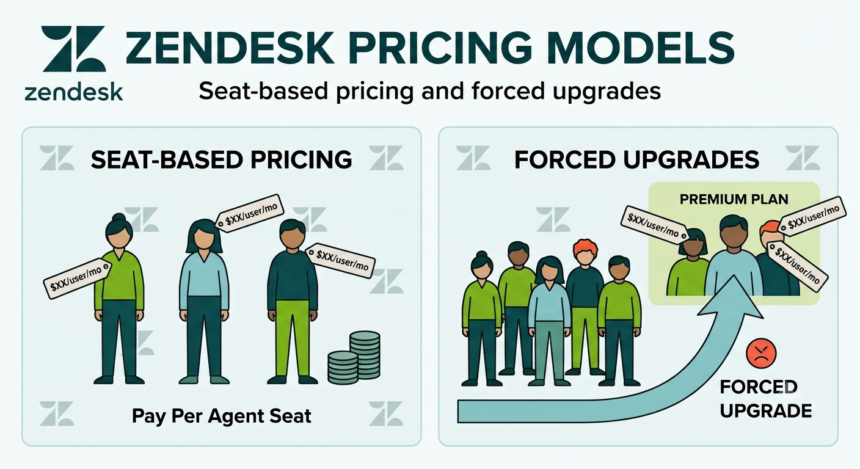

I found the number in a forum thread, tucked between a complaint about a broken macro and a joke about switching to carrier pigeons. A support team had grown from a handful of agents to about two dozen. Their monthly Zendesk bill had climbed to roughly $5,000, and that was before a single add-on. No AI Copilot. No Workforce Management. Just seats, stacked one on top of another, until the invoice stopped looking like a software bill and started looking like rent.
Zendesk is becoming too expensive for our company
by in Zendesk
That thread lives on r/Zendesk, one of dozens of places online where people who run customer support teams gather to compare notes on what has become the platform’s defining feature: not the ticketing system, not the omnichannel routing, not even the AI. The pricing model. Seat-based, meaning you pay per agent, per month, whether that agent handles ten tickets a day or a hundred. It sounds simple. It is not.
I have spent the last several weeks reading through pricing breakdowns, Zendesk’s own help documentation, G2 and Capterra reviews, and threads on r/zendesk, r/helpdesk, and r/CustomerService. What I found was not a single scandal. It was something slower and, in a way, more revealing: a company that built its empire on being the default choice for customer support, and has spent the years since a 2022 leveraged buyout learning how to extract more from that default position without ever quite crossing the line into headline-grabbing outrage.
The Sticker Price Is a Lure
Zendesk’s1 public pricing page opens with a number designed to make you stop scrolling: $19 per agent, per month. That is the Support Team plan, and as one buyer’s guide put it bluntly, it exists mainly so Zendesk can claim a low entry price in comparison articles. It gets you email ticketing. No chat, no voice, no messaging, no help center, no AI. Nobody who runs a real support operation buys it.
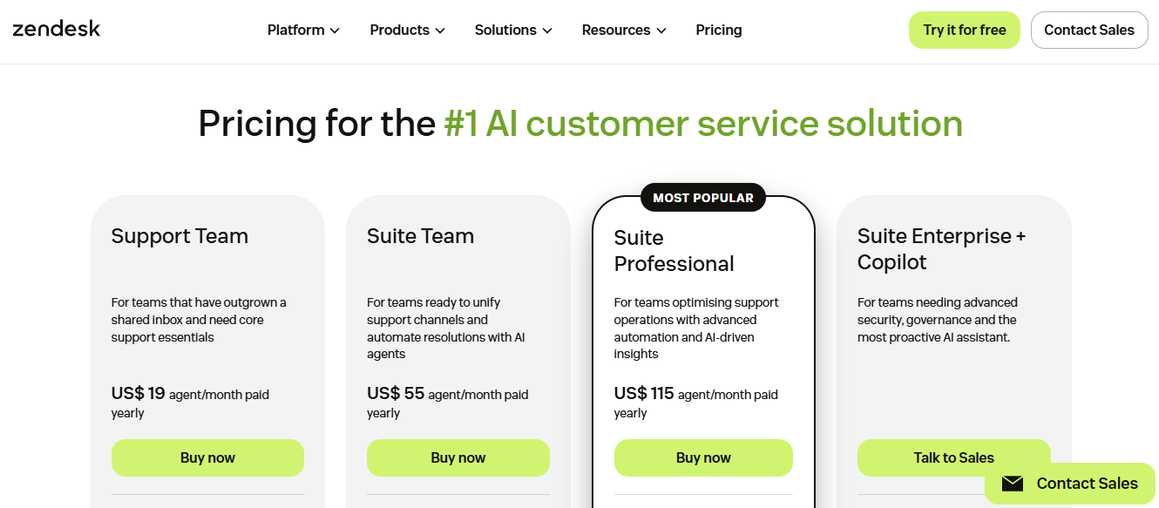
What they buy instead is Suite, which starts at $55 a seat and climbs to $115 for Professional, the tier most mid-market teams land on once they need skills-based routing or real reporting. Enterprise runs $169. Multiply any of those by a headcount that grows every time the business does, and you start to see the shape of the problem. A ten-person team on Professional pays roughly $13,800 a year before touching a single add-on, according to independent breakdowns of the current pricing structure. Double the headcount and the bill doubles too, with no volume discount kicking in to soften the landing.
That is the part that gets lost in the marketing. Seat-based pricing does not scale with how much support a company needs. It scales with how many humans happen to be logged into the software at renewal time. A company that gets better at deflecting tickets, that builds a stronger help center, that trains agents to close cases faster, sees none of that efficiency reflected in the invoice. The invoice only tracks headcount. Grow your team to handle a holiday rush, and Zendesk grows your bill right alongside it, rush or no rush.
The Add-On Ladder
Seats are just the base layer. The tier of paid add-ons that most serious deployments end up buying whether they meant to or not.
Want AI-assisted reply drafting and ticket summarization? That is Copilot, formerly branded Advanced AI, and it costs another $50 per agent per month. Bundle it into a twenty-agent Suite Professional deployment and you have added roughly $12,000 a year to a bill that already ran six figures close to that mark. Want voice support? That is another $50-per-agent bundle, plus per-minute usage charges on top. Want workforce management, quality assurance tooling, or advanced data privacy controls? Each one is its own line item, each one priced per seat, each one quietly compounding the others.
The pattern shows up again and again in independent audits of the pricing structure: teams that start on a mid-tier plan and, once they adopt the add-ons they actually need to compete, end up paying close to three times what they signed up for within a year. That is not a rounding error. That is the business model.
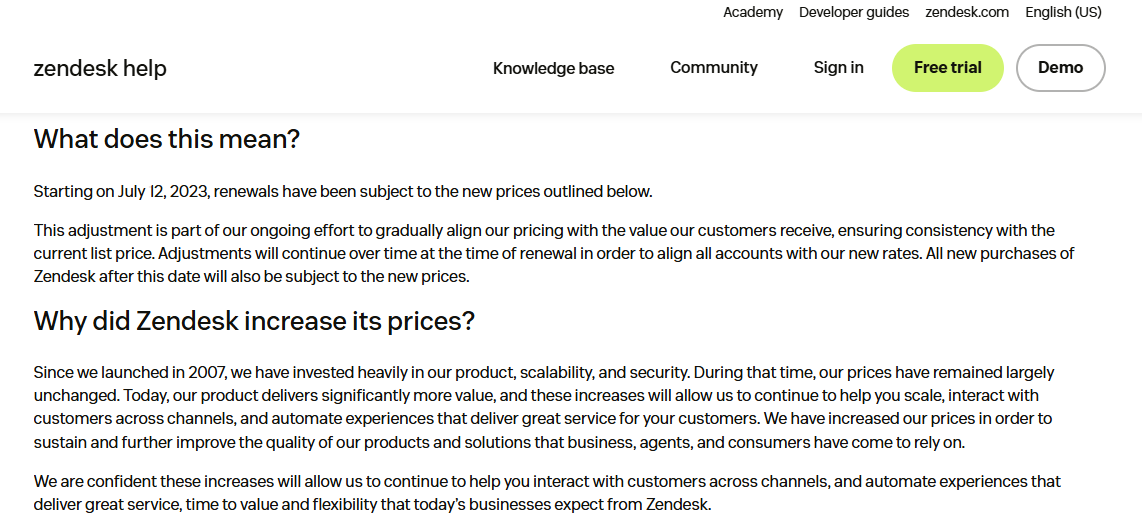
If the add-on ladder is the slow squeeze, the events of July 2023 were the fast one. Zendesk2 announced an average price increase across its Support and Suite packages, and a steeper one, averaging 20 percent, on standalone products. The company framed it in its own help documentation as part of an ongoing effort to gradually align pricing with the value customers receive. Customers experienced it differently. Legacy plans, some of which had been grandfathered in since Zendesk’s earliest years, were discontinued outright. Features that used to ship bundled into a plan, like the Help Center, suddenly had to be purchased separately on the new plans that replaced them.
The rollout did not go smoothly. In Zendesk’s own community forum, one user described getting an email that promised no pricing change until a February 2023 switchover date, only to watch their account get migrated and billed under the new, higher rates weeks early. Zendesk’s support team called it a technical error and said they would issue refunds. Another user, migrated off a plan that had included the Guide Lite help center for free, wrote that the change arrived as a pro-rata new year surprise penalty in the middle of a subscription they had already paid for.
I want to be careful here, because Zendesk was not lying when it called these adjustments routine. Price increases at renewal are ordinary in enterprise software. What made 2023 land differently was the combination of three things happening at once: a double-digit price hike, the forced retirement of plans some customers had relied on for the better part of a decade, and the quiet unbundling of a feature that used to just be there. Any one of those is a normal cost of doing business with a SaaS vendor. All three together, delivered inside the same renewal cycle, is what people mean when they talk about a forced upgrade. You are not choosing to pay more for more. You are being told the thing you already had no longer exists at the price you already agreed to.
The Light Agent Loophole, and Its Limits
To be fair to Zendesk, it built an escape valve. The light agent role lets internal collaborators, the engineer who needs to add a private note, the finance person who needs billing context, the executive tracking one big account, view tickets and comment privately without consuming a full paid seat. On Suite Growth and above, a healthy allotment comes free: fifty on Growth, a hundred on Professional, a thousand on Enterprise. It is, by most accounts, a genuinely useful piece of design.
But the valve only releases pressure in one direction. Light agents cannot send a public reply. They cannot be assigned a ticket. They cannot serve a chat or messaging conversation or take a call. The moment a collaborator needs to do any of that, actually work the queue rather than just watch it, they need a full seat, at full price. The myth is that anyone who touches a ticket needs a full agent, and the reality is that visibility and internal collaboration are exactly what a light agent provides, which means the standard sales pitch, that everyone touching a ticket needs a full seat, is often just wrong. Licensing audits have found that a large share of Zendesk seats go unused entirely, sitting on the books because nobody downgraded a departed employee or reclassified a manager who only ever leaves internal notes.
There is a second trap inside the light agent system that catches even careful admins. A light agent does not use up a Support seat. But grant that same person admin access in Guide, or Explore, or Talk, the other products bundled into Suite, and they silently start consuming a full seat anyway, because seat assignment in a Suite account is interdependent across products. Zendesk’s own help documentation acknowledges the issue exists and offers a filtering workaround to hunt down the mismatched permissions. It is the kind of design quirk that costs nobody anything if you catch it before renewal, and costs you real money if you do not.
The New Meter: AI That Bills by the Resolution
If seats were the whole story, this would be a familiar tale about enterprise software margins. What makes the current moment different is what Zendesk has done with AI.
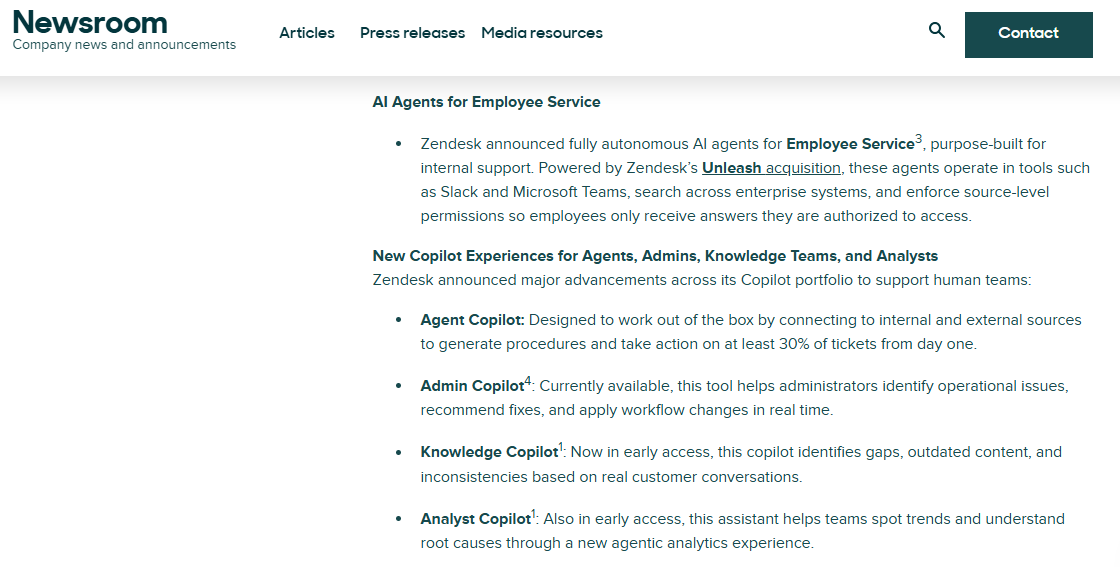
Starting in 2026, Zendesk’s3 AI Agents, the autonomous bots that resolve customer tickets without a human touching them, moved to what the company calls outcome-based pricing. You do not pay a flat fee for the bot. You pay per resolution, somewhere between roughly $1.20 and $2.00 depending on volume and contract terms, every time the AI closes a conversation without escalating it to a person. And as of January 2026, those charges auto-bill with no grace period. The cushion that used to exist for a team that briefly blew past its allowance during a busy month is gone. A product launch or a traffic spike can, according to one cost breakdown, double a company’s AI bill in the same month the AI was supposed to be saving them money.
The definition of “resolution” is where this gets uncomfortable. It is not tied to whether the customer was actually satisfied. It is tied to Zendesk’s own outcome-detection logic, and multiple reports suggest a chat a customer simply abandons can still count as a successful, billable resolution. You can be charged for a bot that failed to help someone, as long as that someone gave up quietly enough. Zendesk did make one concession here: since May 2026, only resolutions verified by an LLM draw from a customer’s allowance, and assisted escalations no longer count. But the core mechanic, paying per outcome the vendor itself defines, remains.
Reaction on Zendesk’s own community forums and on Reddit has been sharper than almost anything I found aimed at the seat pricing itself. One frequently cited reaction on r/zendesk4 called the automated resolution pricing a rip off, and a rushed product to get into the AI hype. A Capterra5 reviewer working as a senior director of consumer support said she would refuse to pay for AI tools that match Zendesk’s own support quality, a line that stuck with me because it captures something the pricing tables never will: the sense that customers are being asked to fund a product they do not yet trust.
One reviewer wrote:
Completely useless, hard to implement, still getting emails through despite cancelling/disconnecting
Another user simply said:
Beware of shady renewal practices
And here is the mechanism that turns this into a forced-upgrade story rather than just an expensive-add-on story. A five-agent team on the entry-level Suite Team plan gets a small allowance of free AI resolutions per agent, per month. Hit that ceiling, which happens fast for any team fielding real volume, and the next resolution does not just cost extra. It pushes the team toward an upgrade to a higher tier, where the allowance is bigger but the seat price is too. The AI meter and the seat ladder are not separate systems. They are the same lever, pulled from two directions at once.
The complaint that stuck with me most did not come from a large enterprise with a dedicated procurement team. It came from small operators, the kind of business that adopts Zendesk early because it looks affordable and only later discovers who the pricing was actually built for.
A thread in r/helpdesk6, started by a small ecommerce operator, put it about as plainly as I have seen anywhere online. The pricing and the surrounding complexity, the person wrote, felt like it wasdesigned for a company with a dedicated support ops team and a product manager just for the helpdesk, which is not the situation most stores doing under three million dollars in revenue are actually in. Another commenter in the same thread described Zendesk’s flexibility honestly: it is real, but that flexibility requires someone to configure it well, and a small team rarely has that person sitting around.
Capterra7 reviews echo the same frustration in a quieter, more institutional register. One reviewer working in hospital and health care wrote that the cost of an agent is pretty pricey for someone who only needs to handle roughly ten tickets a month, a fair description of a huge share of the seats sold on the platform. Another simply noted that the pricing structure can also become expensive as you scale, especially once premium features enter the picture, which is a diplomatic way of saying the same thing everyone else was saying with more heat.
None of these are dramatic complaints on their own. Nobody is alleging fraud. What they add up to is a pattern: a pricing model tuned for a mid-market or enterprise buyer, sold with an entry price aimed at a much smaller one, and a support team somewhere in between left to discover the gap after they have already built their workflows around it. By the time the mismatch is obvious, migrating away costs more than absorbing it.
None of this happened in a vacuum, and I think it is worth naming the thing that changed underneath Zendesk before any of these pricing decisions did. According to Reuters8, in June 2022, an investor group led by the private equity firms Hellman & Friedman and Permira, joined by the Abu Dhabi Investment Authority and Singapore’s GIC, agreed to buy Zendesk for $77.50 a share, a deal that valued the company at roughly $10.2 billion. The acquisition closed that November, and Zendesk stopped trading on the New York Stock Exchange the same day.
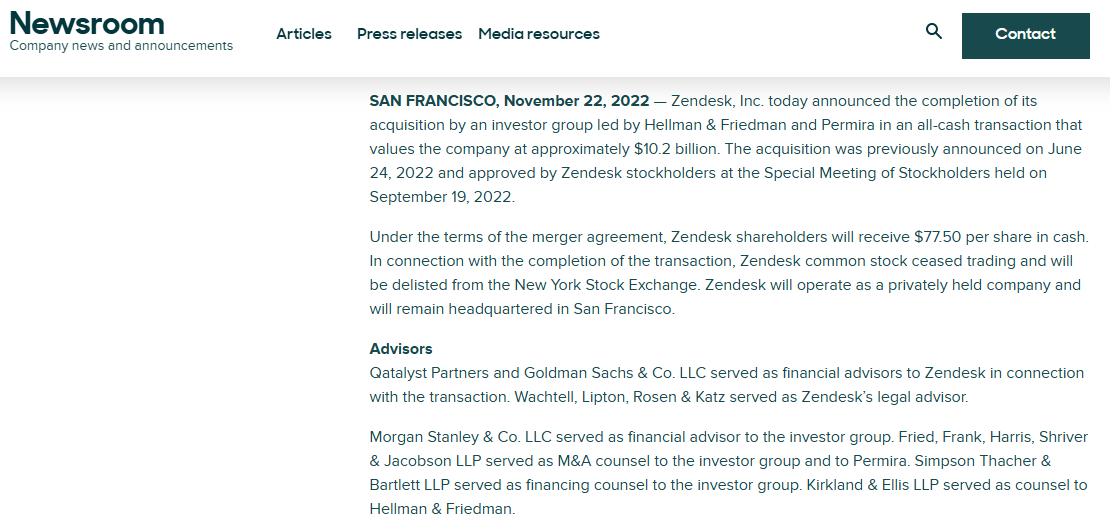
Being taken private does something specific to a company’s incentives. A public company answers to quarterly earnings calls and a stock price that reacts, sometimes badly, to news of angry customers. A private company answers to the return its new owners promised the investors who financed the leveraged buyout, on a much longer and much quieter timeline. That does not make Hellman & Friedman or Permira villains. Private equity ownership of software companies is common, and plenty of PE-backed firms treat their customers well. But it is not a coincidence that the July 2023 price increase, the discontinuation of legacy plans, and the shift toward metered AI billing all landed inside the first three years of new ownership. A leveraged buyout comes with debt, and debt wants servicing.
Every forum thread I read eventually arrives at the same fork. Some teams grit their teeth and pay, usually because the cost of migrating off a platform with 1,800-plus marketplace integrations feels worse than the cost of staying. As one Reddit user put it, switching means auditing all of those integrations and rebuilding them somewhere else, which nobody wants to take on mid-season. That inertia is not an accident either. It is the same dynamic that keeps people on cable packages they resent.
Other teams fight the bill from the inside. A small industry of license-auditing tools has sprung up specifically to comb through Zendesk accounts and find the waste: the suspended agent whose seat never got freed, the manager sitting on a full license who only ever leaves internal comments, the light agent quietly promoted into a paid seat because nobody noticed the permission change. According to upGrowth9, the average enterprise’s wasted Zendesk spend above $500,000 a year. That is not a pricing complaint. That is a governance problem Zendesk’s own interface makes easy to fall into and mildly annoying to climb back out of.
And a smaller but growing group leaves entirely, usually for tools that price by ticket volume or by workflow instead of by seat, on the theory that a support team’s real cost driver is how much work comes in, not how many people happen to be logged in to do it. Whether that theory holds up at scale is an open question. Usage-based pricing has its own failure mode: a bad month becomes a bad bill in a different way than a seat-based one does.
The Part That’s Bigger Than Zendesk
I want to resist the easy version of this story, the one where Zendesk is uniquely predatory and every other SaaS vendor is playing fair. It is not. Seat-based pricing has been the default model for enterprise software for two decades, and the pressure to move away from it, toward usage-based or outcome-based billing, is an industry-wide trend, not a Zendesk invention. What makes Zendesk worth writing about is that it is trying to run both models at once. It wants the predictable, compounding revenue of per-seat licensing and the seemingly-fair, pay-for-value story of per-resolution AI billing, stacked on top of each other, on the same customer, in the same invoice.
That combination is what produces the specific complaint I kept finding, over and over, across G2 reviews, Reddit threads, and independent buyer’s guides: not that Zendesk is bad software, almost nobody says that, but that the bill grows faster than the value does. A support team that gets more efficient should, in a rational market, spend less over time. On Zendesk’s current pricing model, a team that gets more efficient by adopting the AI tools Zendesk itself sells them can end up spending more, because efficiency there is measured in resolutions, and resolutions are the meter.
I do not think Zendesk executives sat in a room and designed this to be confusing. I think it is simpler and a little more mundane than that. A company that dominates its category, the way Zendesk10 still does with more than 100,000 businesses on the platform and a top-tier ranking in Gartner’s own market assessment, does not need to design confusion on purpose. It only needs to keep adding layers, one reasonable-sounding add-on at a time, and let the complexity do the work that a single, obviously unfair price hike never could.
The team behind that $5,000-a-month bill on r/Zendesk11 never named themselves in the thread. They did not need to. Their invoice was legible enough on its own. Twenty-four agents, no AI add-ons, no voice bundle, just seats. If that is the floor, it is worth asking what the ceiling looks like for a company that actually wants to use everything Zendesk is selling.
Sources
- Zendesk, www.zendesk.com/in/pricing/. Accessed 17 Sept. 2026. ↩︎
- “Zendesk’s 2023 Pricing Update: What You Need To Know” Zendesk help, 3 Apr. 2023, support.zendesk.com/hc/en-us/articles/5555300573850-Zendesk-s-2023-Pricing-Update-What-You-Need-To-Know. Accessed 17 Sept. 2026. ↩︎
- Zendesk, www.zendesk.com/newsroom/press-releases/relate-2026/. Accessed 17 Sept. 2026. ↩︎
- Reddit, www.reddit.com/r/Zendesk/. Accessed 17 Sept. 2026. ↩︎
- Capterra, www.capterra.com/p/164283/Zendesk/reviews/?page=2. Accessed 17 Sept. 2026. ↩︎
- Reddit, www.reddit.com/r/helpdesk/. Accessed 17 Sept. 2026. ↩︎
- Capterra, www.capterra.com.sg/software/164283/zendesk. Accessed 17 Sept. 2026. ↩︎
- “Reuters.Com” www.reuters.com/legal/transactional/zendesk-be-taken-private-102-billion-deal-2022-06-24/. Accessed 17 Sept. 2026. ↩︎
- “How Freshworks Went from Chennai to NASDAQ: GTM Strategy Teardown | upGrowth” UpGrowth, 23 Feb. 2026, upgrowth.in/freshworks-gtm-strategy-nasdaq/. Accessed 17 Sept. 2026. ↩︎
- Zendesk, www.zendesk.com/what-is-zendesk/. Accessed 17 Sept. 2026. ↩︎
- www.reddit.com/r/Zendesk/comments/1gjckww/zendesk_is_becoming_too_expensive_for_our_company/. Accessed 17 Sept. 2026. ↩︎