


On October 24, 2025, Chief Judge Shelly Dick of the Middle District of Louisiana issued a temporary restraining order. The order said, explicitly, that ICE could not remove Chanthila Souvannarath from the United States. He had a habeas petition pending. He had claims to citizenship. The court said wait.
ICE deported him anyway. The next day.
According to a press release from the National Immigration Project, Souvannarath was born in a refugee camp in Thailand and entered the United States before his first birthday. He became a U.S. citizen as a minor when his father naturalized and gained sole custody of him.
“ICE defied a federal court order by deporting Chanthila on Friday,” said Bridget Pranzatelli, Staff Attorney at the National Immigration Project, in the release. “This should alarm everyone. Federal agencies cannot simply ignore the other branches of government. ICE, like every other federal and state enforcement agency, is bound by the orders of the court.”
When Courts Say Stop, and the State Keeps Going
However, it appears that they are not bound. And this is not an isolated incident. It connects to something larger happening across American institutions. A pattern where power operates without accountability. Where the old rules, those about due process, conflicts of interest, and checks and balances, just do not seem to apply anymore.
The numbers tell a stark story. According to the American Immigration Council’s December 2025 report, arrests of people with no criminal record increased by 2,450 percent in 2025. The number of people held in ICE detention rose nearly 75 percent, climbing from roughly 40,000 at the start of the year to 66,000 by December. The highest level ever recorded.
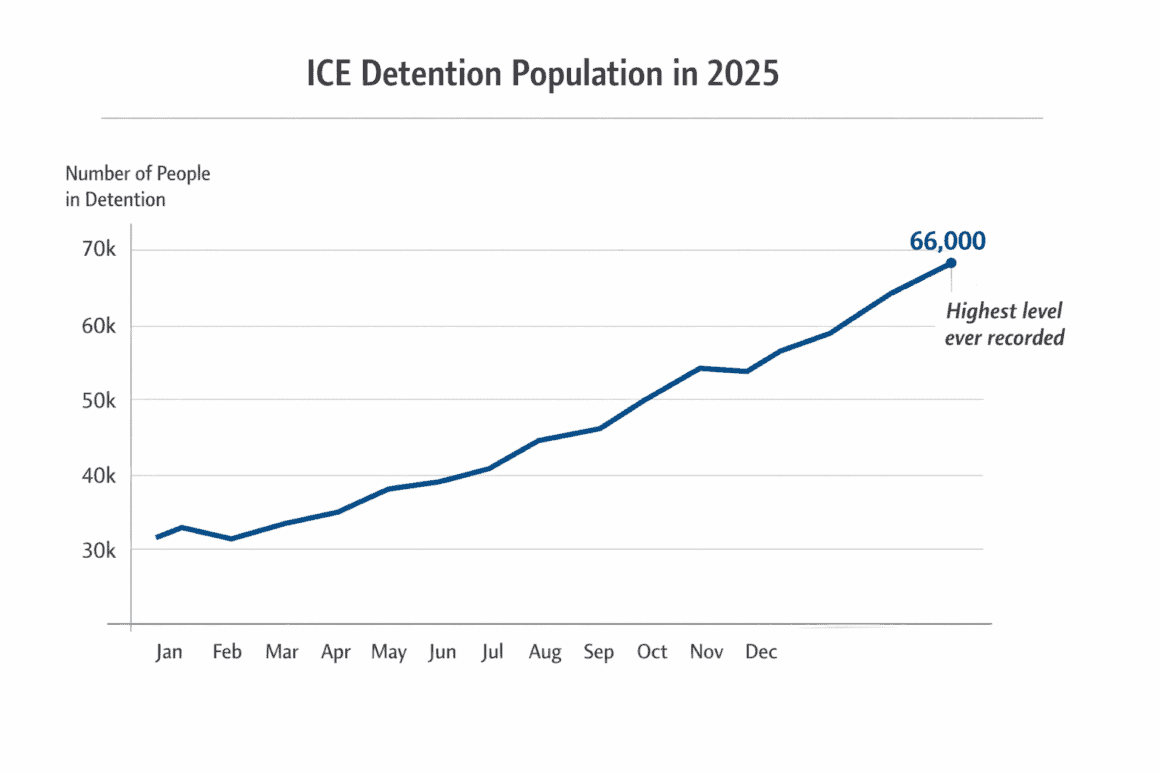
The report also found that more people died in ICE detention in 2025 than in the last four years combined.
“This is a system built to produce deportations, not justice,” said Aaron Reichlin-Melnick, policy director at the American Immigration Council, in the report. “When detention becomes the default response to immigration cases, the costs are borne by everyone.”
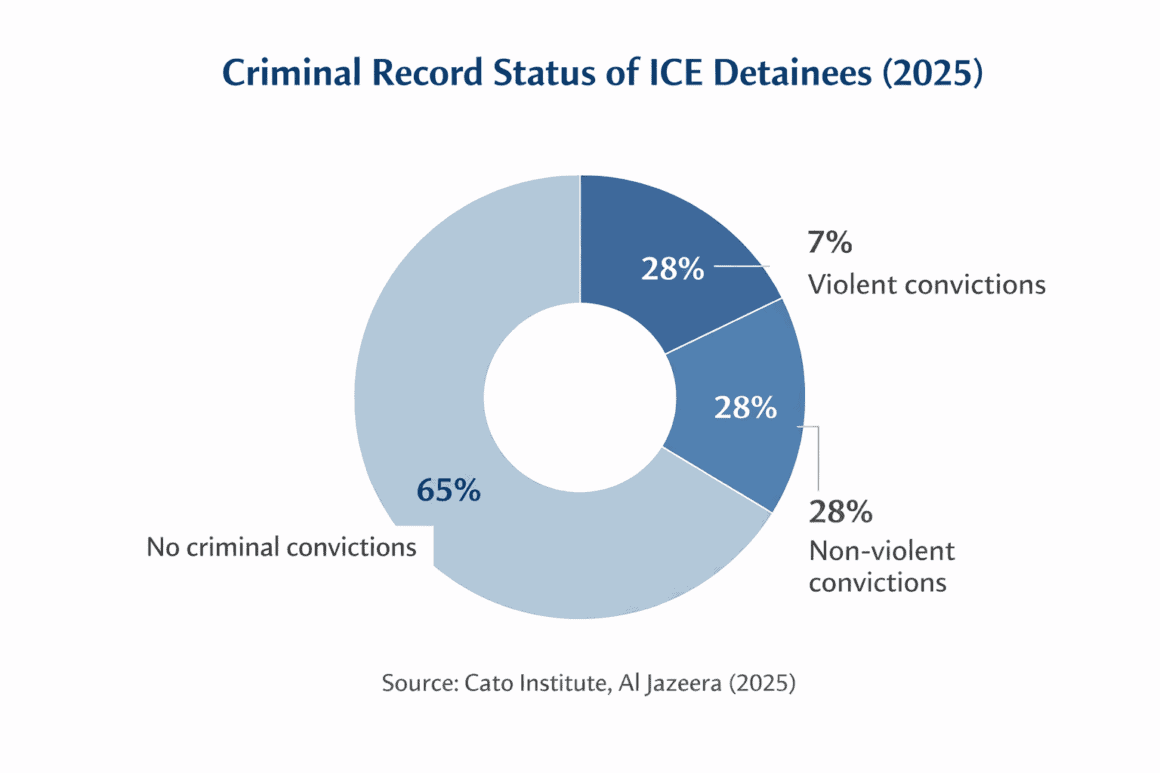
The administration claims it is targeting criminals. But the data says otherwise. The Cato Institute reported in June 2025 that 65% of people detained by ICE had no criminal convictions whatsoever. 93% had no violent convictions. Al Jazeera reported that 73% of the more than 65,000 immigrants in ICE detention as of November had never been convicted of a crime.
When the Courts Become the Enemy
When a federal judge in Colorado ordered ICE to stop making warrantless arrests based on suspected violations, the administration’s response was revealing.
A spokesperson called it an “activist ruling” that was “a brazen effort to hamstring the Trump administration.”
Courts as obstacles to be dismissed. That framing would have been unthinkable not long ago. The pattern extends beyond government. Consider Elon Musk.
In April 2022, days after offering to buy Twitter, Musk posted: “For Twitter to deserve public trust, it must be politically neutral, which effectively means upsetting the far right and the far left equally.”
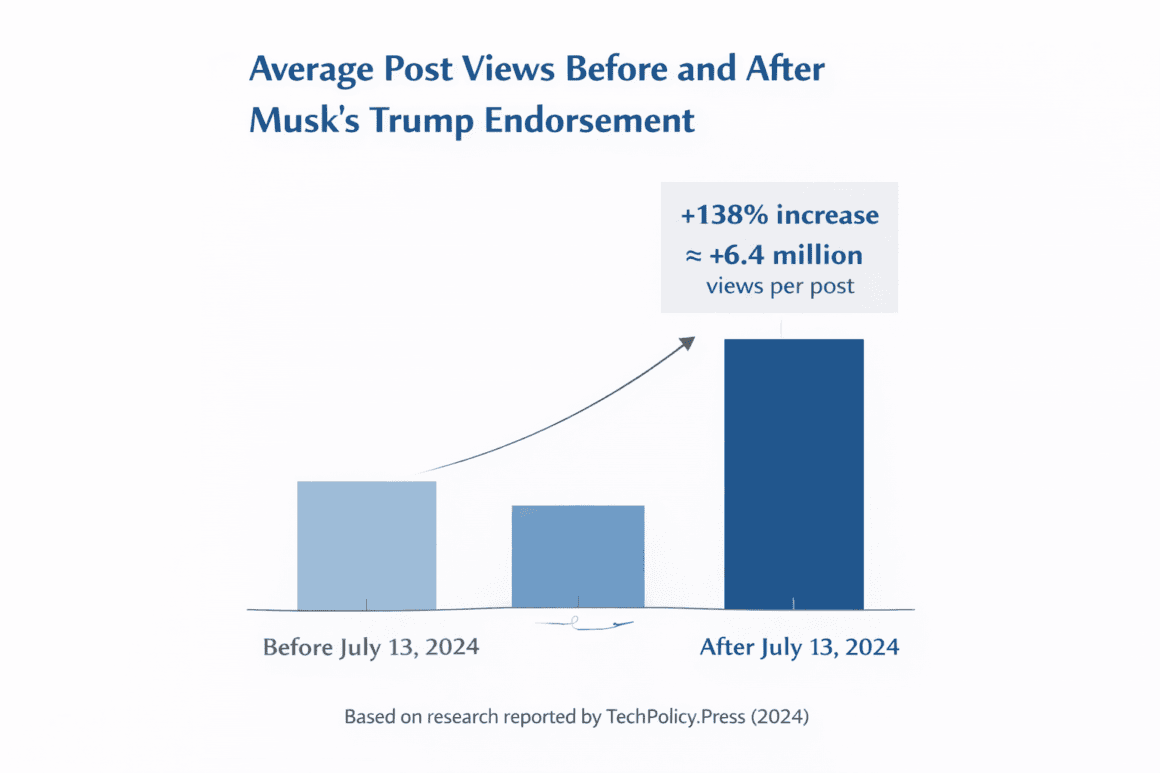
According to research covered by TechPolicy.Press, after Musk endorsed Trump on July 13, 2024, his account received a boost of approximately 6.4 million views per post. A 138.27% increase. The researchers found that “Republican-leaning accounts exhibiting a significant post-change increase relative to Democrat-leaning accounts” in terms of visibility.
Eddie Perez, who directed Twitter’s election integrity work before Musk took over and is now a board member at the OSET Institute, told NPR:
“This is a textbook example of the influence that I think it’s fair to say an oligarch can have in a way that really is impactful to the entire body politic.”
Free Speech in Theory, Control in Practice
The contradictions in Musk’s behavior are documented. In a FRONTLINE documentary, former Twitter head of trust and safety Yoel Roth described how Musk initially wanted to eliminate content moderation, then reversed course when advertisers fled after hate speech surged.
“My directions from Elon directly were: shut it down. Get rid of all of it,” Roth said in the documentary. “He actually even wanted us to go further than we had previously… He pushed us to take a more aggressive position, shutting down free speech.”
Trevor Timm, Executive Director of the Freedom of the Press Foundation, wrote in The Guardian that Musk’s purported support for free expression is a “snake-oil salesman’s marketing scheme” and that he “uses his power to retaliate against his critics more than anyone this side of Donald Trump.”
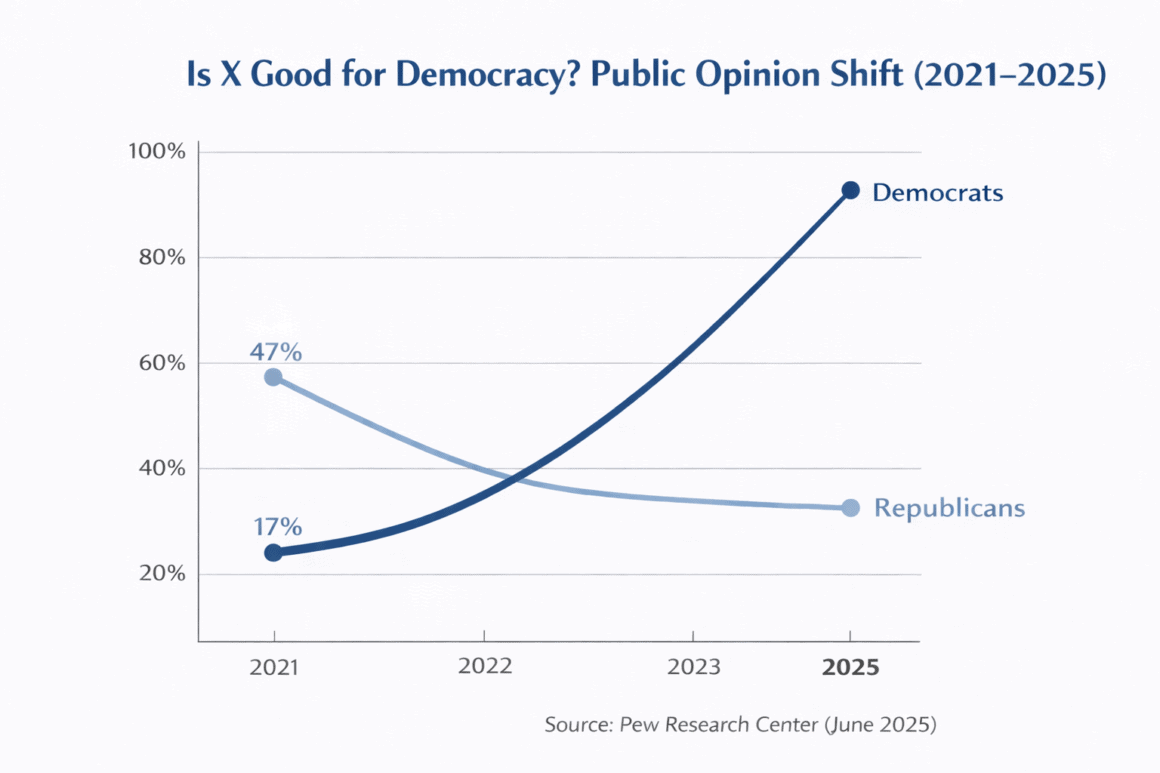
The shift in perception has been dramatic. Pew Research Center data from June 2025 shows that the share of Democrats on X who say the platform is good for democracy dropped from 47% to 17% over four years. Meanwhile, only 11% of Republicans now say it is bad for democracy, down from 60% in 2021.
Then there is the matter of the President’s business dealings.
According to Citizens for Responsibility and Ethics in Washington, during Trump’s first term, more than 150 foreign government officials from 77 countries patronized Trump properties, believing it was “a statement” showing “a close bond with the United States.”
The second term has escalated this. As The Week reported, “past conflict-of-interest concerns about Trump seem petty, as he strikes deals with Middle Eastern sovereign wealth funds and members of the ruling families of the Arab” world.
Senators Jeff Merkley and Elizabeth Warren sent a letter to the administration warning that a deal between a UAE-backed firm and Trump-linked World Liberty Financial “may violate the Emoluments Clause of the U.S. Constitution” and “raises the troubling prospect that the Trump and Witkoff families could expand the use of their stablecoin as an avenue to profit from foreign corruption.”
Rep. Gerald E. Connolly released a list of 100 conflicts of interest in just the first 100 days. “Selling access and influence is the defining feature of the Trump White House,” he said in a statement.
The problem, as The Hill reported, is structural. Ethics expert Richard Painter explained: “There’s no criminal statute. There’s no mechanism for enforcing the Emoluments Clause other than impeachment by the House and removal by the Senate.”
The Brennan Center for Justice notes that lawsuits over the Emoluments Clauses during Trump’s first term were dismissed on procedural grounds, “meaning that there has been no recent, definitive judicial interpretation of either clause.” The Constitution does not say how to enforce the Emoluments Clauses, and “it remains unclear who, if anyone, has the right to sue.”
The tech platforms operate with similar impunity.
Automation Without Appeal
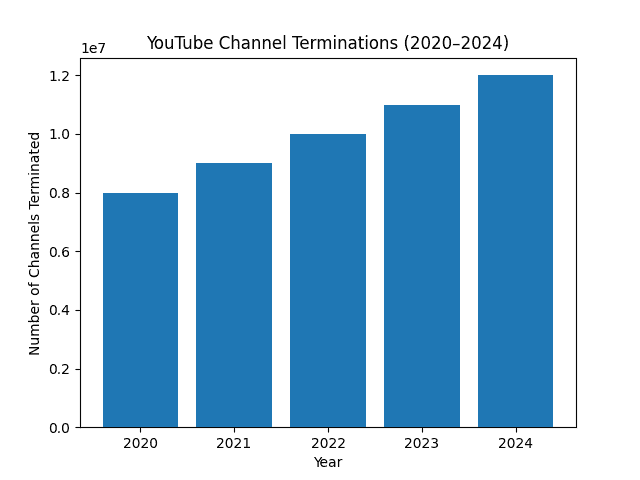
According to Dexerto, YouTube terminated over 12 million channels in the first nine months of 2025.
When creator Nani Josh posted these numbers on X, he asked: “Are we really supposed to believe 12 million creators all violated policies? Did every one of them get a fair human review… or is YouTube’s AI just wiping out channels whenever it feels like it?”
YouTube CEO Neal Mohan defended the approach, telling Time Magazine that AI moderation “improves literally every week” and helps the platform “detect and enforce on violative content better, more precise, able to cope with scale.”
But the cases of wrongful bans keep piling up. SlashGear reported on a popular tech channel called Enderman being banned, with fans pointing to AI moderation.
In a Reddit thread about the ban, one user wrote: “This is why we should never let clankers moderate. Just letting them immediately pull the trigger with zero human review is just going to cause more like this to happen.” Another noted that the appeals process is “fully AI as well.”
Meanwhile, TechPolicy.Press reported that a federal judge in November 2025 dismissed the FTC’s antitrust challenge to Meta. Tim Wu wrote in an op-ed that the decision signals the world’s wealthiest corporations are effectively “above the law.”
There is another dimension to this. Research suggests these systems may be changing how we think.
A study published in Societies in January 2025 by Michael Gerlich at SBS Swiss Business School found “a significant negative correlation between frequent AI tool usage and critical thinking abilities.” The study of 666 participants found that younger participants exhibited higher dependency on AI tools and lower critical thinking scores compared to older participants.
“Cognitive offloading, where individuals delegate cognitive tasks to AI rather than engaging in deep analytical reasoning, is an emerging phenomenon that has not been extensively studied,” Gerlich told PsyPost. “Given the crucial role of critical thinking in decision-making, education, and professional competence, understanding how AI influences cognitive engagement is imperative.”
A population that cannot think critically is a population more easily manipulated. More willing to accept authoritarian shortcuts. Less capable of holding power accountable.
When Decline Becomes Normal
The democracy researchers have been sounding alarms.
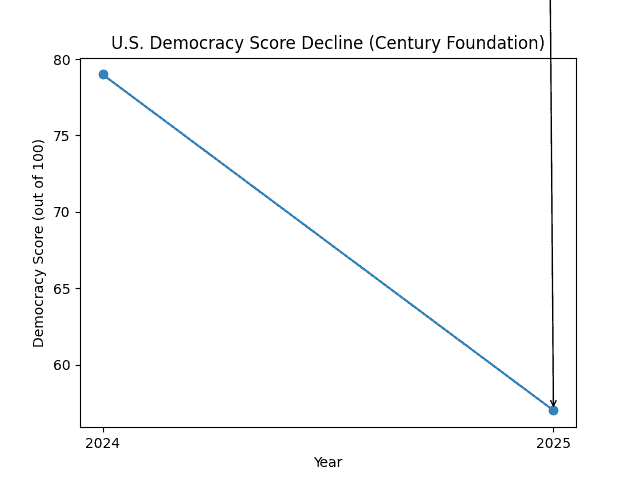
The Century Foundation’s Democracy Meter rated the United States at 57 out of 100 in 2025, down from 79 the year before. A 28% drop in one year. Their assessment: “The U.S. government has become authoritarian in its intentions and its practices.”
The V-Dem Institute’s Democracy Report 2025 describes the United States as experiencing “substantial autocratization.” International IDEA issued 20 democracy alerts for the United States between January and April 2025, twice as many as in any of the previous two full years.
Examples included “efforts to restrict academic freedom, criminalize protest activity, question the legitimacy of certified elections, selectively restrict media access to the executive, and circumvent due process norms.”
Political scientists Steve Levitsky and Lucan Way have declared that the United States is no longer a democracy but a “competitive authoritarianism.”
In a paper published in Science Advances in July 2025, researchers Tali Sharot and Cass Sunstein warned: “The great risk is that we come to accept the absence of democracy the way we accept background noise: as unpleasant, perhaps, but no longer urgent.”
There is a through line here. A federal agency ignores a court order. A billionaire manipulates information systems to favor his political allies. A president profits openly from his office. Tech companies terminate millions of accounts with no human review and no meaningful appeal.
The common thread is not ideology. It is the absence of accountability.
Danielle Allen at Harvard’s Allen Lab for Democracy Renovation put it this way: “We live in an age marked by violence and illiberalism. The purpose of my work, and of this lab, is to change that reality.”
The question is whether that is still possible. Whether the erosion has gone too far. Whether we have collectively decided, perhaps without quite realizing it, that power simply does not need accountability anymore.
And if we have made that decision. What comes next?
Sources
- National Immigration Project. “ICE Deports Man Claiming U.S. Citizenship to Laos Despite Federal Court Order.” October 29, 2025. nipnlg.org
- American Immigration Council. “Immigration Detention Is Harsher and Less Accountable Than Ever.” December 2025. americanimmigrationcouncil.org
- Colorado Public Radio. “Court demands end to unjustified warrantless arrests.” November 25, 2025. cpr.org
- Al Jazeera. “How ICE deports refugees and migrants despite years of good conduct.” December 19, 2025. aljazeera.com
- NPR. “2 years in, Trump surrogate Elon Musk has remade X as a conservative megaphone.” October 22, 2024. npr.org
- TechPolicy.Press. “New Research Points to Possible Algorithmic Bias on X.” November 17, 2024. techpolicy.press
- PBS FRONTLINE. “Elon Musk’s Twitter Takeover.” March 2025. pbs.org
- Pew Research Center. “Republicans and Democrats on X Differ Over the Site’s Politics.” June 5, 2025. pewresearch.org
- Freedom of the Press Foundation. “Elon Musk: the world’s biggest free speech hypocrite.” freedom.press
- Citizens for Responsibility and Ethics in Washington. “The Intensifying Threat of Donald Trump’s Emoluments.” citizensforethics.org
- U.S. Senate Banking Committee. Merkley-Warren letter on Trump crypto conflicts. banking.senate.gov
- House Oversight Committee. “100 Days of Corruption.” April 30, 2025. oversightdemocrats.house.gov
- The Week. “A running list of Trump’s conflicts of interest.” May 20, 2025. theweek.com
- The Hill. “Donald Trump’s expanding business ties come under ethics spotlight.” November 26, 2024. thehill.com
- Brennan Center for Justice. “The Emoluments Clauses, Explained.” brennancenter.org
- Dexerto. “YouTube responds to AI concerns as 12 million channels terminated in 2025.” December 11, 2025. dexerto.com
- SlashGear. “A Popular Tech YouTuber Was Banned, And Fans Are Pointing Fingers At AI.” November 16, 2025. slashgear.com
- TechPolicy.Press. “November 2025 US Tech Policy Roundup.” techpolicy.press
- Gerlich, Michael. “AI Tools in Society: Impacts on Cognitive Offloading.” Societies, 2025. mdpi.com
- PsyPost. “AI tools may weaken critical thinking skills.” March 21, 2025. psypost.org
- The Century Foundation. “Democracy Meter Shows America Took an Authoritarian Turn in 2025.” tcf.org
- V-Dem Institute. “Democracy Report 2025.” University of Gothenburg. v-dem.net
- International IDEA. “The Global State of Democracy 2025.” idea.int
- Sharot and Sunstein. “Will we habituate to the decline of democracy?” Science Advances, July 2025. ncbi.nlm.nih.gov
- Harvard Ash Center. “Allen Lab for Democracy Renovation.” November 10, 2025. ash.harvard.edu


